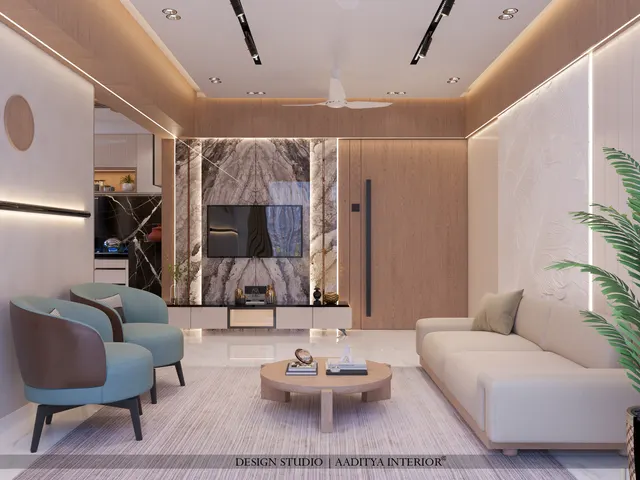
The TV wall is the most photographed surface in an Indian living room, and the most mispriced. Quotations for an 8 ft TV unit swing from Rs 25,000 to Rs 90,000, and both numbers can be honest — the difference is almost entirely the shutter finish and the hardware, not the size. A laminate-faced unit on a BWR plywood carcass and an acrylic-faced unit on the same carcass can differ by a factor of two while looking identical in a photograph.
The confusion comes from how TV units are sold. Dealers quote per square foot of elevation, per running foot of wall, or as a lump sum, and the finish specification hides inside a single word — laminate, membrane, veneer, acrylic, PU. Each of those words is a different material with a different price band and a different maintenance profile. Without the finish named in writing, two quotations cannot be compared at all.
This guide prices the TV unit the way a quantity surveyor would: carcass board, shutter finish, hardware, lighting and labour as separate lines, each with October 2026 dealer rates. It sizes the unit to the TV with published viewing-distance guidance, and it shows exactly what is included — and what is quietly excluded — in a typical 8 ft wall-unit quotation.
What a TV unit is made of
A wall-mounted TV unit is five components, and each one has its own price logic. The carcass is the structural body — back panels, side towers, the floating ledge — built from 18 mm board. The shutter finish is the visible face: laminate, membrane foil, veneer, acrylic or PU paint, each in its own band. Hardware — hinges, channels, push-to-open mechanisms — decides how the shutters feel in five years. LED backlighting is the glow behind the panel, priced per running foot. Labour and installation close the list, and they are the least standardised line of all. The table prices the material stack from October 2026 listings.
| Component | Standard specification | Oct 2026 rate basis |
|---|---|---|
| Carcass / back panel | BWR plywood (IS 303) 18 mm; HDHMR for painted builds | Rs 90-130 / Rs 90-120 per sq ft |
| Budget carcass option | MDF 18 mm — dry rooms only, pre-drill all screws | Rs 55-75 per sq ft |
| Shutter finish: laminate | 1.0 mm decorative laminate, branded | Rs 350-650 per sq ft (material) |
| Shutter finish: membrane | Foil-pressed finish, routed profiles possible | Rs 500-850 per sq ft |
| Shutter finish: veneer | Natural veneer with melamine/PU topcoat | Rs 600-1,100 per sq ft |
| Shutter finish: acrylic | High-gloss acrylic sheet on HDHMR/MDF | Rs 900-1,500 per sq ft |
| Shutter finish: PU paint | Multi-coat polyurethane on HDHMR | Rs 1,000-1,800 per sq ft |
| Hardware set | Soft-close hinges, channels (Hettich/Hafele/Blum grade) | Adds Rs 5,000-15,000 per unit |
| LED backlight | Cove LED strip behind panel | Rs 150-300 per running ft installed |
Sizing: the dimensions that matter
Three dimensions decide whether a TV unit works: the unit width relative to the TV, the TV centre height relative to the seated eye, and the viewing distance. A 55-inch TV measures about 1210 mm wide (typical manufacturer figure); the unit should run at least 600-900 mm wider than the TV so the composition does not look pinched. Seated eye level is commonly cited around 1050-1200 mm from the floor, which puts the TV centre in the same band. Viewing distance comes from display science: for 4K panels the commonly cited guidance is 1 to 1.5 times the screen diagonal (SMPTE/THX-based guides), which puts a 55-inch 4K TV at roughly 1.4-2.1 m — and that single figure decides how far the sofa sits, which decides the living room layout.
Finish cost: the real price ladder
The shutter finish is the price ladder of the TV unit. Branded 1.0 mm decorative laminate adds roughly Rs 42-56 per sq ft as material, and the finished laminate shutter lands at Rs 350-650 per sq ft. Membrane foil at Rs 500-850 allows routed profiles that laminate cannot follow. Natural veneer at Rs 600-1,100 needs a protective topcoat and ages visibly in sunlight. Acrylic at Rs 900-1,500 delivers the mirror gloss, and PU paint at Rs 1,000-1,800 delivers the deep matte — both on HDHMR, both the longest-lasting finish tier, both unforgiving of site dust during application. The chart below puts the October 2026 bands side by side; the finish alone can triple the shutter line.
The cost reality: an 8 ft wall unit, worked
The table below works the material stack for a typical 8 ft wall unit: a 2440 x 2100 mm panel wall with a floating ledge and two side niches, laminate finish, soft-close hardware and LED backlight. Quantities are indicative for this configuration; rates are October 2026 dealer listings. Labour and installation have no standard listing and are quoted per site — which is precisely why lump-sum quotations that hide the finish and hardware cannot be compared.
| Component | Indicative quantity | Rate basis | Worked amount |
|---|---|---|---|
| Back panel + ledge carcass (BWR 18 mm) | 56 sq ft | Rs 90-130 per sq ft | Rs 5,000-7,300 |
| Side niches / towers carcass | 24 sq ft | Rs 90-130 per sq ft | Rs 2,200-3,100 |
| Laminate shutter finish (material) | 30 sq ft of face | Rs 350-650 per sq ft | Rs 10,500-19,500 |
| Edge banding + adhesives | Lump | Consumable | Rs 1,500-2,500 (indicative) |
| Hardware: soft-close set | 1 unit | Rs 5,000-15,000 band | Rs 5,000-15,000 |
| LED backlight strip | 16 running ft | Rs 150-300 per running ft | Rs 2,400-4,800 |
| Material stack total | Rs 26,600-52,200 | ||
| Labour + installation | Per site | No standard listing | Quoted per site (verify locally) |
Viewing distance and the room around the unit
A TV unit is sized to two things — the television it carries and the distance the viewer sits from it — and the second is the one most rooms get wrong. Commonly cited display guidance, derived from SMPTE and THX viewing recommendations, puts 4K viewing distance at roughly 1 to 1.5 times the screen diagonal: a 55-inch 4K panel resolves fully at about 1.4 to 2.1 m, and sitting further back wastes the pixels while sitting closer exposes them. That distance fixes the sofa position first; the unit then occupies the wall between. When the sofa cannot move — a compact living room, a structural column, a passage behind — the screen size is chosen backwards from the available distance, not from the wall length. A 65-inch panel in a 2 m room is a worse decision than a 50-inch panel at the same seat.
The unit's own dimensions follow the same logic. The television's centre lands at 1050-1200 mm from the floor for eye level from a seated sofa (typical guidance), which fixes the ledge height and, with it, the panel wall's visual balance point. The unit width runs TV width plus 600-900 mm — enough breathing room for symmetry, speakers and the devices that live beside the screen. Ventilation is the detail the price ignores: set-top boxes and consoles vent upward, so the ledge needs clear air space or ventilated shelving above the devices, or the cheapest line item in the unit — heat — kills the most expensive line item in the room. Conduits for HDMI and power should be cast or chased before the panel wall is built; chasing a finished acrylic panel for a forgotten cable is the costliest afterthought in TV carpentry.
Where it works and where to avoid
- Living rooms with 1.4-2.1 m viewing distance for a 55-inch 4K TV: the full panel wall earns its keep as the room's focal surface.
- Bedrooms: a slimmer floating ledge without the full panel wall — the viewing distance is shorter and the budget should follow.
- Laminate finish: the value tier for rented homes and high-use family rooms; it resists scratches and wipes clean.
- Acrylic and PU: the premium tier for formal living rooms; keep them out of direct sun-facing walls where gloss shows every reflection.
- MDF carcass: acceptable only for decorative routed panels in dry rooms — never for the load-bearing ledge or bracket zone.
- Glass and mirror shutters (Rs 700-1,400 per sq ft): striking in showrooms, high-maintenance in homes with children.
- Avoid sizing the unit to the wall: an oversized panel with a small TV looks like a billboard; width follows the TV, not the wall.
Sources & standards
- IndiaMART / TradeIndia dealer listings, October 2026 (indicative) — BWR plywood Rs 90-130, HDHMR Rs 90-120, MDF Rs 55-75 per sq ft (18 mm); laminate shutter Rs 350-650, membrane Rs 500-850, veneer Rs 600-1,100, acrylic Rs 900-1,500, PU Rs 1,000-1,800, glass/mirror shutter Rs 700-1,400 per sq ft; hardware soft-close set Rs 5,000-15,000; cove LED strip Rs 150-300 per running ft installed.
- IS 303 — plywood thicknesses include 18 mm; BWR grade for interior carcasses.
- Display-size guidance (commonly cited, SMPTE/THX-based): 4K viewing distance 1-1.5x screen diagonal; 55-inch 4K ≈ 1.4-2.1 m.