Ahmedabad builds villas like few other Indian cities. From the older bungalows of Bodakdev, Thaltej and Satellite to the gated row-house and villa schemes along the SP Ring Road, Shela, South Bopal and the Sardar Patel Ring Road corridor, the city's prosperity shows up first in independent homes. But the question that stalls almost every villa project is the same one: what should the interior actually cost? A flat has a tidy carpet area and a fairly predictable budget. A villa has a staircase, a double-height living room, four or five toilets, a pooja room, a home office, a utility yard and a terrace — and the moment those are added together, the numbers scatter.
Most villa budgets go wrong for three avoidable reasons. The first is the denominator: owners quote a rate against the built-up area printed on the sale deed, when every honest interior rate in India is quoted against carpet area — the usable floor inside the walls. On a villa the gap between the two is large, so applying a carpet rate to a built-up number can inflate a budget by a third before a single sheet of plywood is cut. The second is scope: the fitted-furniture quotation that families compare rarely includes loose furniture, curtains, appliances, air-conditioning, home automation or the staircase railing, yet those line items can equal the carpentry on a villa. The third is the staircase and the double-height volume, which cost real money in railing, cladding, a statement light and the scaffolding to reach it, and which no apartment budget ever had to carry.
This article separates the per-square-foot bands a villa interior actually uses from the loose talk of lakhs and crores, converts a plot into a defensible budget, walks a sample four-bedroom villa room by room, shows where the money truly goes by category, and lists the extras that every clean quotation carries separately. The figures are indicative October 2026 ranges for Ahmedabad and comparable tier-1 and tier-2 cities, and they should always be confirmed with written quotations for the actual design before anyone commits.
How villa interiors were costed before — and why the old rules broke
For a long time, villa interiors in Gujarat were priced the way furniture was always priced: by the piece and by the running foot. A carpenter quoted so much for a wardrobe, so much per foot of kitchen platform, so much for a bed, and the owner added it up. That method worked when a bungalow held a handful of built-in pieces and the rest was loose, bought from a furniture bazaar. It broke the moment interiors became fully fitted — when every wall grew a wardrobe, every ceiling a design, every room a lighting layer — because a per-piece quote hides the finishes, the hardware and the services that now dominate the cost. A family would approve a reasonable-looking furniture list and then be surprised by false ceilings, electrical rework, stone, painting and lighting that together exceeded the furniture.
The per-square-foot band emerged as the honest answer to that confusion. By dividing a completed, comparable project's total cost by its carpet area, designers arrived at a rate that absorbs furniture, finishes, ceilings, electrical and painting into one number — a number that can be sanity-checked against other projects. It is not a quotation; it is a yardstick. A villa quoted far below the band for its grade has almost certainly had scope deleted rather than cost saved, and a villa quoted far above it should be able to show bespoke scope — imported finishes, automation, designer lighting — line by line. The band is the first filter every Ahmedabad homeowner should apply.
The per-square-foot bands for Ahmedabad villas today
Above the per-piece chaos, Ahmedabad practice has settled into three broad bands for a complete, move-in villa interior. Standard, at about ₹1,400–2,000 per sq ft of carpet area, delivers BWR plywood carcasses with laminate shutters, a granite or basic quartz kitchen counter, gypsum ceilings in the key rooms, premium emulsion paint and functional lighting. Premium, at about ₹2,000–3,500, upgrades to better hardware, acrylic or membrane shutters in feature areas, engineered-stone counters, layered ceilings with cove lighting, designer light fittings and a proper staircase treatment. Luxury, at about ₹3,500–6,000 and above, brings veneer and PU finishes, imported stone, full home automation, statement chandeliers, custom joinery and high-end loose furniture. Villas sit higher than flats in every band because they carry more wet areas, more circulation and more volume to furnish.
| Grade | ₹ per sq ft of carpet (Oct 2026) | What it typically includes | Where families land |
|---|---|---|---|
| Standard | ₹1,400 – ₹2,000 | BWR ply + laminate, granite/basic quartz, gypsum ceilings in key rooms, premium emulsion, functional lighting | First villas, rental-ready schemes |
| Premium | ₹2,000 – ₹3,500 | Soft-close hardware, acrylic/membrane features, engineered stone, cove ceilings, designer fittings, clad staircase | Most owner-occupied Ahmedabad villas |
| Luxury | ₹3,500 – ₹6,000+ | Veneer/PU, imported stone, automation, chandeliers, custom joinery, high-end loose furniture | Flagship bungalows, designer homes |
| Shell only (civil extras) | Verify locally | Flooring, facade, elevation, boundary and landscaping are quoted outside interior bands | Always separate |
Two cautions keep the bands honest. First, a villa's rate per square foot tends to sit at the upper end of its band, not the middle, because a villa repeats the expensive rooms — it has more toilets to tile and waterproof, more bedrooms to fit with wardrobes, and a kitchen that is usually larger than a flat's. Second, the bands cover the interior fit-out only. Flooring stone laid across a large ground floor, the external elevation, the compound wall, the gate and any landscaping are civil works that sit outside the interior budget and are quoted on their own; folding them into an interior rate is the quickest way to make a quotation look either suspiciously cheap or needlessly expensive.
Converting a villa's carpet area into a budget
The arithmetic is simple once the denominator is right. Interior cost equals carpet area multiplied by the band rate for the chosen grade. The only discipline required is to use carpet area — the floor a person can actually walk on, inside the walls — rather than the built-up or super built-up figure on the sale document. On a villa the two diverge sharply because staircases, walls, balconies and services eat a larger share than they do in a flat. A useful rule for Ahmedabad villas is that carpet area runs roughly 70 to 78 per cent of built-up area; a 3,600 sq ft built-up villa therefore has about 2,600–2,800 sq ft of carpet. Applying the premium band of ₹2,000–3,500 to 2,800 sq ft gives roughly ₹56 lakh to ₹98 lakh — a wide span that narrows the moment the grade and the loose-furniture scope are fixed.
The budget also needs a contingency the quotation never prints. Villas are built on plots, and plots have surprises: a boundary that is not square, a slab level that varies, an electrical service that must be enhanced for the combined load of air-conditioners, geysers, a lift, pumps and a modern kitchen. Aaditya Interior and most established studios advise keeping 8 to 12 per cent of the interior budget aside for these unknowns, released only against measured work. A budget without a contingency is not cheaper; it is simply a budget that will be exceeded quietly.
A sample four-bedroom villa, room by room
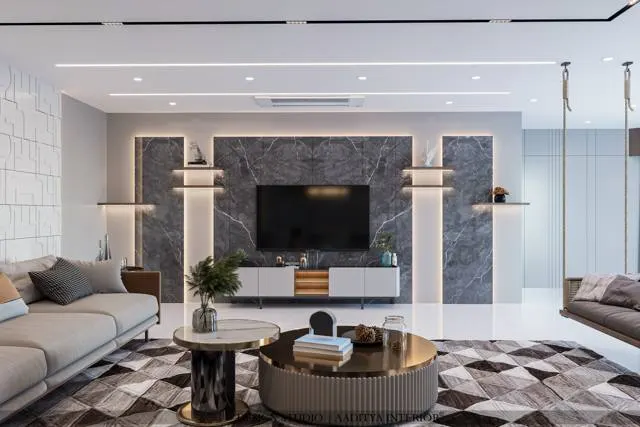
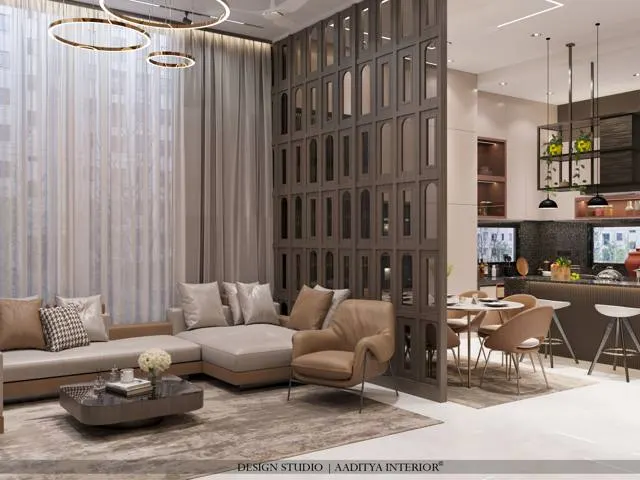
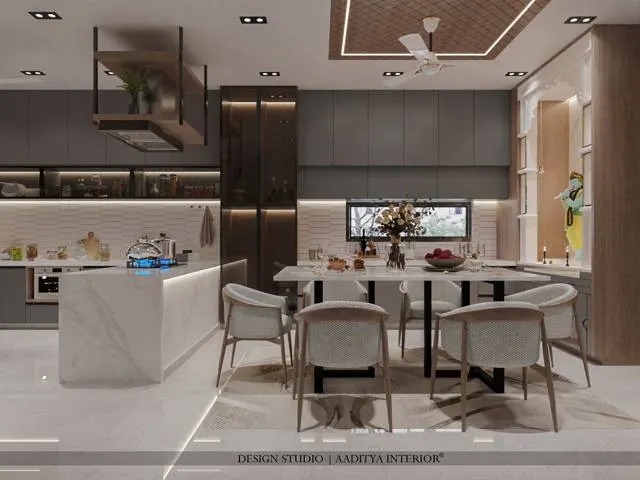
Numbers mean more when they are assembled. The table below builds a premium-grade interior for the sample villa in Figure 2 — about 2,800 sq ft of carpet across two floors, four bedrooms, five toilets, a double-height living room, a modular kitchen with utility, a pooja room and a first-floor family lounge. Each line is an indicative October 2026 range for Ahmedabad, built from the same per-room and per-square-foot rates that price every other interior; appliances, air-conditioning and GST stay out, listed separately as extras.
| Area / scope | Indicative cost (₹ lakh) | What drives the number |
|---|---|---|
| Modular kitchen + utility | ₹5 – 9 | Counter run, tall units, hardware, chimney-ready joinery |
| Living + double-height feature wall | ₹6 – 11 | TV wall, panelling, stone, statement light, railing to void |
| Master suite (wardrobe, bed, dresser, ceiling) | ₹5 – 8 | Walk-in or full wardrobe wall, headboard, cove ceiling |
| Two further bedrooms | ₹7 – 11 | Wardrobe wall, bed unit, study, ceiling in each |
| Guest bedroom (ground) | ₹3 – 5 | Wardrobe, bed, simpler ceiling |
| Five toilets (fittings + joinery) | ₹8 – 13 | Sanitaryware, vanities, glass, mirrors; waterproofing civil |
| False ceilings + lighting (whole villa) | ₹6 – 10 | Gypsum, cove, profile lights, fixtures, wiring points |
| Painting + wall finishes | ₹3 – 5 | Premium emulsion, feature textures, putty base |
| Staircase cladding + railing | ₹2 – 4 | Stone or wood treads, glass or MS railing, stair light |
| Pooja room + loose furniture + curtains | ₹5 – 9 | Mandir joinery, sofas, dining, beds, soft furnishing |
Summed at the lower end, those lines total roughly ₹50 lakh; at the upper end, roughly ₹85 lakh — which lands squarely inside the premium band of ₹2,000–3,500 per sq ft applied to 2,800 sq ft of carpet. The split is illustrative rather than a market statistic, but the order of the items and the rates inside them are the real 2026 figures. Read any villa quotation against this kind of line-item list: if it cannot show the kitchen, the toilets, the ceilings and the loose furniture as separate named blocks, the missing block is where the surprise will later live.
Where a villa's money actually goes
Owners imagine the budget is mostly furniture. On a villa it is not — furniture is the largest single slice, but finishes, ceilings, stone, electrical and loose furnishing together outweigh it. Understanding the split helps an owner decide where to spend and where to hold back. The chart below shows a typical category breakdown for a premium villa interior; the shares shift with taste, but the ranking rarely does. Fitted carpentry leads, finishes and ceilings follow, and the quiet cost of electrical and lighting — doubled by a villa's two floors and many points — is consistently underestimated.
The extras every honest quotation keeps separate
The single biggest cause of villa budget shock is not a high rate; it is the extras list. Several large costs genuinely sit outside an interior fit-out quotation, and a clean quotation keeps them in a separate column rather than burying or omitting them. When two quotations are compared, they must first be normalised to the same scope — a quotation that excludes appliances is not cheaper than one that includes them, it is simply quoting a different job. The table below lists the usual extras for an Ahmedabad villa so that none of them arrives as a surprise.
| Extra | Typical range (Oct 2026) | Why it sits outside the interior band |
|---|---|---|
| Appliances (chimney, hob, oven, fridge, washer) | ₹3 – 10 lakh | Procured by brand and model, not designed by the studio |
| Air-conditioning (split/VRF for a villa) | ₹4 – 12 lakh | HVAC is a specialist trade with its own load design |
| Home automation + security | ₹3 – 15 lakh | Scenes, curtains, cameras priced by system, not area |
| GST on the interior contract | As applicable | A tax on the total, shown as a line, never hidden in the rate |
| Flooring stone / elevation / facade | Verify locally | Civil works quoted on their own, outside interiors |
| Landscaping, boundary, gate, terrace | Verify locally | External scope, often a separate contractor |
The villa interior build sequence
A villa interior is not one job but a sequence of trades that must hand over to each other in the right order, and a realistic timeline is part of the budget, because delay costs money in rent, supervision and borrowed material. A four-bedroom villa typically runs twenty-four to thirty weeks from the first measurement to handover — longer than a flat, because there is simply more of everything and two floors to coordinate. The phases below overlap in practice: procurement begins while the design is still being finalised, and finishes start upstairs while carpentry continues downstairs, so the calendar is shorter than the sum of the individual stages.
| Phase | Typical weeks | What happens |
|---|---|---|
| Survey + design | Wk 1–5 | Measurement, layouts, 3D views, material and finish selection |
| Approvals + procurement | Wk 3–8 | Society NOC, discom liaison, ordering of long-lead items |
| Civil + false ceiling | Wk 6–12 | Plumbing and electrical rework, ceilings, waterproofing |
| Carpentry | Wk 10–20 | Wardrobes, kitchen, vanities and units, on-site or modular |
| Finishes + painting | Wk 18–26 | Shutters, veneer, stone, putty, paint and polish |
| Furniture + handover | Wk 24–30 | Loose furniture, curtains, light fittings, snagging, cleaning |
Two phases quietly decide whether a villa finishes on time. The services rework — the plumbing and the electrical enhancement for the combined load of air-conditioners, geysers, pumps and a modern kitchen — must be settled before the ceilings close, because reopening a finished ceiling is destructive and expensive. And procurement of the long-lead items — imported stone, statement lighting, automation hardware — has to begin early, since these arrive weeks after they are ordered and a villa stalled for a missing chandelier or a delayed slab of marble burns supervision cost every day. A budget that funds the work but not the sequence still overruns, which is why an experienced studio prices the calendar alongside the quotation.
Where villa interiors are heading in Ahmedabad
Three shifts are changing how villa budgets are built. The first is factory-made modular joinery: wardrobes, kitchens and vanities manufactured off-site to tolerances a site carpenter cannot match, delivered flat and assembled in days. It trims site time and dust and makes a villa's many repeated units — five toilets, four wardrobes — more predictable to cost. The second is home automation moving from a luxury add-on to a planned layer, which means wiring and conduit decisions now sit at the start of the design rather than being retrofitted. The third is energy: rooftop solar, heat-pump water heating and better glazing are entering villa briefs, and while they are building-services costs rather than interior ones, they increasingly share the same planning table. A villa designed in 2026 is wired for the decade ahead, not just finished for the photograph.
Rules for budgeting and comparing villa quotations
- Fix the grade first — standard, premium or luxury — and read every total against that band per sq ft of carpet.
- Use carpet area as the denominator, never built-up or super built-up; confirm the carpet figure before quoting anyone a budget.
- Demand a line-item quotation with the kitchen, toilets, ceilings, electrical and loose furniture as separate named blocks.
- Keep appliances, air-conditioning, automation, GST and civil works in a visible extras column, and normalise scope before comparing.
- Hold 8 to 12 per cent of the interior budget as a contingency, released only against measured work.
- Never economise on carcass grade, waterproofing or electrical capacity — these are the items that cannot be redone cheaply later.
- Treat the staircase and double-height volume as their own budget line; they are the villa costs no flat ever had.
- Get the lighting and automation conduit plan frozen before civil work closes the walls and ceilings.
Frequently asked questions
How much does it cost to do a 4BHK villa interior in Ahmedabad?
For a four-bedroom villa of about 2,800 sq ft of carpet area in 2026, a complete premium interior lands at roughly ₹56–85 lakh, or ₹2,000–3,500 per sq ft of carpet. A standard finish can bring it to about ₹40–56 lakh, and a luxury specification with imported stone, veneer and automation pushes past ₹1 crore. Appliances, air-conditioning and GST are extra in every case.
Is villa interior costlier than flat interior per square foot?
Yes, usually. A villa repeats the expensive rooms — more toilets, more bedrooms, a larger kitchen — and adds a staircase and often a double-height living volume that a flat never has. So a villa tends to sit at the upper end of each per-sq-ft band rather than the middle, and carries budget lines, such as the staircase railing and the void feature light, that do not exist in an apartment.
What is not included in a villa interior quotation?
Most quotations exclude appliances, air-conditioning, home automation, external flooring stone, the elevation and facade, the compound wall and gate, landscaping, and GST. These are genuine costs that sit outside the interior fit-out, so a clean quotation lists them in a separate extras column rather than hiding them in the rate.
Should the budget be based on built-up or carpet area?
Carpet area, always. Interior rates in India are quoted against the usable floor inside the walls. On a villa the built-up figure can be 25 to 30 per cent larger than the carpet area, so applying a carpet rate to a built-up number inflates the budget substantially. Confirm the carpet figure from the floor plan before budgeting.
How much contingency should a villa interior budget keep?
About 8 to 12 per cent of the interior budget, held aside for the surprises that plots and ageing services deliver — an electrical enhancement for combined loads, an uneven slab, a boundary correction. Release it only against measured work, not as a rounding-up buffer, and a villa project stays on budget through its many trades.
Sources & standards
- Bureau of Indian Standards — National Building Code of India 2016, Part 3 (Development Control Rules and General Building Requirements) for habitable room, kitchen and toilet minimums
- Bureau of Indian Standards — IS 303 (plywood for general purposes) and IS 710 (marine plywood) grade definitions used in carcass specification
- Comprehensive General Development Control Regulations (CGDCR), Gujarat — plot, setback and built-up definitions applicable to Ahmedabad villas
- Full-home interior bands 2026: basic ₹800–1,200, mid ₹1,200–2,000, premium ₹2,000–3,500+ per sq ft of carpet (indicative), with villas sitting above flats in each band
- Modular kitchen factory benchmark 2026: about ₹1,340 per sq ft of cabinetry for HDHMR carcass with laminate finish, hardware extra
- IndiaMART and TradeIndia dealer listings, October 2026 (indicative, excluding GST), for boards, stone, hardware and fittings
- Price ranges: indicative October 2026 estimates — confirm locally before budgeting