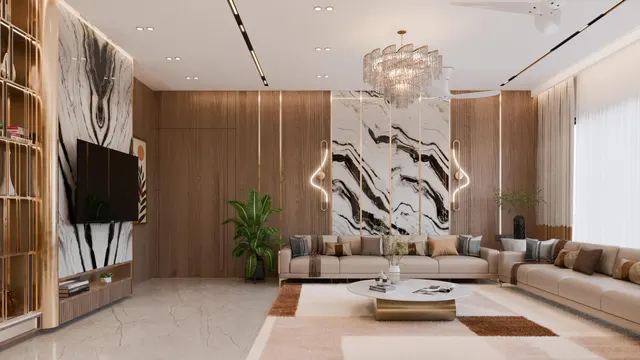
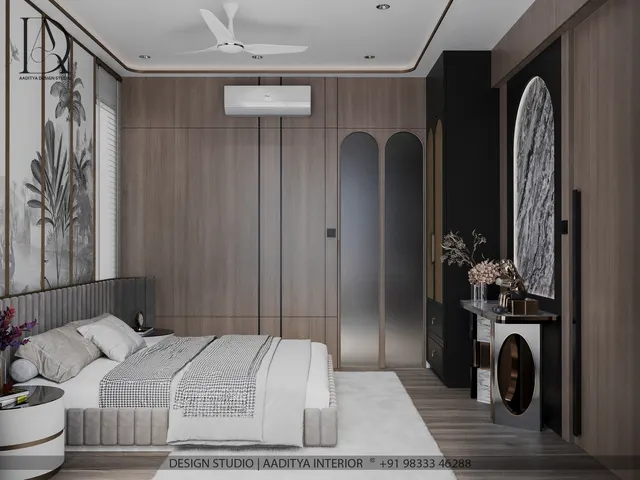
Wall panelling has become the default answer to almost every feature wall in Indian homes and offices. The TV wall, the wall behind the bed, the reception backdrop, the dining wall with a crockery unit, the corridor that needs some character — each one now arrives on site with a sample board of louvres, fluted strips, veneer or marble-look sheets. The trouble is that the quotations for these walls are rarely comparable. One vendor quotes the panel alone, another quotes it fixed on the wall, a third quotes it with a framework, trims and a cove light, and all three use the same phrase: rate per square foot.
This matters because the spread is enormous. The cheapest panelling in the market costs less per square foot than a good texture paint; the most expensive costs more than a modular wardrobe. Between them sit a dozen materials that look similar in a photograph and behave very differently in a humid Surat monsoon, in a rented flat that will be vacated in three years, or in a hotel corridor that is cleaned every night. Families who choose by photograph alone often pay veneer prices for a wall that a laminate panel would have done just as well — or save on a printed sheet that starts to look tired within two summers.
This guide lays out what wall panelling actually costs per square foot in October 2026, material by material, using the same price bands Aaditya Interior uses across its other guides on fluted panels, charcoal louvres, WPC and PVC panels, veneer and transitional mouldings. It then explains how the area is measured, what is hidden inside a per-square-foot rate, how the build-up thickness affects switches and skirting, and how to read a panelling quotation before signing it.
A short history of wall panelling in Indian interiors
Lining a wall with timber is old in India. The great Chettinad mansions of Tamil Nadu used imported Burma teak for columns, ceilings and doors on a scale that still astonishes visitors; Kerala's timber houses lined rooms in jackwood and teak; and the carved wooden facades of Gujarat's pol houses show how comfortable local carpenters were with large areas of joinery. In these buildings timber was not decoration applied to a wall — it often was the wall, or the structure that carried it.
The colonial bungalow and the club brought a different idea: the timber dado, a band of teak or deodar panelling up to about waist or shoulder height, with plaster above. It protected the lower wall from furniture, damp and wear, and it carried the moulded frames that defined the classical wall. Many government offices, railway buildings and old clubs across India still have these dados, and the proportions they used — a base of about 800–1200 mm, a rail, then a lighter field above — are still the starting point for a well-proportioned panelled wall today.
After independence, solid timber became expensive and scarce, and plywood took over. From the 1980s and 1990s the typical Indian panelled wall was plywood on battens, finished with decorative laminate or, in better work, natural veneer and polish. The 2010s added factory products that needed less carpentry: PVC strips for bathrooms and ceilings, WPC boards and louvres, high-gloss UV marble sheets, and in the 2020s the printed charcoal sheets and louvres that now fill dealer showrooms. CNC routers made fluted and grooved MDF affordable, and polymer mouldings brought back the classical frame without a carver. The market today is therefore a mix of three generations — carpentry systems, factory sheets and hybrid systems — and each prices differently.
| Era | Typical panelling system | How it was priced | What it changed |
|---|---|---|---|
| Before 1900 | Solid timber linings, carved joinery in havelis and mansions | By the craftsman's time and timber volume | Panelling as structure and status |
| 1900s–1950s | Teak or deodar dados with mouldings | By running foot of dado and moulding | The proportioned classical wall: base, rail, field |
| 1980s–2000s | Plywood on battens with laminate or veneer | By sq ft of carpentry, finish extra | Affordable panelling for flats and offices |
| 2010s | PVC strips, WPC boards, UV marble sheets | By sq ft supplied, fixing extra | Fast, moisture-tolerant, low-skill installation |
| 2020s | Charcoal sheets and louvres, fluted MDF, polymer mouldings | By sq ft installed, often all-in | Feature walls at many price points |
| Next | Click-fit factory panels, acoustic and recycled boards | Likely by system kit per wall | Less site work, more predictable quotes |
The cost table: twelve panelling materials per square foot
The table below brings together the installed bands used across this blog, so that a TV-wall decision can be made on one page. All figures are indicative October 2026 ranges per square foot of finished wall in metro and tier-2 cities, supplied and fixed, excluding GST, wiring and lighting unless stated. The lower end of each band assumes a simple flat wall, standard finishes and a reasonable area; the upper end covers premium brands, thicker profiles, more joints and cut-outs, and small jobs where the vendor's visit cost is spread over fewer square feet.
| Panelling system | Indicative installed cost (₹ per sq ft of wall) | What the rate usually covers | Best for | Typical life in a living room |
|---|---|---|---|---|
| PVC strips on battens | ₹50–90 | Hollow interlocking strips, light frame, trims | Bathrooms, utility, store rooms, ceilings | Moderate; can look plastic |
| PVC UV marble sheet | ₹120–220 | Sheet glued to flat plaster or board, edge trims | Glossy stone-look TV and bed walls | Moderate; scratches show |
| Charcoal sheet | ₹110–250 | Printed composite sheet, adhesive or clips, trims | Dry feature walls on a budget | Moderate; prints date |
| Charcoal louvres | ₹150–320 | Louvre strips with clips or adhesive | TV walls, bed backs | Moderate |
| Panel moulding on a painted wall | ₹120–300 | PU, polymer or MDF profiles fixed and painted | Transitional and classic rooms | Long; repaintable |
| WPC fluted louvres | ₹300–500 | Louvres on battens, corners and trims | Living rooms, semi-humid areas | Long; water-tolerant |
| Laminate on plywood panelling | ₹250–450 | Battens, ply, laminate, edge work | Offices, bed backs, wainscots | Long |
| Fluted panel, laminate or membrane | ₹350–850 | Pre-finished fluted board or membrane-pressed MDF | Contemporary feature walls | Long if dry |
| Upholstered or fabric panel | ₹600–1,500 | Board, foam, fabric, frame | Bed backs, echoing rooms, cinemas | Medium; fabric soils |
| Veneer panelling on ply | ₹700–1,300 | Battens, ply, natural veneer, polish | Premium living, lobbies, cabins | Long; can be re-polished |
| Fluted sandstone or limestone | ≈ ₹700–1,600 | Stone strips or slabs, adhesive or clamps | Foyers, facades, statement walls | Very long |
| Fluted MDF, PU painted | ₹1,000–1,800 | CNC-routed MDF, PU paint system | Crisp custom profiles, any colour | Long if dry |
For orientation, the cheapest wall treatment is still paint: premium emulsion costs about ₹20–30 per sq ft of paintable area, texture or designer finishes about ₹40–150 or more, and wallpaper about ₹60–250 installed. Any panelling rate should be judged against these. A 100 sq ft wall in WPC louvres at ₹300–500 is ₹30,000–50,000; the same wall in premium emulsion is ₹2,000–3,000. Panelling earns its price where it adds something paint cannot — depth, shadow, warmth, acoustic softness, a hidden service void or durability against knocks.
How panelling area is measured
Before comparing rates, it helps to agree on the area. Panelling is billed per square foot of wall face, measured as width times height of the panelled zone. That sounds simple, but three questions change the number. First, are openings deducted? A door or a large window inside the panelled zone is often deducted if it is bigger than a threshold — many vendors deduct only openings larger than about 5–10 sq ft — while small cut-outs for switches and sockets are not deducted, because cutting around them takes more labour, not less. Second, are returns counted? The sides of a niche, the edges of a column or a TV recess are panelled surfaces too, and they are usually added at the same rate or at a running-foot rate. Third, what is the wastage allowance? Sheet materials come in fixed sizes, and a wall that does not suit the sheet wastes material that someone pays for.
The worked take-off in Fig. 2 shows why two honest quotations can differ by twenty per cent before anyone has discussed material. A vendor who bills the gross 104.6 sq ft without deducting the door, and another who bills 84 sq ft net plus 12 per cent wastage, are not quoting the same job. Neither is wrong; they are using different conventions. The fair comparison is to convert both to a single total for the same wall, with openings, returns and wastage stated.
Sheet size and wastage
Plywood, MDF, HDHMR, charcoal and UV marble sheets are commonly sold in 2440 × 1220 mm (8 × 4 ft) sizes, with some products available in longer lengths. A 2700 mm high wall therefore needs either a 260 mm filler strip above a full sheet, a horizontal joint, or a longer sheet at a premium. A 3000 mm wide wall takes two full sheet widths and leaves 560 mm to be cut from a third. Designers who set out the wall to the sheet — a centred sheet with equal side pieces, a joint hidden at a rail line or behind a TV — control both cost and appearance. Wastage of 10–15 per cent is a reasonable planning allowance for sheet materials; strip and louvre products cut from long lengths often waste less.
What a per-square-foot rate leaves out
A panelling quote that looks cheap is usually cheap because something has been left out of the rate and moved into a separate line — or left for the client to discover. The items below are where most disputes arise. None of them is a trick; they are genuine costs, and a good quotation lists each one so that two vendors can be compared fairly.
| Item | Indicative cost (Oct 2026) | When it applies | What to check |
|---|---|---|---|
| Batten framework (timber, ply or aluminium) | Often inside louvre and carpentry rates; else priced per sq ft | Uneven walls, louvres, ply panelling, hidden wiring | Batten spacing (300–600 mm) and anchoring into masonry |
| Trims, corners and end profiles | ≈ ₹20–80 per running ft | Every exposed edge and corner | PVC vs aluminium trims; colour match |
| Cove or profile LED in the panel | ₹150–300 per running ft installed | Lit grooves, top coves, backlit sheets | Driver location and access for replacement |
| Switch and socket cut-outs | Usually included up to a few per wall; extra beyond | TV walls, bed backs | Extension boxes to bring switches flush |
| Wall preparation (damp treatment, levelling) | Quoted per job | Damp, cracked or very uneven walls | Never panel over an active damp patch |
| Skirting and junction details | Per running ft | Where panels meet floor or ceiling | Shadow gap or skirting — decide before ordering |
| Transport, loading and site visit | Lump sum on small jobs | Jobs under about 50–80 sq ft | Minimum-order or minimum-visit charges |
| GST | 18 % on most supply-and-fix contracts (confirm the applicable rate) | All registered vendors | Is the quoted rate inclusive or exclusive? |
Lighting deserves a special note because it changes the budget more than any material upgrade. A 3000 mm wide TV wall with a single top cove needs about 10 running feet of LED profile; at ₹150–300 per running foot, that is ₹1,500–3,000. The same wall with lit vertical grooves every 600 mm, each 2400 mm tall, needs roughly 40 running feet more, adding ₹6,000–12,000 before drivers and controls. The lighting should be decided at the drawing stage, because wiring and driver access have to be built into the framework before the panels close.
Build-up thickness: the cost nobody budgets for
Every panelling system adds thickness to the wall, and that thickness has consequences. A glued sheet adds about 3–8 mm and can usually sit behind existing switch plates with a small adjustment. A batten system with louvres or plywood adds roughly 35–60 mm, which means every switchboard on that wall must be brought forward with an extension box, the skirting has to be rethought, and the panel will stand proud of the door architrave unless the junction is detailed. These small changes add electrician and carpenter time that rarely appears in the panel rate.
The void behind a batten system is also an opportunity. It can carry HDMI and power conduits for a wall-mounted TV, the wiring for lit grooves, and even a shallow niche. In offices and hotel rooms it can hold acoustic infill to soften sound between rooms. The point is to decide its use at drawing stage; a void that is discovered on site is a void that gets wasted.
Worked examples: three walls, three budgets
The examples below use typical Indian wall sizes and the bands from the cost table. They show totals for material and fixing only, excluding GST, lighting and electrical work, rounded to the nearest thousand rupees. Real quotations will vary with brand, city and site conditions, but the proportions between options are reliable.
| Wall and size | Budget option | Mid option | Premium option |
|---|---|---|---|
| TV wall 10 × 9 ft (≈ 90 sq ft) | Charcoal louvres ₹150–320: ≈ ₹14,000–29,000 | WPC louvres ₹300–500: ≈ ₹27,000–45,000 | PU fluted MDF ₹1,000–1,800: ≈ ₹90,000–1,62,000 |
| Bed-back wall 11 × 9 ft (≈ 99 sq ft) | UV marble sheet ₹120–220: ≈ ₹12,000–22,000 | Fluted laminate ₹350–850: ≈ ₹35,000–84,000 | Upholstered centre + veneer sides ₹600–1,300: ≈ ₹59,000–1,29,000 |
| Dado wainscot, 3 walls × 12 ft × 3.5 ft (≈ 126 sq ft) | Panel moulding ₹120–300: ≈ ₹15,000–38,000 | Laminate on ply ₹250–450: ≈ ₹32,000–57,000 | Veneer on ply ₹700–1,300: ≈ ₹88,000–1,64,000 |
| Office reception wall 16 × 10 ft (≈ 160 sq ft) | WPC board cladding ₹220–450: ≈ ₹35,000–72,000 | Fluted laminate ₹350–850: ≈ ₹56,000–1,36,000 | Fluted stone ≈ ₹700–1,600: ≈ ₹1,12,000–2,56,000 |
| Bathroom wall above tiles, 6 × 3 ft (≈ 18 sq ft) | PVC strips ₹50–90: ≈ ₹1,000–2,000 + minimum visit | WPC board ₹220–450: ≈ ₹4,000–8,000 | Fluted porcelain tile ₹250–600: ≈ ₹4,500–11,000 |
Two lessons stand out. First, the jump from mid to premium is far larger than the jump from budget to mid, because premium systems are carpentry and paint processes rather than factory products. Second, small walls attract minimum charges: an 18 sq ft bathroom panel will rarely be done at the per-square-foot rate alone, because the vendor's visit, cutting and trims cost almost the same as a wall three times bigger. Grouping small panelling jobs into one visit is one of the easiest savings available.
Choosing by room: where each material earns its price
Living room and TV wall
The TV wall is the most panelled surface in Indian homes, and it is the wall seen most often in daylight from a seated distance of 2.5–4 m. At that distance louvres and fluting read clearly, and printed finishes are usually convincing. WPC louvres at ₹300–500 are the safest all-round choice; charcoal louvres at ₹150–320 are acceptable in dry rooms and for shorter horizons, such as a rented flat. PU fluted MDF is the choice when the colour must match a specific scheme or when profiles are custom. Avoid glossy sheets directly opposite large windows, where reflections fight the TV picture.
Bedroom and bed back
The bed-back wall is touched by heads, pillows and hands, and it is seen at close range from the bed. Upholstered panels soften the room and absorb sound; veneer gives warmth; fluted laminate is a durable middle path. Keep the panel field at least as wide as the bed plus side tables — often 2400–3000 mm — so the composition does not look like a postage stamp on a large wall. Charcoal and UV marble sheets work here on a budget, but the print is visible at arm's length, so matte and textured films age better than gloss.
Bathrooms, utility and kitchens
Wet and semi-wet zones need materials that do not swell: PVC strips, WPC boards, fluted porcelain tiles and stone. MDF, plywood with veneer and upholstered panels have no place in a bathroom. Even water-tolerant panels need a sound substrate: panels glued over a damp wall simply hide the problem until it shows as stains or loose joints. In kitchens, panelling near the hob must be non-combustible or kept clear of the cooking zone; tile, stone or toughened glass belong behind the burners.
Offices, showrooms and hotels
Commercial walls are cleaned harder and bumped more often than domestic ones, and they are expected to last until the next refurbishment cycle. Laminate on ply, WPC board and stone are the workhorses; veneer and PU belong in cabins and lobbies where traffic is controlled. Fire behaviour matters more here: in corridors, exits and assembly areas, the interior lining must meet the surface-spread-of-flame requirements that the fire consultant applies under the National Building Code, which can rule out some plastic-based panels in escape routes. That check should come before the material is chosen, not after it is fixed.
How to read and compare panelling quotations
The fairest comparison is a single total for a single, dimensioned wall. Give every vendor the same drawing — wall width and height, openings, returns, switch positions and lighting intent — and ask for a quote that states the area method, the wastage, and every extra. Then compare totals, not rates. A vendor quoting ₹280 per sq ft with trims, battens and cut-outs included can be cheaper than one quoting ₹220 with each of those added.
- Send a dimensioned elevation, not a photograph — width, height, openings, switch and TV positions.
- Ask whether the rate is supplied-only, labour-only or supplied-and-fixed, and whether GST is included.
- Ask how openings and returns are measured, and what wastage allowance is inside the rate.
- Confirm battens, trims, corners, end profiles and cut-outs are included, with brand and colour named.
- Decide lighting before ordering: cove or groove LED is ₹150–300 per running ft and needs wiring inside the frame.
- Check the wall first: damp, cracks or soft plaster must be repaired before any panel goes on.
- Ask for the material brand, thickness and finish code in writing, and approve a sample piece under the room's own light.
- Group small panelling jobs into one visit to avoid minimum charges.
- For commercial escape routes, get the fire consultant's approval of the lining material first.
Where panelling prices are heading
Three trends are visible in the market. First, panelling is moving from site carpentry towards factory kits: louvres, profiles, trims and lighting channels designed to work together, which makes quotes more predictable and reduces the skill needed on site. Second, finishes are improving fastest at the low and middle end — printed films with deeper texture, better matte surfaces and more convincing timber and stone looks — which narrows the visual gap with veneer and stone, though not the gap in feel and repairability. Third, there is growing interest in acoustic panels, recycled-content boards and low-emission adhesives, especially in offices and hotels where indoor air quality and sound are part of the brief. Aaditya Interior expects carpentry-based premium panelling to keep its place in statement walls, while factory systems take more of the everyday market.
For a family planning a home today, the practical consequence is that the mid-range — WPC louvres, fluted laminate, laminate on ply and panel mouldings — offers the best value per square foot, and premium money is best concentrated on one or two walls where it will be seen and touched every day.
Frequently asked questions
What is the cheapest wall panelling per sq ft in India?
Plain PVC strips on a light frame, at about ₹50–90 per sq ft installed in October 2026, are the cheapest panelling. They are practical for bathrooms, utility areas and stores, but look plastic on a living-room feature wall. For feature walls on a budget, charcoal sheets (₹110–250) and charcoal louvres (₹150–320) are the usual entry points.
Is WPC panelling better than charcoal panelling?
WPC louvres are generally thicker, more rigid and more water-tolerant, and cost about ₹300–500 per sq ft against ₹150–320 for charcoal louvres. Charcoal's printed film looks good from a distance but is easier to scratch and cannot be refinished. For a long-term home, WPC is usually the better value; for a rental or a short-horizon refresh, charcoal is reasonable.
How much does a TV wall panel cost?
A typical 10 × 9 ft TV wall of about 90 sq ft costs roughly ₹14,000–29,000 in charcoal louvres, ₹27,000–45,000 in WPC louvres, ₹32,000–77,000 in fluted laminate and ₹90,000–1,62,000 in PU-painted fluted MDF, before GST, lighting and electrical work (indicative October 2026).
Is wall panelling cost calculated on wall area or panel area?
It is billed on wall area — the face of the panelled zone — but vendors differ on whether openings are deducted, how returns are counted and whether wastage is inside the rate. Always compare totals for the same dimensioned wall rather than rates alone.
Can wall panels be fixed on a damp wall?
No. Even water-tolerant panels such as PVC and WPC will hide, not cure, damp. The source — a leaking pipe, a failed external joint, rising damp — must be fixed and the wall allowed to dry before panelling; otherwise adhesive fails, battens rot and stains appear at joints.
Sources & standards
- Bureau of Indian Standards — IS 303 (plywood for general purposes), IS 710 (marine plywood), IS 12406 (medium density fibreboard)
- National Building Code of India 2016, Part 4 (Fire and Life Safety) — interior finish and surface spread of flame requirements for escape routes
- National Building Code of India 2016, Part 7 (Constructional Practices and Safety) — general guidance on finishes and fixings
- Neufert, Architects' Data — wall proportions, dado and panelling heights
- Manufacturer standard ranges for WPC, PVC, charcoal and UV marble panels, and laminate and veneer sheet sizes (2440 × 1220 mm), described generically
- Price ranges: indicative October 2026 estimates, consistent with this blog's fluted panel, charcoal louvre, WPC/PVC, veneer and transitional-moulding guides — confirm locally before budgeting