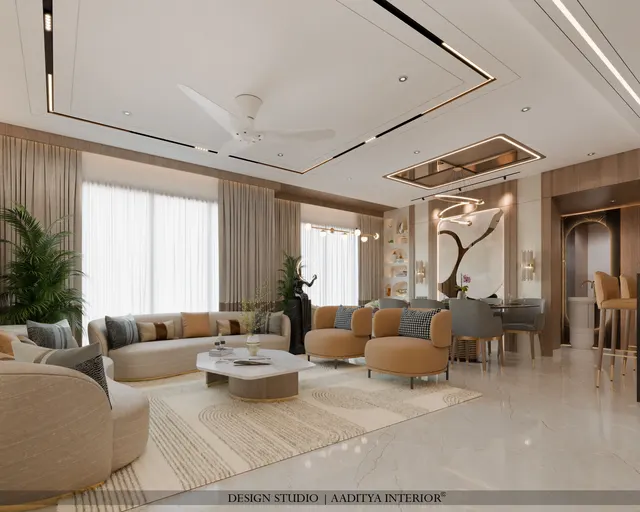
Walk into a home where the cove glows warm amber and the downlights burn icy white over the same sofa, and the eye knows something is wrong before the mind names it. Colour temperature — measured in Kelvin — is the single most visible lighting decision in a home, and the most commonly botched. The rule itself is simple: warm light (2700–3000K) where people relax, neutral white (4000K) where people work. The execution fails because fittings are bought room by room, sale by sale, with no one specifying the Kelvin value on the plan.
Kelvin is not brightness; it is colour. A 2700K lamp and a 6500K lamp can produce identical lumens while making the same room feel like evening versus noon. Warm light flatters skin tones, wood and warm paint colours — which is why living rooms and bedrooms want it — while neutral 4000K renders task surfaces, food and text with clarity, which is why kitchens, studies and bathrooms want it. Daylight at 5000–6500K belongs in no Indian living space after dark; it is the colour of offices and hospitals, and it makes a home feel like both.
This article assigns a colour temperature to every room, explains why mixing temperatures in one sightline is the top lighting mistake in Indian homes, shows how to specify Kelvin so the electrician cannot get it wrong, and prices what a whole-home correction costs. All guidance is commonly cited lighting-design practice; lux targets are from IS 3646-1 and the CIBSE Code for Lighting.
The Kelvin scale, room by room
| Room | Colour temperature | Why |
|---|---|---|
| Living room | 2700–3000K — commonly cited practice | Relaxation, skin tones, warm materials; the evening room |
| Bedroom | 2700–3000K — commonly cited practice | Warm light supports winding down; cool light fights it |
| Dining area | 3000K — commonly cited practice | Food looks appetising; faces look human |
| Kitchen work zones | 4000K — commonly cited practice | Task clarity for chopping and cooking; matches 500 lux target |
| Study / home office | 4000K — commonly cited practice | Reading contrast and alertness for sustained work |
| Bathroom, mirror zone | 4000K — commonly cited practice | True colour for grooming; warm light yellows the face |
| Pooja corner | 2700–3000K — commonly cited practice | The warmth of diyas and tradition |
| Balcony / outdoor | 2700–3000K — commonly cited practice | Mood, not task; warm light flatters the evening |
The pattern is deliberate: every room where the family unwinds gets warm light, every room where the family works gets neutral white. The bathroom surprises people — but a 2700K mirror light casts a yellow tint that misleads shaving and makeup, while 4000K renders the face truly. Note the boundary rule that follows: the two temperatures must never share a sightline. A 4000K kitchen visible from a 2700K living room is fine — they are separate rooms. A 2700K cove and 6500K spots over the same sofa is the mistake: the eye compares them directly and the room reads as broken.
Why mixing is the top mistake
Mixed colour temperatures fail for a physiological reason: the eye adapts to one white point at a time, and two competing white points in one field of view prevent clean adaptation. The result reads as cheap and unfinished even when every fitting is expensive. The mistake usually enters through the sales counter — a homeowner buys warm cove strips in one purchase and cool-white panels in another, months apart, and the electrician installs both without comment. The prevention is procedural: the lighting plan lists the Kelvin value beside every circuit (A: cove 2700K, B: spots 4000K, C: pendant 3000K), and all fittings for one circuit are bought in one purchase from one batch. LED colour varies slightly between manufacturing batches, so single-batch purchasing is not fussiness; it is the only way the cove reads as one continuous line.
Specifying it so the site cannot get it wrong
Kelvin must be written, not spoken. On the lighting plan, every circuit carries its temperature: cove circuit 2700K, work spots 4000K, dining pendant 3000K. On the purchase list, every fitting line carries the same number, and fittings for one circuit are bought together from one batch. On site, the electrician's copy of the plan is the authority — verbal instructions evaporate. Two further details matter: dimmers shift the perceived warmth of a lamp slightly, so dimmed warm circuits are tested at their usual evening setting before sign-off; and smart RGB fittings default to whatever colour the last user left, so any colour-changing fitting in a home should default to the room's specified temperature on power-up.
What correcting the colour costs
Fixing colour temperature is usually a re-lamping job, not a rewiring job: the circuits exist, only the fittings' colour is wrong. Cove LED strips re-lamp at ₹150–300 per running foot installed, panel and spot lights at ₹400–1,200 per piece, and a dining pendant at ₹2,000–15,000 per piece if its fixed colour is the problem. A 2BHK with roughly 60 running feet of cove, twenty panels and spots, and two pendants typically lands the correction in the ₹35,000–90,000 band — far less than living with a broken-looking room. The cheapest prevention remains free: write the Kelvin value on the plan before the first purchase.
| Item | Indicative range, excl. GST | Notes |
|---|---|---|
| Cove LED strip, re-lamp / new | ₹150–300 / running ft installed | Buy one batch per circuit for colour consistency |
| Panel / spot lights | ₹400–1,200 / piece | Check the Kelvin printed on the fitting, not the box |
| Designer pendant | ₹2,000–15,000 / piece | 3000K over dining; replace if fixed at the wrong colour |
| Dimmers for cove and pendant circuits | Quoted per switch by electricians | Evening mode depends on dimming the warm layers |
| Task lamp, 4000K (study) | ₹400–1,200 / piece | Panel-light band; the study's work light |
| Bathroom mirror light, 4000K | ₹400–1,200 / piece | Side-mounted strips or sconces, not top-down |
Where each temperature works, and where it backfires
- 2700–3000K in living rooms and bedrooms: flatters people and warm materials; backfires in any task zone, where it feels dim and sleepy.
- 4000K in kitchens, studies and bath mirror zones: task clarity and true colour; backfires in living and bedrooms, where it feels clinical.
- 3000K over the dining table: food and faces at their best; avoid 4000K here, which makes dinner look like a canteen.
- One temperature per sightline: the non-negotiable rule; warm and neutral may meet at a doorway but never over the same seating.
- Kelvin written per circuit on the plan: the only specification the site respects; verbal instructions evaporate by purchase day.
- Single-batch purchasing per circuit: prevents visible colour steps along a cove; avoid buying the same strip months apart.
- 6500K daylight: belongs in offices, not homes; avoid it in every residential room after dark.
The evening test is the final authority: at 8 pm, with the room's usual scene switched on, the light should feel like one decision, not three purchases. Stand in the doorway and look across the room — if the cove, the spots and the pendant read as one continuous warmth, the temperatures are right. If any fitting argues with the rest, its Kelvin value is wrong, and re-lamping that one fitting is the cheapest upgrade in the house.
Sources & standards
- Commonly cited lighting-design practice — room-by-room colour temperature bands 2700–3000K / 4000K.
- IS 3646-1 (1992) — service illuminance: dining rooms 200, food preparation 500 lux.
- CIBSE Code for Lighting — residential lounge 100–300 lux; writing and reading 500 lux.
- IndiaMART dealer listings, October 2026 (indicative) — LED strip, panel, spot and pendant price bands.