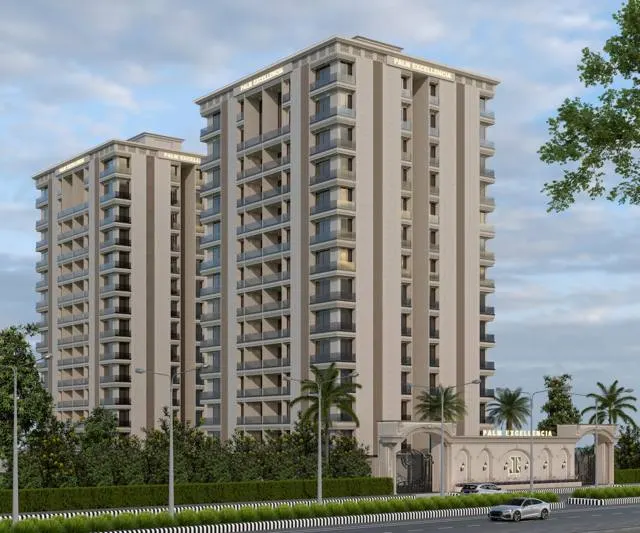
Picture a bungalow ten days before a family wedding. The decorator's team has wrapped every column, the gate, two trees and both balcony railings in lights, and fed the whole display from a single porch socket through three extension reels joined end to end. By the second evening the main switch trips every twenty minutes; by the third, a reel left coiled on the wet lawn after the morning wash smells of hot plastic. The usual culprit, once an electrician traces it, is a cracked connector sitting in a puddle and leaking current to earth — and the mehendi night is spent half dark.
That scene repeats across Indian cities every Diwali and every wedding season, because festive lighting is treated as decoration rather than as an electrical installation. It is both. A string of LEDs is a small appliance with a plug, a cable and joints, and when forty of them are hung outdoors for a month in dew, dust and the odd unseasonal shower, the rules that apply to any outdoor circuit apply to them too. This guide covers both halves of the job: how to compose festive lighting so the house looks designed rather than smothered, and how to power it so that it stays on, stays dry and never puts a child, a guest or the building at risk. It is written for homeowners, and for anyone briefing a decorator; the wiring itself belongs to a licensed electrician.
Plan the picture first: lines, layers and one warm colour
Lighting a house for a festival is not about quantity. Indian homes have a long tradition of festive light — rows of oil diyas on parapets and steps for Diwali, lanterns at the door, and later the strings of small incandescent bulbs that decorators hung on wedding houses through the late twentieth century. The diya row worked because it followed the architecture: it traced a parapet, a sill or a step, and the building's shape glowed in outline. Modern LED strings can do the same thing at a fraction of the heat and power, but they are cheap enough that people buy far too many and hang them everywhere, which flattens the building into a single glowing blob.
A better method is to choose two or three lines and one focal point. The lines are usually the top of the parapet or terrace railing, the edge of the main balcony or a horizontal band at a floor level, and the gate or compound wall. The focal point is the entrance — the main door, the toran and the steps — where guests arrive and photographs are taken. Everything else is optional. Trees are lovely when one or two are wrapped well, but a garden of wrapped trees competes with the house. Columns can be wrapped in a spiral or lit from below with a single warm spot. Windows can carry a curtain light inside the glass, which reads from the street without any outdoor wiring at all.
Colour matters more than people expect. Warm white of about 2700–3000 K reads as festive and flattering on Indian skin, marigold, red fabric and sandstone. Cool white looks clinical outdoors, and multicolour chasing strings, used everywhere, make even a fine elevation look cheap. A reliable formula is warm white for all the architectural lines, with colour limited to one feature — a coloured rangoli light, a gate arch, or a single tree — and any chasing or flashing effects kept away from the main lines, where they also cause discomfort to neighbours and passing drivers.
Fig. 1 also shows the hidden half of the plan: where the power comes from. Each line has its own outdoor socket close to it, so that a short lead runs from socket to string and nothing crosses a path, a step or a lawn. The single biggest improvement most homes can make is not a better light, but sockets in the right places; the last section of this guide shows how to add them permanently.
| Element | Good festive treatment | Typical length or quantity | What to avoid |
|---|---|---|---|
| Parapet or terrace railing | One continuous warm-white string or LED neon line along the top edge | Facade width, often 30–60 ft per side | Drooping loops; strings tied to TV aerials or solar frames |
| Main balcony | String along the railing top rail, or a curtain light hung inside the railing | 8–20 ft per balcony | Wrapping every baluster — heavy, slow and cluttered |
| Gate and compound wall | Arch or line on the gate, warm spots on the pillars | Gate width plus pillars | Strings on moving gate leaves — cables fatigue and snap |
| Entrance, steps, toran | Diyas or electric diyas on steps, a lit toran, one warm spot on the door | One focal point | Bare bulbs at eye level; glare in photos |
| Trees | One or two trees wrapped trunk-to-branch in warm white | 100–300 ft of string per medium tree | Wrapping every tree; tight wraps that cut bark |
| Windows | Curtain lights inside the glass | One per window | Outdoor strings across window openings |
| Columns | Spiral string or a single uplight | 2–4 columns | Different colours on each column |
Choosing the lights: strings, curtains, neon and floods
Almost all festive lighting today is LED, and that is the main reason it can be done safely at all. The old strings of small incandescent bulbs drew far more power for the same length and ran hot; a wedding house lit with them needed heavy cables and often a separate supply. LED strings draw a small fraction of that, so a whole facade can usually run from one or two ordinary socket circuits. But the products sold for festivals vary enormously in quality. A string bought loose from a street market may have thin wire, no rating marks, and an unsealed plug-in controller; a string sold with a stated wattage, an IP rating and a sealed transformer will usually last several seasons.
| Light type | Typical label power (indicative) | Minimum IP outdoors | Best for | Watch out for |
|---|---|---|---|---|
| LED rice or fairy string (on wire) | Roughly 3–10 W per 10 m set | IP44 sheltered; IP65 exposed | Railings, trees, parapets | Unsealed controller boxes; cheap ones are indoor-only |
| LED curtain light | Roughly 10–30 W per 2–3 m curtain | IP44 under cover | Inside windows, balcony fronts, backdrops | Hanging in rain; tangling on removal |
| LED net light | Roughly 10–25 W per net | IP44–IP65 | Hedges and bushes | Shapes that do not fit the plant |
| LED rope light (tube) | Roughly 5–15 W per metre | IP65 | Gates, steps, outline lines | Kinking; cut ends left unsealed |
| LED neon flex | Roughly 8–14 W per metre | IP65–IP67 | Crisp outline of parapets and arches | Needs a proper driver and end caps |
| LED flood or spot | Roughly 10–50 W each for homes | IP65 | Columns, trees, gate pillars | Glare into neighbours' windows |
| Electric diyas, LED lanterns | Under 1–3 W each | Indoor or IP44 | Steps, sills, rangoli | Battery types need checking nightly |
| Oil diyas and candles | Open flame | — | Steps, sills, tulsi, rangoli | Fabric, paper and dry leaves nearby |
The wattages above are indicative label ranges, not a specification; the figure that matters is the one printed on the product or its transformer, and it should be added up before anything is plugged in. Two practical rules help when buying. First, buy strings that are designed to be connected end to end, and note the maximum number of sets the manufacturer allows on one feed — this is printed on good products and ignored on most installations. Second, for anything that will be outdoors for more than a few evenings, buy IP65 products with a sealed plug-in transformer or driver, so that only safe low voltage runs along the string itself.
IP ratings and weather: what the festive season does to outdoor lights
The IP (ingress protection) code, defined in IS/IEC 60529, is two digits: the first for dust and solid objects, the second for water. IP20 means fingers cannot touch live parts, but water can get in — fine for indoor use only. IP44 resists splashing water from any direction and suits a covered balcony or porch. IP65 is dust-tight and resists water jets, and is the sensible minimum for anything exposed to the sky. IP67 survives temporary immersion and suits ground-level fittings where water can pool. The rating applies to the whole assembly, including the plug, the controller and every joint, which is where most festive installations fail.
In Gujarat and much of India, the Diwali-to-wedding season, from about October to February, is mostly dry, which lulls people into thinking weather does not matter. It does. Winter nights bring heavy dew that wets every exposed surface by dawn; lawns are watered and floors are washed every morning; and an unseasonal shower is not unusual. A connector lying on a balcony floor or a lawn sits in water for hours every day. The result is the most common festive fault — the RCCB trips at night or the morning after a wash — and the most common response, unfortunately, is to bypass the RCCB rather than to find the wet joint.
| Location | Exposure | Minimum rating for lights, joints and sockets | Practical detail |
|---|---|---|---|
| Inside a window or room | Dry | IP20 | Keep strings off hot lamps and away from curtains if candles are near |
| Covered balcony or porch | Splash, dew, floor washing | IP44 | Joints lifted off the floor; sockets at least 450 mm above floor |
| Open balcony, terrace railing | Rain, dew, sun | IP65 | Connectors in sealed boxes, drip loops below every joint |
| Facade and parapet | Rain, wind, dust, sun | IP65 | Cables clipped every 300–500 mm; no loose loops in wind |
| Lawn, garden, trees | Pooling water, irrigation | IP65 lights; IP67 for anything on the ground | Never leave a connector or reel on the soil |
| Near pools or fountains | Immersion risk | Keep festive mains lights away entirely | Only purpose-made low-voltage pool fittings belong here |
Power: load, circuits, MCBs and the 30 mA RCCB
Every festive scheme should start with a simple sum: add the wattage of everything that will be on at once. LED loads are small, so the number is usually reassuring. The worked example below lights the bungalow in Fig. 1 generously in warm white and still totals well under 1 kW. The real risks are therefore not the total load but the way it is connected: too many sets daisy-chained beyond the manufacturer's limit, thin multi-plug adaptors, coiled extension reels that heat up, and joints left in the wet. Where older halogen floodlights or incandescent sets are still in use, the sum changes quickly, and a single 500 W halogen flood can draw as much as an entire LED facade.
| Item (Fig. 1 bungalow) | Quantity | Power each (from label, indicative) | Total watts |
|---|---|---|---|
| Warm-white LED strings on parapet, 10 m sets | 6 | 8 W | 48 |
| Warm-white LED strings on balcony and gate, 10 m sets | 4 | 8 W | 32 |
| Tree wrap, 10 m sets | 8 | 8 W | 64 |
| LED curtain lights inside windows | 4 | 20 W | 80 |
| LED neon flex on gate arch | 6 m | 12 W per metre | 72 |
| LED spots on gate pillars and columns | 4 | 20 W | 80 |
| Total connected festive load | — | — | 376 W, about 1.6 A at 230 V |
For comparison, an ordinary 6 A socket on a 230 V supply can carry about 1.38 kW in principle, and a 16 A power socket about 3.7 kW, but neither should be loaded close to its rating for hours, and the rating of the extension lead, the multi-plug and the connectors may be lower than the socket's. The practical rule is to keep festive load on any one socket well below half its rating, to split the facade across two circuits where possible, and never to plug a heater, a kettle or a sound system into the same lead as the lights. A large wedding sound system, a fog machine or a catering appliance needs its own circuit.
Two protective devices do different jobs. The miniature circuit breaker (MCB, IS/IEC 60898-1) protects the cable: it trips when the current exceeds its rating or when there is a short circuit. The residual current device — an RCCB to IS/IEC 61008-1, or an RCBO that combines both functions to IS/IEC 61009-1 — protects people: it compares the current going out on the live conductor with the current returning on the neutral, and if more than a small amount is missing, because it is leaking through water, a damp wall or a person, it switches off within a fraction of a second. For personal protection, a sensitivity of 30 mA is the standard choice. India's electrical safety regulations require residual current protection in many installations, and good practice under IS 732 and the National Building Code recommends it for every circuit feeding outdoor and wet areas. Many older homes have no RCCB at all, or one covering only part of the board. Before any festival, it is worth asking an electrician to confirm that the circuits feeding outdoor sockets are covered, and to add a device if they are not.
Fixing lights without damaging the house
Festive lights are up for a few weeks and then come down, and the fixing should leave no trace. The worst damage seen on Indian sites comes from nails and screws driven into fresh paint, into stone cladding and into the waterproofing upstand of a terrace parapet, where every hole becomes a leak at the next monsoon. Adhesive hooks pull paint off when removed in cold weather. Tight plastic ties left on tree branches cut into the bark as the tree grows. The aim is to clip, wrap or hang — never to penetrate.
- Railings: clip the string to the top rail every 300–500 mm with reusable plastic clips or soft ties, on the inside face where the person fixing it can stand safely.
- Parapets: run the string on the inside face of the parapet or on its coping with weighted or clip-on holders; do not drill into the coping or the waterproofing upstand.
- Stone and cladding: never fix into stone, ACP or HPL; wrap columns or use freestanding stands instead.
- Trees: wrap loosely, trunk first and then two or three main branches; remove every tie when the season ends.
- Windows: hang curtain lights from a tension rod or the curtain track inside the glass, so the outdoor wiring stays at zero.
- Gates: fix to the fixed frame or pillars, never to moving leaves; cable that flexes every time the gate opens will crack.
Working at height deserves a sentence of its own, because falls during decoration are a more common injury than electric shock. Parapet and balcony work should be done from the inside of the railing, never by leaning over it, and anything that needs a ladder on the outside of the building — high facade lines, trees, top-floor balconies — should be done by the decorator's team with proper ladders or access, or not at all. Children should not help with the high work, however much they want to.
Wedding scale: decorators, generators and temporary connections
A wedding at home changes the numbers. Lighting may run on the facade, a tent or shamiana on the plot or the street, a stage, a mandap, catering counters and sound — and the total can grow from a few hundred watts to many kilowatts. At that scale, three questions should be settled in writing with the decorator before work begins: where the power will come from, who is responsible for the electrical safety of the temporary installation, and what protection is being used.
The household supply is sized for the house, not for an event. Plugging a decorator's distribution of halogen floods, a sound system and catering equipment into the house sockets is how main switches burn and meters fail. For large functions, families usually use either a hired generator with its own distribution board, operated by the supplier, or a temporary electricity connection, which electricity distribution companies in Gujarat and most states offer for events and construction on application and payment. Either way, the temporary supply should come with its own main switch, MCBs, residual current protection and earthing, and its cables should run overhead out of reach or in protected routes, not across walkways. A generator should stand outdoors, away from windows and doors, because its exhaust contains carbon monoxide, and it must never be connected into the house wiring except through a proper changeover switch installed by a licensed electrician.
| Question for the decorator or event electrician | Good answer | Warning sign |
|---|---|---|
| What is the total connected load, and how is it split? | A written figure in kW and a list of circuits | "Everything will run from your porch socket" |
| Where does the power come from? | Generator with its own board, or a temporary connection | House sockets plus long extension reels |
| Is there residual current protection on the outdoor circuits? | RCCB or RCBO at 30 mA on lighting and outdoor sockets | No RCCB; or "it trips, so we removed it" |
| Are your lights and joints rated for outdoor use? | IP65 strings and sealed joint boxes | Taped joints; indoor strings on the facade |
| How are cables routed across paths and the street? | Overhead out of reach, or in protective covers | Cables loose on the ground under carpets |
| Who supervises the installation each evening? | A named electrician on site | Only the decoration crew |
| How will you fix lights to the building? | Clips, ties and stands; no drilling | Nails into plaster, stone or parapets |
Decorators generally quote festive and wedding lighting as a package per event, often including rental of the lights, labour for fixing and removal, and sometimes the generator. Packages vary so widely with the size of the house, the number of days and the type of lights that a single per-square-foot figure is not meaningful. The useful comparison is like-for-like: the same lines, the same type of lights, the same number of nights, and the same responsibility for electrical safety written into each quotation.
Diyas, candles and fire safety
Open flame is part of the festival and should stay part of it, in the right places. Diyas belong on stone, tile or metal surfaces — steps, sills, a brass thali, the rangoli border — and at least about 300 mm from anything that can burn: curtains, torans of dry leaves, paper lanterns, fabric drapes and the plastic housing of a light string. Wedding houses add hazards of their own: fabric draping on the facade and in the tent, marigold garlands that dry out in a few days, and lights wound through both. LED strings run cool, but their connectors and transformers still warm up, and a cheap one can fail. Keep transformers out of drapes and garlands, where heat cannot escape.
A few simple habits prevent most festive fires. Put out every diya and candle before the family goes to bed, and never leave them burning in an empty house. Keep a fire extinguisher suitable for ordinary materials and electrical fires — a multipurpose ABC dry powder type to IS 15683 is common in homes — and a bucket of sand near the main areas of diyas. Keep crackers, which are a separate subject with their own legal rules, well away from the facade lighting, the parking and any fabric. Sky lanterns are restricted in many places because they land, still burning, on roofs and dry vegetation; local rules should be checked, and they should never be launched near buildings or overhead lines.
Making a home festive-ready: provisions to add during interiors
The safest festive lighting is the one designed into the house. When a home is being built or its interiors are being done, a few inexpensive additions remove almost every risk described above, and they turn each future festival into a matter of plugging in. The table below prices a typical set of provisions for a bungalow or a large flat with a balcony and terrace. These are indicative October 2026 ranges, consistent with the electrical rates used elsewhere on this site, and they assume new work coordinated with the main wiring rather than retrofit chasing.
| Provision (bungalow, three festive lines) | Quantity and basis | Low (₹) | High (₹) |
|---|---|---|---|
| Dedicated outdoor circuit from the board, in conduit | One circuit, about 20–30 m of wiring | 4,000 | 9,000 |
| MCB and 30 mA RCCB or RCBO for that circuit | One set at the distribution board | 2,000 | 5,000 |
| IP65 weatherproof sockets with lids, fixed and wired | 3 points at ₹900–1,800 each, plus box upgrade | 3,500 | 7,000 |
| Timer or smart switch for the festive circuit | One device | 1,500 | 4,500 |
| Concealed hooks or eyelets planned on parapet coping and balcony soffit | Fixed once during construction, sealed | 1,000 | 3,000 |
| Total festive-ready package | Sum of the above | 12,000 | 28,500 |
The package costs roughly ₹12,000–28,500 — about the price of one season of decorator rental for a small house — and it lasts the life of the wiring. The sockets also serve every other outdoor need: a pressure washer, garden tools, a balcony fan or an outdoor speaker. Where the building is a flat, the same thinking applies at a smaller scale: one IP-rated socket on the balcony, fed from a circuit with residual current protection, removes the need to run a lead through the balcony door, which is the most common way cables get crushed. In new homes with automation, the festive circuit can sit on a scene with the facade lights, so that a single button turns on the festival.
Festive lighting is also moving in a clear direction. Addressable LED strips and pixel controllers let one installation show warm white for Diwali, colours for Navratri and a soft glow for the rest of the year, and permanent architectural outline lighting, designed with the facade, is increasingly replacing temporary strings on new bungalows. These systems belong in the design drawings, with proper drivers, enclosures and access for maintenance, not added the week before a wedding. Whatever the technology, the principles stay the same: light the architecture, keep the power protected and dry, and keep flame where it can do no harm.
Ten rules for festive lighting that stays on and stays safe
- Light two or three architectural lines and one focal point in warm white; resist wrapping everything.
- Add up the wattage from the labels before plugging in, and keep any one socket well below half its rating.
- Use IP65 lights, joints and sockets wherever the sky can reach them, and IP44 at minimum under cover.
- Feed every outdoor socket from a circuit protected by an MCB and a 30 mA RCCB or RCBO, and test the RCCB before each season.
- Never bypass a tripping RCCB; find and discard the wet or damaged string instead.
- Lift every connector off the floor in a sealed box, with a drip loop below it.
- Unwind extension reels fully, keep them off wet ground, and never chain one reel into another.
- Clip, wrap and hang — no nails, screws or adhesive hooks in plaster, stone, coping or waterproofing.
- For weddings, get the load, the power source and the protection in writing, and have a licensed electrician supervise.
- Keep diyas and candles 300 mm or more from anything that burns, put them out at night, and keep an ABC extinguisher handy.
Frequently asked questions
Can festive string lights be left on all night?
Good-quality LED strings with sealed transformers can technically run for long hours, but there is little reason to. A timer that switches the festive circuit on at dusk and off around midnight saves electricity, reduces wear and avoids the risk of an unnoticed fault while the family sleeps. Strings with unsealed controllers, or anything bought loose without a rating, should be switched off whenever nobody is watching them.
Why does my MCB or RCCB trip when I switch on the decoration lights?
An MCB trips on overload or a short circuit: too much load on one circuit, or a damaged string shorting. An RCCB trips on earth leakage, which outdoors almost always means water in a connector or a damaged cable. Unplug everything, reconnect one string at a time, and remove whichever one causes the trip. If either device trips with nothing connected, a licensed electrician should inspect the fixed wiring.
Are indoor LED strings safe to use on a balcony?
Only on a fully covered balcony that never gets wet, and even then they should be kept off the floor and away from washing water. Indoor strings are usually IP20, with unsealed controllers and joints; dew alone can make them trip or fail. For open balconies, terraces, gates and trees, buy strings sold as outdoor with an IP65 rating.
How much does it cost to run Diwali lights for a month?
Less than most people think if the lights are LED. The 376 W scheme in this article, run for six hours a night for 30 nights, uses about 68 units of electricity. At an illustrative residential tariff of ₹6–9 per unit, that is roughly ₹400–610 for the month. Old incandescent or halogen decorations can cost several times as much for the same effect.
Do I need permission for a temporary electricity connection for a wedding at home?
A temporary connection is applied for through the local electricity distribution company, which sets its own forms, deposits and timelines; it should be requested well in advance of the function. Public roads, society common areas and shamianas outside the plot may also need permission from the society or the local authority. These are administrative requirements that vary by city, so the decorator and the family should confirm them locally.
Sources & standards
- Bureau of Indian Standards — IS 732: Code of practice for electrical wiring installations
- National Building Code of India 2016, Part 8 (Building Services), Section 2: Electrical and allied installations; Part 4 (Fire and Life Safety)
- IS/IEC 60898-1 (circuit breakers for household installations), IS/IEC 61008-1 (RCCBs) and IS/IEC 61009-1 (RCBOs)
- IS/IEC 60529 — Degrees of protection provided by enclosures (IP code)
- Central Electricity Authority (Measures relating to Safety and Electric Supply) Regulations — residual current protection and safety of installations
- IS 15683 — Portable fire extinguishers: performance and construction
- Manufacturer data sheets for outdoor LED strings, neon flex and weatherproof sockets, described generically
- Price ranges: indicative October 2026 estimates — confirm locally before budgeting