An accent chair is the piece of furniture people buy on impulse and regret on delivery. It looks perfect in the showroom or the online photograph, arrives, and is somehow wrong: too low to rise from easily, too deep for a short person's back to reach the rest, too wide to fit beside the sofa, or so large that it blocks the walk to the balcony. None of this is bad luck. An accent chair is a precise ergonomic object, and whether it works in a room depends on a handful of dimensions — seat height, seat depth, seat width, backrest height and arm height — and on the clearances left around it. Get those right and a chair is a joy to sit in and a pleasure to look at; get them wrong and the most beautiful chair in the catalogue becomes the seat nobody uses.
The ottoman has the same story. Sold as a footstool, a spare seat, a coffee-table substitute or hidden storage, an ottoman only earns its place if its height matches the chair it serves and it leaves enough room to walk past. A pouffe that sits far below the chair seat does nothing for tired legs; a storage ottoman used as a coffee table at the wrong height is awkward for everyone. And both pieces live not in isolation but in a group — a chair, an ottoman, a side table, a sofa and a coffee table — whose spacing decides whether people can talk comfortably, reach their tea and get up without a scramble.
This article gives the working dimensions for accent chairs and ottomans in Indian homes, in millimetres, drawn from standard anthropometric references and from practice. It covers the five dimensions that make a chair comfortable, the common chair types and how their sizes differ, ottoman sizes by use, the clearances a seating group needs, how to judge upholstery for Indian conditions, and indicative October 2026 prices. The aim is to let a reader measure a chair against a room before buying, rather than after.
The five dimensions that matter
Every accent chair is judged on five measurements. Seat height is the distance from the floor to the top of the seat cushion, and for most adults a comfortable range is about 420 to 480 millimetres — roughly the height of the back of the knee — so the feet rest flat and rising is easy; a lower lounge chair of 380 to 420 millimetres is relaxing but harder to get out of. Seat depth, from the front edge to the backrest, should be about 480 to 560 millimetres so that a seated person's back reaches the rest while the front edge clears the calf; too deep and short users perch forward, losing all back support. Seat width, the usable space between the arms, wants to be at least 450 to 500 millimetres for one person in comfort.
The two remaining dimensions govern support and fit. Backrest height varies with the chair's purpose: a low accent chair may rest the lower back only, at around 350 to 450 millimetres above the seat, while a lounge or wingback chair supports the shoulders or head at 600 to 850 millimetres above the seat or more. Arm height, measured from the seat to the top of the armrest, is comfortable at about 180 to 250 millimetres, matching a relaxed elbow; arms that are too high hunch the shoulders and too low give nothing to rest on. Overall, these combine into a chair roughly 500 to 750 millimetres wide and 750 to 1100 millimetres tall, which is the footprint a room must accommodate.
| Dimension | Comfortable range (mm) | What it controls |
|---|---|---|
| Seat height | 420–480 (lounge 380–420) | Easy sitting and rising; feet flat |
| Seat depth | 480–560 | Back reaches rest; front clears calf |
| Seat width (between arms) | 450–500+ per person | Room to sit without squeezing |
| Backrest height (above seat) | 350–450 low; 600–850 lounge/wing | Lower-back vs shoulder/head support |
| Arm height (above seat) | 180–250 | Relaxed elbow rest |
| Overall height | 750–1100 | Visual weight; fit under a window/sill |
How chair types differ
"Accent chair" is a catch-all, and the type decides the dimensions. A club chair is deep, low and generously padded with full arms, built for lounging; a wingback is tall-backed with side wings that once sheltered from draughts and now frame the head, so it needs height and visual room. A tub chair has a low, curved, continuous back-and-arm that wraps the sitter, compact in footprint but wide across. A slipper chair has no arms and a low seat, slim enough for a bedroom or a tight corner. A lounge or easy chair reclines more, with a lower seat and a longer back, often paired with an ottoman. Knowing the type tells a buyer roughly what footprint and height to expect before measuring.
| Chair type | Seat height (mm) | Overall width (mm) | Back height (mm, above seat) | Suits |
|---|---|---|---|---|
| Club chair | 400–450 | 700–850 | 450–550 | Lounging; living rooms |
| Wingback | 440–480 | 750–900 | 650–850 | Reading corners; formal rooms |
| Tub chair | 430–460 | 650–800 | 400–500 | Compact corners; studies |
| Slipper chair (armless) | 400–450 | 500–600 | 450–550 | Bedrooms; tight spaces |
| Lounge / easy chair | 380–430 | 750–900 | 600–800 | Relaxing; pairs with ottoman |
| Occasional / dining-style | 450–480 | 450–550 | 400–500 | Desk, balcony, extra seat |
Type also sets the visual weight a room can carry. A deep club chair or a winged lounge chair is a heavy object that anchors a large living room but swallows a small one, where a slim armless slipper chair or a compact tub chair leaves the floor feeling open. A useful check is to compare the chair's footprint to the sofa: a single accent chair should read as a companion to the sofa, not a rival to it, so in a modest flat one well-chosen chair usually works better than a pair of large ones. The seat height should also sit in sympathy with the sofa — within about 50 millimetres — so that people are at a similar level when they talk, rather than one guest perched high and another sunk low.
Ottoman dimensions by use
An ottoman is sized by the job it does. As a footstool paired with a chair, its height should match or sit slightly below the chair's seat — about 380 to 450 millimetres — so the legs extend naturally, and its top should be roughly 450 to 600 millimetres across. As an occasional extra seat, the same 380 to 450 millimetre height works, with a firmer top. As a storage ottoman it is usually a box of about 450 to 500 millimetres high with a lift lid, sized to the blankets or toys it hides. As a cocktail or coffee ottoman used in place of a low table, it runs larger and lower — around 900 by 900 millimetres or a long bench of 1000 to 1200 millimetres — with a firm or tray top at about 380 to 450 millimetres, matching the surrounding seats. The one rule across all of them is that the height relates to the seats it serves, not to a number chosen in isolation.
| Ottoman use | Height (mm) | Top size (mm) | Note |
|---|---|---|---|
| Footstool with chair | 380–450 | 450–600 across | Match or sit just below the seat |
| Extra occasional seat | 380–450 | 450–500 | Firmer top; round or square |
| Storage ottoman | 450–500 | To suit contents | Lift lid; blankets, toys |
| Cocktail / coffee ottoman | 380–450 | 900 × 900 or 1000–1200 bench | Firm or tray top; table substitute |
Clearances: the space a chair needs around it
A chair's own dimensions are only half the problem; the space around it decides whether it is usable. In front of an accent chair, leave about 300 to 450 millimetres to an ottoman or a coffee table so the legs extend and the knees clear. A walkway past a seated person needs 600 millimetres as an absolute minimum and 900 millimetres to pass comfortably — the figure a reader will recognise from circulation standards. A side table beside the chair should sit within easy reach, its top near the arm height at about 500 to 650 millimetres, placed so a cup can be set down without leaning. Behind a chair that stands away from the wall, allow enough room that it does not foul the walk, and in front of a wingback or tall chair leave visual space so the room does not feel blocked. These clearances, not the chair's size alone, are what a floor plan must check.
Two placement habits save most regret. The first is to pull the chair slightly away from the wall rather than jamming it into a corner, because a little breathing space makes a chair look deliberate and lets it be angled toward the group. The second is to think about how a person rises: a chair wants clear floor in front and a firm enough seat edge to push up from, so a very soft, very low lounge chair is kind to younger users and unkind to elders, and a mixed household is often better served by a slightly firmer, higher seat. Where an ottoman doubles as a coffee table, a firm top or a tray keeps cups stable, and leaving it on castors or light enough to slide lets it move between footrest and extra seat as the evening needs.
Grouping chairs into a conversation
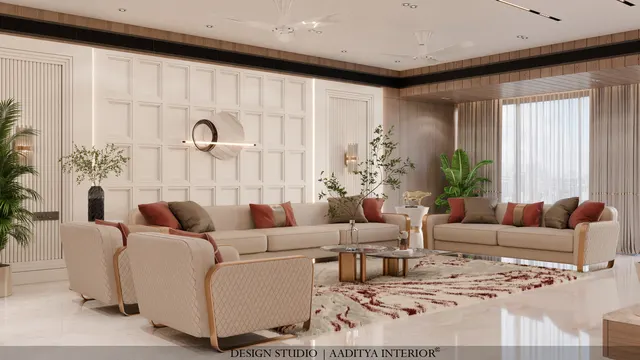
Accent chairs rarely stand alone; they complete a seating group. The guiding idea from space-planning standards is the conversation distance: people talk comfortably when their seats face each other across roughly 1800 to 2400 millimetres — close enough to hear, far enough not to crowd. A common arrangement sets a three-seat sofa with two accent chairs at right angles to it, around a coffee table, so every seat is within that distance and within reach of the table. The coffee table itself sits about 350 to 450 millimetres from the seat fronts and stands near the seat height. Planned this way, the group reads as one composition and works for both a quiet evening and a room full of guests; scattered without these distances, the same furniture feels random and nobody can reach anything.
Upholstery: judging it for Indian homes
A chair's fabric is a dimension of a different kind — of durability. Upholstery is rated for abrasion by the Martindale test (ISO 12947), where a higher rub count means a tougher cloth: roughly up to 20,000 rubs suits decorative or light domestic use, 20,000 to 40,000 suits general domestic and family use, and above 40,000 is heavy-duty or commercial. For a chair that will be used daily, a family-grade or heavy-duty fabric is sensible. Beyond abrasion, Indian conditions reward fabrics that resist fading in strong sunlight, shed dust and wipe clean; performance weaves and good-quality faux leathers do this well, while delicate silks and pale linens are better kept for low-use accent pieces. The filling matters too: high-resilience foam holds its shape, while feather or fibre needs plumping. None of this changes the chair's size, but it decides whether it still looks good in five years.
The frame under the fabric is worth a question too, because it carries the warranty on comfort. A well-made accent chair has a hardwood or engineered-wood frame with corner blocks, webbing or a sprung base, and high-resilience foam of a sensible density rather than a soft foam that flattens within a year; metal-framed and cane or rattan chairs trade some of that softness for lightness and a different look. For a chair that will be sat in daily, firmness and frame quality matter more than the depth of the padding, which is why a slightly firmer seat often outlasts and out-supports a plush one. The seat height and depth given earlier assume the chair holds its shape, so a collapsing cushion quietly ruins dimensions that were right on paper.
| Upholstery | Martindale (rubs) | Use level | Note for Indian homes |
|---|---|---|---|
| Light decorative weave / silk | Up to ~15,000 | Light / occasional | Keep for low-use accent pieces |
| General domestic weave | 20,000–25,000 | Everyday family use | Good all-round living-room choice |
| Heavy-duty / performance fabric | 40,000+ | Hard daily / commercial | Best for a chair used every day |
| Faux / genuine leather | Varies; wipeable | Family use | Easy to clean; check fading in sun |
Where seating is going
Accent chairs and ottomans are moving in two directions at once. In smaller urban homes, pieces are getting more multi-functional — storage ottomans, nesting stools, swivel chairs that turn to face either the television or the group, and lightweight chairs that move easily for guests. At the other end, the accent chair remains the room's jewellery, where a single sculptural piece or a bold fabric does the decorative work. Materials are shifting toward performance fabrics that survive daily Indian use, responsibly sourced wood and metal frames, and modular ottomans that double as seating and tables. Through all of it the dimensions hold: a comfortable seat is still 420 to 480 millimetres off the floor, and a seating group still talks best across 1800 to 2400 millimetres. Studios such as Aaditya Interior choose accent pieces to those numbers first, and to the look second.
Rules for choosing accent chairs and ottomans
- Measure seat height (420–480 mm), depth (480–560 mm) and width (450–500+ mm) before buying — not just the overall look.
- Match the chair type to the use: club or lounge for relaxing, wingback for reading, tub or slipper for tight spaces.
- Pair an ottoman at or just below the chair's seat height (380–450 mm); never leave a big gap to the legs.
- Leave 300–450 mm of leg room in front of the chair and 600–900 mm for a walkway past it.
- Place a side table near arm height (500–650 mm) within easy reach of the seat.
- Arrange seats to face across 1800–2400 mm so people can talk, with the coffee table 350–450 mm from each seat.
- Choose upholstery by Martindale rating — family-grade (20,000+) or heavy-duty (40,000+) for daily use.
- Check the chair fits under any window sill and does not block a doorway or circulation route.
Frequently asked questions
What is the standard height of an accent chair seat?
About 420 to 480 millimetres from the floor to the top of the seat cushion for an upright accent chair, which lets most adults rest their feet flat and rise easily. Relaxed lounge chairs sit lower, around 380 to 420 millimetres, which is comfortable to sink into but harder to get out of.
How big should an ottoman be for a chair?
The ottoman's height should match or sit just below the chair's seat — about 380 to 450 millimetres — so the legs extend naturally. A footstool top of roughly 450 to 600 millimetres across suits a single chair; larger cocktail ottomans of 900 by 900 millimetres or long benches work as shared footrests or table substitutes.
How much space do you need around an accent chair?
Allow about 300 to 450 millimetres in front for leg room to an ottoman or coffee table, and 600 to 900 millimetres for a walkway past the chair. A side table should sit within arm's reach at around 500 to 650 millimetres high. These clearances matter as much as the chair's own size.
How far apart should chairs and a sofa be?
Seats talk best facing each other across roughly 1800 to 2400 millimetres — close enough to hear, far enough not to crowd. The coffee table in the middle should sit about 350 to 450 millimetres from each seat front, near the seat height, so everyone can reach it.
What fabric is best for an accent chair in India?
For daily use, a family-grade fabric rated about 20,000 or more on the Martindale abrasion scale, or a heavy-duty performance weave of 40,000-plus, lasts best. Fabrics that resist fading in strong sun and wipe clean suit Indian conditions; keep delicate silks and pale linens for low-use accent pieces.
Sources & standards
- Neufert, Architects' Data — seating and anthropometric dimensions
- Time-Saver Standards for Interior Design and Space Planning — furniture and clearance dimensions
- Julius Panero and Martin Zelnik, Human Dimension and Interior Space — anthropometrics of seating
- Henry Dreyfuss Associates, The Measure of Man and Woman — human factors in design
- ISO 12947 — Martindale method for determining the abrasion resistance of textile fabrics
- National Building Code of India 2016, Part 3 — circulation space within dwellings
- Price ranges: indicative October 2026 estimates — confirm locally before budgeting