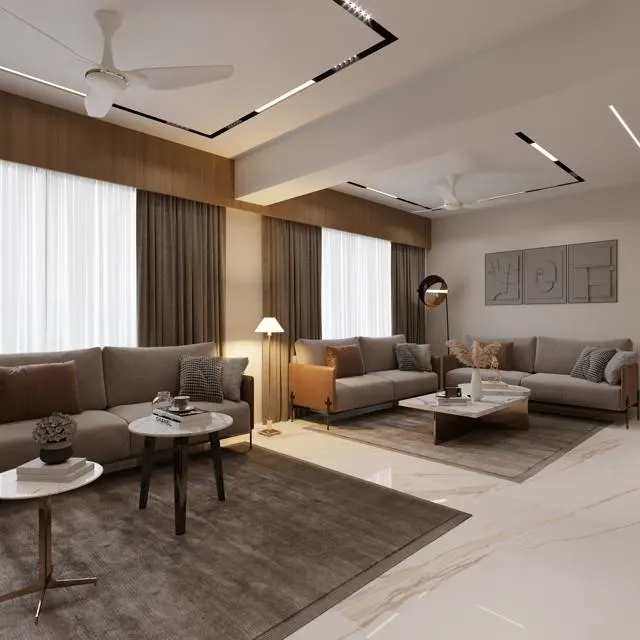
The three-seater sofa is the most bought piece of furniture in Indian homes, and also the most commonly bought in the wrong size. Families measure the wall, order a sofa that fits the wall, and only discover the problem when it arrives: the sofa is too deep for the room, the coffee table no longer fits, the walkway behind it has vanished, or the seat is so deep that shorter family members cannot sit with their feet on the floor. The sofa looked right in the showroom because showrooms are large, bright and empty; the living room is none of those things. A sofa is a dimensioned object, and its dimensions have to be checked against the room, the people who will sit on it, and the furniture around it — before the order is placed.
This article gives the numbers. It starts with the standard dimensions of a three-seater sofa — the overall width, depth and height, and the seat dimensions that decide comfort — then explains how those numbers change with style, from a compact apartment sofa to a deep lounge sofa. It then works out the room size a three-seater needs, the clearances around it, and the television distance it implies. It compares the three-seater with the two-seater, the L-shaped sofa and the sectional, so that a family can check whether the three-seater is even the right choice. And it ends with materials, prices and a buying checklist, so that the sofa that arrives is the sofa the room actually needs.
All dimensions here are in millimetres, with feet and inches where Indian shoppers usually think in them, and all prices are indicative October 2026 ranges for Indian showrooms and online retailers. The standards referenced are the familiar ones: the National Building Code of India 2016 for room sizes and clearances, Neufert's Architects' Data and the Time-Saver Standards for furniture dimensions, and the Human Dimension and Interior Space clearances that most Indian designers use in practice. Where a dimension varies by manufacturer, the article gives the range and says which end of the range suits which household.
The standard three-seater sofa, dimension by dimension
A standard three-seater sofa in India is 2000 to 2200 mm long, 900 to 1000 mm deep, and 850 to 1000 mm high. Those three numbers describe the outside of the sofa, but comfort is decided by the inside numbers: the seat height, the seat depth, the seat width per person, the arm height and the back height. The seat height — the floor to the top of the seat cushion — is 450 to 480 mm for most adults, which lets the feet rest flat on the floor with the knees at roughly a right angle. The seat depth — the front edge of the cushion to the backrest — is 550 to 600 mm, which supports the thighs without pressing behind the knees. Each person gets 600 to 700 mm of seat width, so three seats need 1800 to 2100 mm of seating width before the arms are added.
The arms add 75 to 150 mm on each side for slim track arms, and 200 to 300 mm on each side for wide rolled arms, and that is why two sofas with the same seating width can differ by up to 450 mm in overall length. A sofa with slim arms at 2000 mm overall gives nearly the same seating as a sofa with wide arms at 2200 mm — and in a narrow room, that 200 mm is often the difference between a comfortable walkway and a blocked one. The back height, measured from the floor, is typically 850 to 1000 mm; the arm height is 600 to 700 mm from the floor. A sofa deeper than 1000 mm or higher than 1000 mm is a lounge or recliner design rather than a standard three-seater, and it needs to be judged by different rules.
| Dimension | Standard range | What it decides | If it is wrong |
|---|---|---|---|
| Overall width (length) | 2000–2200 mm | How many people sit, and whether it fits the wall | Too long blocks doors; too short seats only two comfortably |
| Overall depth | 900–1000 mm | How much floor the sofa takes | Over 1000 mm eats the walkway in a 3 m room |
| Overall height | 850–1000 mm | Sightlines across the room | Over 1000 mm cuts a narrow room in two |
| Seat height | 450–480 mm | Feet flat on the floor, knees at right angles | Too high dangles feet; too low is hard to rise from |
| Seat depth | 550–600 mm | Thigh support without pressing behind knees | Too deep for shorter people; too shallow feels perched |
| Seat width per person | 600–700 mm | Elbow room for three adults | Under 600 mm per person is a two-and-a-half seater |
| Arm height | 600–700 mm from floor | Elbow rest and the sofa's visual weight | High arms enclose; low arms open the sofa up |
| Arm width | 75–150 mm slim; 200–300 mm wide | Overall length for the same seating | Wide arms can add up to 450 mm to the overall length |
How sofa dimensions change by style
Not all three-seaters are the same shape, and the style changes the dimensions more than most shoppers expect. A compact apartment sofa is 1800 to 2000 mm long and 850 to 900 mm deep, with slim arms and a seat depth of about 550 mm; it is designed for rooms 2.4 to 2.7 metres wide and for households that need the sofa to leave room for other furniture. A standard three-seater, at 2000 to 2200 mm by 900 to 1000 mm, is the middle of the range and suits most Indian living rooms. A deep lounge sofa runs 1000 to 1100 mm deep with a seat depth of 650 to 700 mm, and it is meant for lounging with cushions and throws rather than for upright sitting; it needs a room at least 3.3 metres wide and a family that is comfortable sitting cross-legged or with feet up.
Recliners change the numbers again. A three-seater recliner is typically 2000 to 2200 mm long but 950 to 1050 mm deep when closed, and it needs a further 400 to 500 mm of clear space behind it for the back to tilt, plus 500 to 600 mm in front for the footrest to extend. That means a recliner needs a room depth of at least 3.6 metres to work properly, and the wall behind it cannot hold a shelf or a picture at low level. Sofa-cum-beds are a separate case: they are usually 2000 to 2200 mm long and 900 to 1000 mm deep as a sofa, but they open into a bed about 1400 to 1500 mm wide, so they need the same clear space in front as a recliner's footrest. The lesson is to measure the sofa in its used position — reclined, extended, or opened — not in its showroom position.
| Sofa style | Overall size (mm) | Seat depth | Room width needed | Best for |
|---|---|---|---|---|
| Compact apartment three-seater | 1800–2000 × 850–900 | 550 mm | 2.4–2.7 m | Small flats, second seating, bedrooms |
| Standard three-seater | 2000–2200 × 900–1000 | 550–600 mm | 2.7–3.3 m | Most Indian living rooms |
| Deep lounge three-seater | 2000–2300 × 1000–1100 | 650–700 mm | 3.3 m or more | Lounging, large families, home theatres |
| Three-seater recliner | 2000–2200 × 950–1050 | 550–600 mm | 3.6 m or more | Elderly family members, TV rooms |
| Sofa-cum-bed, three-seater | 2000–2200 × 900–1000 | 550–600 mm | 3.3 m or more | Guest rooms, studio flats, small homes |
| L-shaped three-seater + chaise | 2400–2800 long side | 550–600 mm | 3.3 m or more | Large families, open-plan living |
| Chesterfield three-seater | 2000–2200 × 950–1050 | 550–600 mm | 3.0 m or more | Formal living rooms, classic interiors |
The room a three-seater needs
A three-seater sofa does not live alone; it lives with a coffee table, a television, a walkway and, in most Indian homes, a dining table at the far end. The room width is therefore decided by addition. Take the sofa depth of 950 mm, add a coffee-table gap of 450 mm, add a television unit 400 mm deep, and the total is 1800 mm — but that leaves no walkway at all. Add a walkway of 900 mm and the room needs to be 2700 mm wide at the absolute minimum, and 3000 mm wide to be comfortable. That is why the standard advice is that a three-seater needs a living room at least 3 metres wide, and why rooms narrower than 2.7 metres are better served by a two-seater or a compact three-seater with slim arms.
The room length matters too, because the sofa needs wall length as well as floor depth. A three-seater 2200 mm long needs a clear wall of at least 2400 mm once side tables or a floor lamp are allowed for, and 2700 mm if an armchair is to sit beside it. In a living room 6 metres long, that leaves room for a dining zone at the far end; in a room 4.5 metres long, the sofa and the dining table will compete for the same stretch, and the family must choose between a full dining table and a full sofa. The honest answer for a short room is often a two-seater sofa with two chairs, which seats the same number of people in a more flexible arrangement than a three-seater that dominates the room.
| Room width | Sofa that fits | Coffee table | Television | Verdict |
|---|---|---|---|---|
| 2.4–2.7 m | Compact three-seater 1800–2000, or two-seater | Small, 900 × 500, or none | 43-inch, wall-mounted | Tight — wall-mount the TV and skip the big table |
| 2.7–3.0 m | Standard three-seater 2000–2200 | 1000–1200 × 500–600 | 55-inch, wall-mounted (2100–2800 mm eye-to-screen) | The common case — works well with slim arms |
| 3.0–3.3 m | Standard three-seater + one chair | 1200 × 600, round or rectangular | 55–65-inch | Comfortable — room for a chair and a side table |
| 3.3–3.6 m | Three-seater + two chairs, or L-shape | 1200–1400 × 600–700 | 65-inch, wall-mounted (2500–3400 mm eye-to-screen) | Generous — the full living-room set fits |
| 3.6 m or more | Deep lounge or recliner three-seater | Large centre table | 65–75-inch | Choose the sofa for lounging, not for fitting |
The television distance deserves its own check, because the sofa position fixes it — and the distance that matters is eye-to-screen, not wall-to-wall. A 55-inch television is comfortable from about 2.1 to 2.8 metres eye-to-screen, a 65-inch from about 2.5 to 3.4 metres, and a 43-inch from about 1.6 to 2.2 metres. Seated eyes sit about 600 to 700 mm in front of the sofa back, so in a room 3 metres wide with a standard three-seater the eye-to-screen distance is about 2.35 m with a wall-mounted television — comfortable for a 55-inch screen — and about 1.95 m with a floor-standing unit 400 mm deep, which suits a 43-inch screen. A 65-inch screen needs about 2.5 m eye-to-screen, which needs a room about 3.2 m wide with a wall-mounted screen (about 3.5 m with a floor-standing unit). Wall-mounting the television gains about 300 to 400 mm of viewing distance compared with a floor-standing unit, which is often enough to move up a screen size. The television centre should sit at about 1050 to 1200 mm from the floor for a seated viewer, so that the neck stays level rather than tilted up.
Three-seater versus the alternatives
The three-seater is the default, but it is not always the best seat for the room. A two-seater, at 1500 to 1800 mm long, seats two adults comfortably and fits rooms under 2.7 metres wide where a three-seater would dominate; paired with two armchairs, it seats four in a more flexible arrangement than a three-seater with one chair, because the chairs can be moved for guests, for conversation, or for cleaning. The L-shaped sofa seats five or six in the same floor area as a three-seater plus a chair, but it needs a room at least 3.3 metres wide and it fixes the layout — an L-shape cannot be rearranged when the family wants a change. A sectional, which is an L-shape made of movable pieces, offers more flexibility but costs more and needs the same width.
The decision should start from the household, not the catalogue. A family of two, or a couple with one child, rarely needs a three-seater at all; a two-seater with two chairs seats four and leaves the room feeling larger. A joint family of five or six needs the three-seater plus chairs, or an L-shape, and should measure the room before falling in love with a deep lounge design. Elderly family members need a seat height at the top of the range — 470 to 480 mm — and firm foam, because a low, soft sofa is hard to rise from. Families with small children need washable fabric and a frame that survives climbing, and should avoid light colours on the seat cushions. The right sofa is the one that fits the people, not the one that fills the wall.
| Seating option | Overall size | Seats | Room width needed | Flexibility |
|---|---|---|---|---|
| Three-seater alone | 2000–2200 × 900–1000 | 3 | 2.7–3.0 m | Low — one fixed piece |
| Three-seater + 1 chair | 2200 + chair 700–800 | 4 | 3.0–3.3 m | Medium — the chair moves |
| Two-seater + 2 chairs | 1700 + 2 × 750 | 4 | 2.7–3.0 m | High — chairs move anywhere |
| L-shape (3-seater + chaise) | 2400–2800 long side | 5–6 | 3.3 m or more | Low — the shape is fixed |
| Sectional, modular | 2400–3000 long side | 5–6 | 3.3 m or more | High — pieces rearrange |
| Three-seater recliner | 2000–2200 × 950–1050 | 3 | 3.6 m or more | Low — needs clearance behind |
What to check before paying: frame, foam, fabric and suspension
A sofa's dimensions are visible; its construction is not, and construction is what decides whether it lasts five years or fifteen. The frame should be kiln-dried hardwood or engineered hardwood — mango wood and other soft woods are common in budget Indian sofas and can loosen at the joints within a few years. Ask whether the frame is hardwood, and whether the joints are glued and screwed rather than merely stapled. The suspension — the support under the seat cushions — should be sinuous springs or elastic webbing, not a bare plywood board, which makes the seat hard and causes the foam to break down unevenly. The foam density matters more than the foam thickness: a density of about 32 to 40 kg per cubic metre is the usual range for a seat cushion that holds its shape, and the showroom should be able to state it.
Fabric is the other decision that cannot be undone cheaply. In an Indian home with dust, cooking smells and children, a fabric with a high rub count and a stain-resistant finish is worth the premium. Removable, washable cushion covers are the single most practical feature a family sofa can have, and they should be asked for explicitly — many Indian sofas are sold with fixed covers, and reupholstering a three-seater later costs a substantial fraction of a new sofa. Leather and leatherette look premium and wipe clean, but they are hot to sit on in summer, cold in winter, and they need conditioning; fabric is cooler and more forgiving in daily use. Whatever the material, the colour should be chosen in the room's light rather than the showroom's light, and a shade darker than the first instinct is usually the right choice for a family sofa.
| What to check | Good sign | Warning sign | How to check it |
|---|---|---|---|
| Frame wood | Kiln-dried hardwood, joints glued and screwed | Soft wood, stapled joints, wobble when pushed | Lift one front corner — the other should lift too |
| Suspension | Sinuous springs or elastic webbing | Bare plywood board under the cushion | Press the seat — it should spring back evenly |
| Foam density | 32–40 kg per cubic metre for seat cushions | Seller cannot state the density | Ask for the specification in writing |
| Cushion covers | Removable and washable | Fixed covers, no zip | Look for zips; ask about washing |
| Fabric rub count | 20,000+ rubs for family use | No rub rating, very light colour | Ask for the Martindale or Wyzenbeek rating |
| Legs and feet | Solid wood or metal, firmly fixed | Plastic feet, loose legs | Tilt the sofa and check each leg |
| Warranty | 5 years on frame, 1–3 years on foam | No written warranty | Get it in writing on the bill |
How the three-seater has changed over time
The sofa itself is a relatively recent arrival in the Indian home. Traditional Indian seating was the divan, the charpai, the floor cushion and the low wooden takhat — all of them low, firm and close to the floor. The Western sofa arrived with colonial bungalows and then with the post-independence middle class, and it brought with it the upright sitting posture, the sprung seat and the idea of a living room arranged around a single large piece of furniture. Early Indian sofas were often deep and heavily upholstered, modelled on British designs, and they suited large bungalow drawing rooms far better than they suited flats.
The modern Indian three-seater is a compromise between that history and the reality of flat living. It is shallower than its British ancestor, firmer than the deep lounge sofas of American showrooms, and increasingly modular — Indian manufacturers now sell three-seaters with removable arms, reversible chaises and washable covers, all responses to small rooms and family use. The future points in the same direction: slimmer profiles, lighter frames, stain-resistant performance fabrics, and sofas designed to be moved through a 900 mm doorway and up a staircase. The dimension that has changed least is the seat height, which has stayed near 450 to 480 mm for a century because the human body has not changed. A sofa that respects the body will always be a better buy than a sofa that follows a fashion.
Prices: what a three-seater costs in India
A fabric three-seater from a mid-range Indian brand costs about ₹25,000 to ₹60,000, with budget options from about ₹15,000 and premium designer pieces from ₹60,000 to ₹1,50,000 or more. Leatherette three-seaters run about ₹40,000 to ₹90,000, and genuine leather three-seaters from about ₹80,000 to ₹2,00,000 or more, depending on the hide and the brand. Recliners add about ₹15,000 to ₹40,000 to the equivalent fixed sofa, and a sofa-cum-bed adds about ₹5,000 to ₹15,000. Delivery, installation and GST are usually extra, and the old sofa's removal may be charged separately — all of which should be confirmed in writing before payment.
| Three-seater type | Indicative price (₹) | Frame and foam | Best for |
|---|---|---|---|
| Budget fabric, online or local | ₹15,000–30,000 | Soft wood frame, basic foam | Rented homes, short-term use |
| Mid-range fabric, branded | ₹25,000–60,000 | Hardwood frame, 32–40 density foam | Most family living rooms |
| Premium fabric, designer | ₹60,000–1,50,000 | Hardwood frame, high-resilience foam | Formal living rooms, long-term homes |
| Leatherette | ₹40,000–90,000 | Hardwood frame, medium foam | Easy cleaning, modern look |
| Genuine leather | ₹80,000–2,00,000+ | Hardwood frame, premium foam | Luxury homes, cool rooms with AC |
| Three-seater recliner, fabric | ₹45,000–1,00,000 | Reinforced frame, recliner mechanism | TV rooms, elderly family members |
| Sofa-cum-bed, fabric | ₹25,000–70,000 | Hardwood frame, folding mechanism | Guest rooms, small homes |
The price should be judged against the cost per year of use. A ₹30,000 sofa that lasts four years costs ₹7,500 a year; a ₹60,000 sofa that lasts twelve years costs ₹5,000 a year and is more comfortable for most of that time. The frame and the foam decide the lifespan, not the fabric, so the money is best spent on construction first and appearance second. A good test is the showroom sit: ten minutes in the family's normal sitting posture, including getting up from the sofa, tells more about the seat height and the foam than any specification sheet. And the delivery must be measured too — a 2200 mm sofa needs a door and a staircase or a lift that can take it, and a sofa that cannot enter the flat is a familiar and expensive Indian story.
Eight rules for buying a three-seater sofa
- Measure the room width first: a three-seater needs at least 2700 mm clear, and 3000 mm to be comfortable.
- Measure the wall the sofa will stand against — allow 2400 mm for the sofa plus a side table or lamp.
- Sit-test for ten minutes in the family's normal posture, and check that feet rest flat on the floor.
- Check the seat depth against the shortest person who will use it daily — 550–600 mm suits most adults.
- Ask for the frame wood, the foam density and the suspension type in writing before paying.
- Choose removable, washable cushion covers; a fixed cover is a reupholstery bill waiting to happen.
- Measure the door, the staircase and the lift before ordering — a sofa that cannot enter the flat is useless.
- Buy the sofa for the room it will live in, not for the showroom it was displayed in.
Frequently asked questions
What is the standard size of a 3 seater sofa in India?
A standard three-seater sofa in India is 2000 to 2200 mm long (about 6 ft 7 in to 7 ft 3 in), 900 to 1000 mm deep (about 3 ft to 3 ft 3 in) and 850 to 1000 mm high. The seat height is 450 to 480 mm and the seat depth is 550 to 600 mm. Compact versions run 1800 to 2000 mm long, and deep lounge versions run 1000 to 1100 mm deep.
What room size is needed for a three-seater sofa?
A three-seater needs a living room at least 2700 mm wide — sofa depth 950 mm, plus a 450 mm gap to the coffee table, plus a 400 mm television unit, plus a 900 mm walkway. At 3000 mm wide the room is comfortable. The wall the sofa stands against should be at least 2400 mm clear, and the room should be at least 4.5 to 5 metres long if a dining table is also needed at the far end.
Is a three-seater sofa enough for a family of four?
For sitting, yes — three on the sofa and one in a chair — but a three-seater alone seats only three. A family of four is better served by a three-seater plus one armchair, or by a two-seater plus two chairs, which seats four in a more flexible arrangement. A family of five or six should consider an L-shaped sofa or a sectional.
How far should the sofa be from the TV?
The viewing distance depends on the screen, measured eye-to-screen: about 1.6–2.2 m for a 43-inch television, 2.1–2.8 m for a 55-inch, and 2.5–3.4 m for a 65-inch. In a room 3 metres wide with a standard three-seater, the eye-to-screen distance works out at about 2.35 m with a wall-mounted screen, which suits a 55-inch screen; with a floor-standing unit it drops to about 1.95 m, which suits a 43-inch screen. Wall-mounting the television gains about 300 to 400 mm of viewing distance.
What is a good seat depth for a three-seater sofa?
A seat depth of 550 to 600 mm suits most adults, supporting the thighs without pressing behind the knees. Shorter people, or families where elderly members sit daily, should stay near 550 mm; a depth of 650 to 700 mm is a lounge depth, meant for sitting with cushions or with feet up, and it needs a room at least 3.3 metres wide.
Sources & standards
- Bureau of Indian Standards — National Building Code of India 2016, Part 3 (development control and general building requirements) and Part 8 (building services, lighting and ventilation)
- Neufert, Architects' Data — seating, sofa and living-room dimensions; Time-Saver Standards for Architectural Design Data — residential furniture clearances
- Panero and Zelnik, Human Dimension and Interior Space — seating dimensions and clearances for residential interiors
- Energy Conservation Building Code (ECBC) and Eco-Niwas Samhita — daylight and ventilation guidance for Indian homes
- Price ranges: indicative October 2026 estimates — confirm locally before budgeting