The headboard is the most measured and the least measured part of an Indian bedroom. It is the most measured because every carpenter, every furniture showroom and every online listing quotes a size for it; and the least measured because the size is almost always quoted for the wrong thing — the panel alone, without the mattress, the pillows, the bed frame or the wall behind it. The result is a familiar sight in Indian homes: a headboard that is narrower than the bed it is supposed to anchor, so the pillows stick out on both sides; or a headboard so tall that it swallows the wall and makes a 2700 mm ceiling feel low; or a headboard so low that it disappears behind the pillows and might as well not be there.
The dimensions are not mysterious. They follow from three things that are already fixed: the size of the bed, the height of the mattress, and the height of the ceiling. A queen bed in India is 1524 × 1981 mm (60 × 78 inches) and a king bed is 1829 × 1981 mm (72 × 78 inches), and those two numbers decide the width of the headboard. The mattress, usually 150–250 mm thick, decides how much of the headboard shows above it. And the ceiling, usually 2700–3000 mm in an Indian flat, decides how tall the headboard can be before the room feels crowded. This article puts those three relationships into numbers, with dimensioned drawings, a comparison of materials and fixings, and the costs of getting it made in October 2026.
A headboard does more than decorate. It protects the wall behind the bed from the oils and scuffs of daily use, it gives a reader something to lean against, it hides the gap between the bed and the wall, and in a cold room it keeps the sleeper's head off a cold wall. In Indian homes it also carries a cultural job: the headboard is often the most visible piece of wood or upholstery in the bedroom, and families choose it the way they choose a sofa — as the room's statement piece. Getting its dimensions right is therefore not a detail. It is the decision that makes the bedroom look finished.
A short history of the headboard
The headboard began as a practical object. In the four-poster beds of Europe and in the heavy wooden beds of India, a tall panel at the head of the bed kept the sleeper away from a cold, damp wall and gave the bed a back to lean against. In Indian homes the traditional equivalent was the carved wooden headboard of a teak or rosewood bed — often a single plank, sometimes with a small shelf or a carving at the top — and in many homes the bed had no separate headboard at all: the bed was pushed against the wall, and the wall, often painted or tiled, served as the headboard. The headboard was part of the bed, not a separate purchase.
The modern headboard arrived with the modern bed. When Indian furniture makers began selling beds as frames with a separate mattress, the headboard became a separate component that could be chosen, upholstered or panelled independently of the bed. The hotel industry pushed the change further: hotels discovered that a tall upholstered headboard, often running the full width of the bed and sometimes the full width of the wall, made a room look luxurious for a modest cost, and guests began asking for the same at home. By the 2010s the tall upholstered headboard had become the default in Indian showrooms, and the wall panel — a padded or wooden panel that runs behind the bed and sometimes across the whole wall — had become the premium version.
That history explains the confusion over sizes. A traditional carved headboard was as wide as the bed and about 900–1200 mm high, because it was part of a wooden bed. A hotel-style upholstered headboard is often 150–300 mm wider than the bed and 1200–1500 mm high, because it is a wall feature as much as a bed part. A full wall panel can be 3000 mm wide and run to the ceiling. All three are legitimate, but they are different objects with different dimensions, and ordering one when the room needs another is the most common headboard mistake in Indian homes.
Bed sizes first: queen and king in India
Indian bed sizes follow the imperial sizes that the furniture trade has used for decades, converted to millimetres. A single bed is 914 × 1981 mm (36 × 78 inches). A double bed is 1219 × 1981 mm (48 × 78 inches). A queen bed is 1524 × 1981 mm (60 × 78 inches). A king bed is 1829 × 1981 mm (72 × 78 inches). A super king, offered by some premium brands, is 1981 × 1981 mm or 2134 × 1981 mm. The length is the same across all of them — 1981 mm, or 78 inches — because it is set by the height of the sleeper, while the width is set by how many people sleep in the bed. The headboard's width follows the bed's width, and its height is independent of the bed's length.
Two cautions belong here. First, the actual size of a bed bought in India can vary by 25–50 mm from the nominal size, because frames are made by different factories to slightly different jigs, and a mattress can be a few millimetres wider than its nominal size once it is unpacked. A headboard ordered from a drawing without measuring the actual bed can therefore arrive 25 mm too narrow. Second, the Indian "queen" sold by some brands is 1524 × 1829 mm — shorter than the standard 1981 mm — and the "king" is sometimes 1829 × 1829 mm. Always measure the bed that will stand in front of the headboard, in millimetres, before ordering, and write the measured width on the order, not the name of the size.
| Bed size (India) | Width × length | Sleeps | Headboard width to order | Room width needed |
|---|---|---|---|---|
| Single | 914 × 1981 mm (36 × 78 in) | 1 person | 914–1067 mm | 2400 mm or more |
| Double | 1219 × 1981 mm (48 × 78 in) | 2 people, tight | 1219–1372 mm | 2700 mm or more |
| Queen | 1524 × 1981 mm (60 × 78 in) | 2 people | 1524–1676 mm | 3000 mm or more |
| King | 1829 × 1981 mm (72 × 78 in) | 2 people, generous | 1829–1981 mm | 3300 mm or more |
| Super king | 1981–2134 × 1981 mm | 2 people + child | 1981–2286 mm | 3600 mm or more |
| Custom / low bed | Varies | Varies | Bed width + 0–150 mm | Measure the actual bed |
Headboard height: how much should show above the mattress
The height of a headboard is measured in two parts, and confusing them is the second most common mistake. The first part is the total height from the floor to the top of the headboard, which is what a carpenter builds and what the room sees. The second part is the visible height above the mattress, which is what the eye actually judges. A headboard that is 1200 mm high in total, standing behind a bed whose mattress top is at 600 mm, shows only 600 mm above the mattress — and behind two pillows of 150–200 mm thickness, it shows almost nothing. The number that matters for the look of the room is the visible height, and the number that matters for the order is the total height.
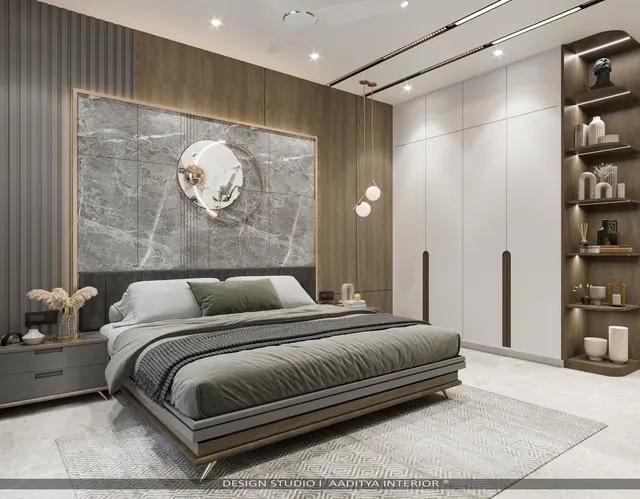
The working rule used by Indian designers is this: the top of the headboard should sit 1200–1500 mm from the floor, and 600–900 mm above the top of the mattress. Below 1200 mm total, a headboard reads as a low panel and the bed looks unfinished; above 1500 mm, it begins to dominate a room with a 2700 mm ceiling and competes with the ceiling itself. Within that band, the choice is a matter of style: a low, wide headboard of 1050–1200 mm total suits a low platform bed and a calm, minimal room; a tall headboard of 1350–1500 mm suits a hotel-style upholstered bed and a room with a high ceiling; and a full-height panel of 2400–2700 mm is a different object altogether — a wall treatment that happens to stand behind a bed.
The mattress thickness changes the arithmetic, and it is the detail most often forgotten. A thin mattress of 150 mm puts the top of the mattress at about 450–500 mm from the floor on a standard frame; a thick mattress of 250 mm puts it at 550–650 mm. The same 1350 mm headboard therefore shows 850–900 mm above a thin mattress and only 700–800 mm above a thick one. If the mattress is going to be replaced, decide the new mattress thickness before ordering the headboard, or order a headboard at the top of the band so that it still reads well after the change. Pillows add a second adjustment: a sleeping pillow is 150–200 mm thick when uncompressed and about 100–150 mm when a head rests on it, so the headboard should clear the top of the pillows by at least 300 mm to read as a headboard rather than a cushion rail.
| Headboard style | Total height from floor | Visible above mattress | Best for | Watch out for |
|---|---|---|---|---|
| Low wooden panel | 900–1050 mm | 300–450 mm | Low platform beds, minimal rooms | Disappears behind pillows |
| Standard upholstered | 1200–1350 mm | 600–750 mm | Most queen and king beds | The safe default for Indian flats |
| Tall hotel-style | 1350–1500 mm | 750–900 mm | Hotel look, high ceilings | Can crowd a 2700 mm ceiling |
| Full wall panel | 2400–2700 mm | 1800–2100 mm | Feature wall, premium bedrooms | Needs a straight wall; costly to change |
| Curved / arched top | 1200–1500 mm at centre | 600–900 mm at centre | A soft, classic look | The arch must clear the pillows at the sides too |
| Headboard with shelf | 1200–1350 mm | 600–750 mm | A phone, a book, a small lamp | The shelf must not catch a pillow |
Thickness, depth and the gap behind the bed
A headboard's thickness is a structural question disguised as a style question. A wooden headboard made from a single board is 18–25 mm thick and needs a frame behind it or legs to the floor to stand straight; a headboard made from a panel with a frame is 40–75 mm thick and can be bolted to the bed; an upholstered headboard is 75–150 mm thick because it carries a layer of foam of 50–90 mm over a board of 18 mm, plus the fabric and the backing. The thickness matters for two reasons: it decides how far the bed stands from the wall, and it decides whether the headboard feels solid when a reader leans against it. A headboard thinner than about 40 mm, if it is not fixed to the wall, will flex when leaned on; a headboard thicker than 150 mm pushes the bed so far into the room that a 3000 mm wide bedroom loses a noticeable slice of its walkway.
The gap behind the bed is the second dimension, and it is the one that causes the most daily irritation. A bed pushed hard against a headboard that is fixed to the wall leaves no gap, which is tidy, but it also means the bed cannot be pulled out to make it or to clean behind it. A gap of 25–50 mm lets the bed be moved and lets air circulate, which matters in a humid climate, but it also lets pillows fall down the back of the bed in the night. The practical answer in most Indian bedrooms is a headboard bolted to the bed frame, which moves with the bed and leaves no gap at all, or a wall-mounted headboard with the bed pushed against it and a small bolster or a long cushion filling the gap. A headboard that is fixed to the wall and a bed that stands 100 mm away from it is the worst of both worlds.
| Fixing method | How it is held | Thickness needed | Best for | Watch out for |
|---|---|---|---|---|
| Bolted to the bed frame | Two bolts through the bed's head rail | 40–75 mm | Most queen and king beds; rented flats | The bolt holes must line up with the bed frame |
| Wall-mounted on a cleat | French cleat or Z-bracket screwed to the wall | 40–100 mm | A clean look with no gap | Needs a straight, solid wall; two people to hang |
| Wall-mounted, direct screw | Screws through the panel into wall plugs | 25–75 mm | Thin wooden panels | Holes in the wall; hard to remove cleanly |
| Freestanding / leaning | Stands on the floor, held by the bed | 75–150 mm | Rented flats; tall upholstered panels | Needs a level floor; can topple if pulled |
| Full wall panel | Battens screwed to the wall, panel fixed to battens | 50–100 mm over battens | Feature walls in owned homes | The most expensive to change later |
Materials and finishes compared
The material of a headboard decides its weight, its price, how it ages and how it feels to lean against. Solid wood — teak, rosewood or engineered alternatives such as rubberwood with a veneer — is the most durable and the most expensive, and it suits a classic bedroom where the headboard is expected to last twenty years. Plywood with a laminate or veneer finish is the workhorse of Indian bedrooms: a 18 mm BWR plywood panel with a laminate face costs a fraction of solid wood, it does not warp in humidity the way a single solid plank can, and it can be cut to any shape, including an arch. MDF with a PU or duco paint finish gives the smoothest coloured surface and the sharpest modern look, but it must stay dry and it chips if it is knocked.
Upholstery is the other family, and it has become the default for a reason: a foam layer of 50–90 mm over a board, covered in fabric, leatherette or genuine leather, is comfortable to lean against for an hour of reading, and it softens the look of a bedroom in a way that wood cannot. Fabric is the most comfortable and the easiest to change — a loose cover can be removed and washed — but it marks and absorbs dust, which matters in a dusty Indian city. Leatherette wipes clean and looks smart for a few years, then cracks at the fold lines if it is a cheap grade. Genuine leather is the most durable and the most expensive, and it needs conditioning. The choice is therefore a trade between comfort, maintenance and budget, and the table below puts the numbers side by side.
| Material | Typical thickness | Indicative cost for a queen headboard | Feel to lean on | Maintenance |
|---|---|---|---|---|
| Solid wood (teak / rosewood) | 25–40 mm | ₹25,000–80,000 | Hard, cool, durable | Polish once a year; lasts decades |
| BWR plywood + laminate | 18–25 mm panel | ₹8,000–20,000 | Hard, smooth | Wipe clean; resists humidity |
| BWR plywood + veneer | 18–25 mm panel | ₹12,000–30,000 | Hard, warm grain | Polish occasionally; keep dry |
| MDF + PU / duco paint | 18–25 mm panel | ₹10,000–25,000 | Hard, very smooth | Chips if knocked; touch up paint |
| Upholstered, fabric | 75–120 mm | ₹15,000–45,000 | Soft, warm, comfortable | Vacuum weekly; stains need care |
| Upholstered, leatherette | 75–120 mm | ₹12,000–35,000 | Soft, smooth | Wipe clean; cracks in 3–5 years if cheap |
| Upholstered, genuine leather | 75–120 mm | ₹40,000–1,00,000+ | Soft, cool, premium | Condition twice a year |
| Metal (MS / brass frame) | 25–50 mm frame | ₹10,000–30,000 | Hard, cool, light look | Polish metal; check welds |
What it costs, and where the money goes
The cost of a headboard in India spans a wide band, and the band is decided less by the size than by the material and the finish. A simple plywood panel with laminate, made by a local carpenter for a queen bed, costs about ₹8,000–20,000 including fitting. An upholstered headboard in fabric from a mid-range brand costs about ₹15,000–45,000. A solid teak headboard costs about ₹25,000–80,000, and a full wall panel with padding, lighting and a shelf can cost ₹50,000–1,50,000 or more. The fitting is a small part of the cost — usually ₹1,000–3,000 for a wall-mounted headboard — unless the wall needs a batten or the panel is very heavy, in which case a second person and a stronger fixing add to the bill.
The cheapest headboard that still looks right is a leaning panel, which needs no fixing at all: a plywood panel with laminate or fabric, 1524 mm wide and 1200 mm high, made by a local carpenter, costs about ₹6,000–15,000 and can be carried into a rented flat by two people. The most expensive mistake is to order a headboard without measuring the bed, and then to pay a carpenter to alter it — an alteration costs almost as much as a new panel, because the fabric or the laminate has to be stripped and remade. Measure twice, order once, and the headboard is one of the cheapest transformations in a bedroom.
| Headboard option (queen, 1524 mm) | Indicative cost | What is included | Lead time |
|---|---|---|---|
| Plywood + laminate panel, local carpenter | ₹8,000–20,000 | Panel, edge banding, fitting | 3–5 days |
| MDF + PU painted panel | ₹10,000–25,000 | Panel, paint, fitting | 5–7 days |
| Upholstered fabric, mid-range brand | ₹15,000–45,000 | Board, foam, fabric, fitting | 7–14 days |
| Upholstered leatherette | ₹12,000–35,000 | Board, foam, leatherette, fitting | 7–14 days |
| Solid wood (teak / veneer) | ₹25,000–80,000 | Panel, polish, fitting | 10–21 days |
| Full wall panel with cove light | ₹50,000–1,50,000+ | Panel, battens, light, fitting | 2–4 weeks |
| Leaning panel, no fixing (rented flat) | ₹6,000–15,000 | Panel only | 3–5 days |
Where headboards are heading
Three changes are visible in Indian bedrooms. First, the headboard is becoming a wall rather than a board: full-height panels with integrated reading lights, a small shelf and a USB charging point are appearing in premium flats, and the headboard is increasingly designed together with the false ceiling and the bedside lighting rather than bought separately. Second, the materials are changing: washable performance fabrics that resist stains, recycled foam and engineered wood are replacing the cheapest foam and the cheapest MDF, because a headboard that is leaned against every night needs to survive daily use. Third, the rented flat is influencing the owned flat: freestanding and bolted-to-the-bed headboards, which need no wall fixing, are being chosen even by owners, because they can be moved when the room is repainted or the bed is replaced.
None of this changes the dimensions. A queen bed will still be 1524 mm wide, a king bed 1829 mm, and the top of the headboard will still sit best at 1200–1500 mm from the floor. What changes is the expectation: a headboard is now expected to carry a light, a charger and a shelf, and to be removable without damage. The designers who get the dimensions right and add those small functions are the ones whose bedrooms feel finished, whether the bed cost ₹15,000 or ₹1,50,000.
- Measure the actual bed in millimetres before ordering — never order from the size name alone.
- Order the headboard 0–150 mm wider than the bed; never narrower than the bed.
- Keep the top of the headboard at 1200–1500 mm from the floor, and 600–900 mm above the mattress.
- Decide the mattress thickness before ordering the headboard, not after.
- Use high-density foam (32 kg/m³ or more) in an upholstered headboard, or it flattens within a year.
- Bolt the headboard to the bed frame where possible — it moves with the bed and leaves no gap.
- Check the wall is straight before ordering a wall-mounted panel; a bowed wall shows at the edges.
- Keep at least 300 mm of headboard visible above the pillows, or it reads as a cushion rail.
Frequently asked questions
Should a headboard be wider than the bed?
Yes, slightly: 0–150 mm wider than the bed is the right band. A headboard exactly the width of the bed looks correct and tidy. A headboard 75–150 mm wider on each side gives the bed a framed, hotel-like look and leaves room for a bedside lamp to overlap the edge. A headboard narrower than the bed is the one mistake to avoid, because the pillows overhang on both sides and the bed looks wider than its own headboard.
How high should a headboard be for a king bed?
The same as for a queen bed: 1200–1500 mm from the floor, with 600–900 mm visible above the mattress. The height does not change with the width of the bed, because it is set by the mattress, the pillows and the ceiling, not by the bed's width. A king bed with a tall headboard of 1500 mm looks balanced; a king bed with a low headboard of 900 mm looks unfinished, because the wide bed needs a tall anchor behind it.
Can a headboard be fixed without drilling the wall?
Yes. Bolt it to the bed frame, which is the best answer and needs no wall fixing at all, or use a freestanding leaning panel that stands on the floor and is held in place by the bed. Both work in rented flats and both move with the bed. A wall-mounted headboard on a French cleat is the third option, but it needs screws in the wall and the landlord's permission.
What is the best headboard material for Indian homes?
BWR plywood with laminate is the most practical for most homes: it resists humidity, wipes clean and costs ₹8,000–20,000 for a queen size. Upholstered fabric is the most comfortable for readers and the best-looking in a hotel-style bedroom, at ₹15,000–45,000. Solid wood is the most durable and the most expensive, at ₹25,000–80,000, and suits a bedroom that will not be changed for many years.
Does a headboard need to match the bedside tables?
It should relate to them, not match them exactly. A good rule is to keep the headboard and the bedside tables in the same family of material or colour — wood with wood, or a fabric headboard with wooden tables in a tone that repeats in the bed frame. The tables should be lower than the top of the mattress by about 50–100 mm, so a lamp on the table lights the bed without shining in the sleeper's eyes.
How thick should an upholstered headboard be?
75–120 mm in total: an 18 mm board, 50–90 mm of high-density foam and the fabric. Thinner than 75 mm it feels hard and looks flat; thicker than 150 mm it pushes the bed too far into the room. Use foam of 32 kg/m³ density or more for the front layer, because soft foam flattens within a year where heads rest every night.
Sources & standards
- National Building Code of India 2016, Part 3 — Development Control Rules and General Building Requirements (room heights and minimum sizes)
- Bureau of Indian Standards — IS 303 (plywood for general purposes), IS 12406 (medium density fibreboard), IS 14587 (prelaminated medium density fibreboard)
- Bureau of Indian Standards — IS 17635:2022 (beds, under the Furniture (Quality Control) Order, 2025)
- Neufert, Architects' Data — bed sizes, bedroom clearances and headboard heights
- Time-Saver Standards for Interior Design and Space Planning — bedroom planning and furniture dimensions
- Price ranges: indicative October 2026 estimates — confirm locally before budgeting