Art Deco is often treated in India as an imported, glamorous add-on — a bit of brass, a fluted panel, a fan-shaped mirror — borrowed from films and foreign hotels. In fact it is one of the country's own great modern styles. Mumbai holds one of the largest collections of Art Deco buildings anywhere in the world, and the city's Victorian Gothic and Art Deco ensembles were inscribed as a UNESCO World Heritage Site in 2018. The curved balconies of Marine Drive, the sunburst grilles of the Oval Maidan apartments, the streamlined cinemas with their vertical name-towers — this is Indian Art Deco, built by Indian patrons and architects in the 1930s and 1940s, and it is the natural reference for any revival at home.
The reason the revival so often goes wrong is that Art Deco is a grammar, not a kit of parts. It has rules about geometry, symmetry, repetition and contrast, and a tight vocabulary of motifs — the stepped ziggurat, the sunburst or rising sun, fluting and reeding, the chevron, the streamlined curve. When those are understood, a single stepped cornice or one fluted bar unit can make a whole room read as Deco. When they are not, the look collapses into a jumble of gold and mirror that feels like a themed restaurant. The style is also, at heart, disciplined: strong geometry, luxurious materials used sparingly, and a palette of a few deep colours lifted by black, white and metal.
This guide tells the Bombay Deco story briefly, sets out the motif grammar and the materials — terrazzo, brass, fluting, lacquer, veneer and glass — and then shows how to use them room by room without overdoing it. It gives dimensions for the signature details, a disciplined palette, and indicative October 2026 costs, so Art Deco can be revived as a considered style rather than a coat of glamour.
Where Art Deco came from, and the Bombay Deco story
Art Deco takes its name from the 1925 Exposition Internationale des Arts Décoratifs et Industriels Modernes in Paris, the show that gave the world a new decorative language: geometric, streamlined, machine-age, confident and modern, in deliberate contrast to the curling naturalism of Art Nouveau before it. Through the late 1920s and 1930s it spread across the world as the style of the modern age — of cinemas, ocean liners, skyscrapers and smart apartments. It arrived in India at a moment of great building energy, and nowhere embraced it more than Bombay.
From the early 1930s, a prosperous and aspirational Bombay built block after block of Art Deco apartments, cinemas and offices — along Marine Drive and the Backbay reclamation, around the Oval Maidan facing the older Gothic buildings, and across the suburbs. These buildings mixed the international Deco vocabulary with local touches: Indian motifs, tropical features like deep balconies and sun-breakers, and a sub-style, sometimes called Deco-Saracenic or tropical Deco, that married streamlined forms to the Indian climate and sensibility. The cinemas — with their bold vertical signage towers, curved frontages and glamorous terrazzo-and-chrome foyers — were the most public face of the style. This is the body of work that UNESCO recognised in 2018, and it is why Art Deco in India is a heritage to draw on, not merely a foreign fashion.
After independence the style fell out of fashion, dismissed as dated and ornamental in the decades of modernist concrete that followed. It survived quietly in thousands of flats and foyers, its terrazzo floors and sunburst grilles worn but intact. The listing of Mumbai's ensembles in 2018, together with a global revival of interest in Deco glamour, has brought it firmly back — and for Indian homeowners it carries the rare appeal of a style that is both internationally chic and genuinely local.
The motif grammar: five shapes that make it Deco
Art Deco is built from a small, recognisable set of geometric moves, and a room becomes Deco by using one or two of them with conviction rather than all of them at once. The stepped or ziggurat form — shapes that rise in symmetrical steps, like a stylised skyline — appears in cornices, headboards, mirror tops and cabinet silhouettes. The sunburst or rising-sun motif radiates lines from a point or a semicircle, and is the single most emblematic Deco device, used in grilles, mirrors, inlay and glass. Fluting and reeding — rows of parallel concave or convex half-rounds — give the vertical rhythm seen on bar fronts, panelling and columns. The chevron and the zigzag bring sharp, repeated diagonals to floors, rugs and inlay. And the streamline curve — the smooth rounded corner, often with parallel speed lines — is the signature of the later Streamline Moderne, seen in Bombay's curved balconies and furniture.
| Motif | What it is | Where to use it | Keep it from kitsch by |
|---|---|---|---|
| Stepped / ziggurat | Symmetrical stepped profile | Cornices, headboards, mirror and cabinet tops | Using it once as a strong silhouette, not everywhere |
| Sunburst / rising sun | Rays from a point or semicircle | A mirror, a grille, an inlay medallion | Making it the single hero of the room |
| Fluting / reeding | Rows of parallel half-rounds | Bar fronts, panelling, vanity and TV units | Keeping the reed size consistent across the room |
| Chevron / zigzag | Repeated sharp diagonals | Floors, rugs, inlay bands | One scale and two colours, not a riot |
| Streamline curve | Rounded corner, speed lines | Sofa arms, counters, balcony lines | Pairing soft curves with crisp straight contrast |
The materials that carry Art Deco
Deco is a material style as much as a geometric one, and the materials are specific. Terrazzo — marble chips set in cement and ground smooth — is the quintessential Deco floor, used across Bombay's foyers and flats in bold two-tone patterns with brass dividing strips; it is cool, hard-wearing and unmistakably period. Brass and chrome supply the metal: thin brass inlay lines in floors and furniture, brass handles and trims, chrome on earlier pieces. Fluted and reeded wood, usually MDF or veneered board worked into parallel reeds and lacquered or veneered, gives the vertical rhythm. Rich veneers — walnut, rosewood, burl — and high-gloss lacquer give the glamour. And glass is everywhere: tinted and antiqued mirror, etched and frosted glass, and bevelled edges that catch the light. The craft is to use these richly but sparingly, letting one luxurious surface carry a room against calmer backgrounds.
Colour: the disciplined jewel palette
Art Deco colour is bold but controlled. It works on a base of a few deep, saturated jewel tones — emerald green, sapphire or petrol blue, oxblood or burgundy, mustard and ochre — anchored by black and white and lifted by the warm glint of brass and gold. The discipline is in restraint: one or two jewel colours per room, large areas kept calm (often in a soft neutral, deep green or black), and the richness delivered in a few places — a lacquered cabinet, a velvet sofa, a terrazzo floor — rather than smeared across every surface. Metallic is an accent, not a field: a room that is gold everywhere reads cheap, while a calm room with one gold-lined mirror reads expensive. High contrast — black against white, brass against deep green — is more Deco than any amount of glitter.
| Palette role | Colours | Where | Caution |
|---|---|---|---|
| Deep base | Emerald, petrol blue, oxblood, black | One feature wall, cabinetry, upholstery | One or two per room, not all at once |
| Neutral ground | Cream, taupe, soft grey, off-white | Large walls, ceilings, backgrounds | Keeps the jewel tones from overwhelming |
| Contrast | Black and white | Floors, trims, graphic bands | The crisp contrast is essential to Deco |
| Metal accent | Brass, gold, a little chrome | Inlay, handles, mirror frames, lighting | Accent only; gold everywhere looks cheap |
Texture does as much work as colour in a Deco room, and pairing it well is what separates a rich scheme from a flat one. The style thrives on contrast between hard and soft, matt and gloss, cool and warm: a high-gloss lacquered cabinet against a matt plaster wall, cool terrazzo underfoot against a deep velvet sofa, crisp brass lines against warm walnut veneer. A useful discipline is to let each surface be clearly one thing — a floor that is unmistakably terrazzo, a wall that is plainly painted, a cabinet that is confidently lacquered — rather than blending many half-finishes. The 1930s interiors read as confident precisely because their materials are stated plainly and set against one another, not muddled together. Choosing fewer materials, each used with conviction, almost always produces a more convincing Deco room than a wide, timid mixture.
How to use Art Deco room by room
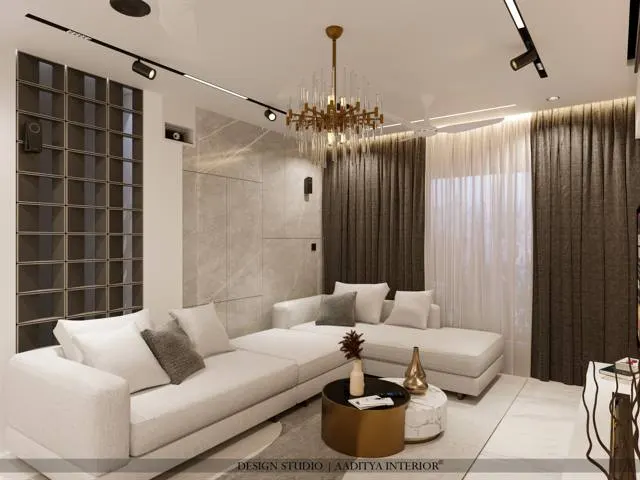
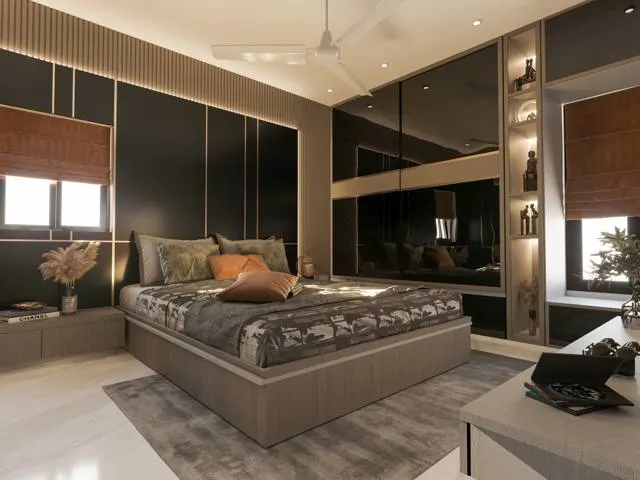
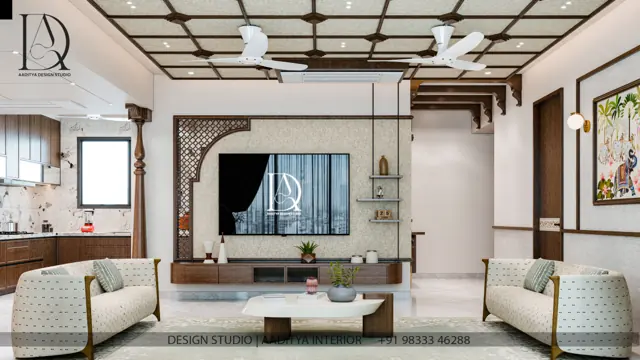
In a living room, a single stepped or sunburst mirror over a console, a fluted and lacquered media unit, a terrazzo or terrazzo-look floor and one jewel-toned velvet sofa will establish the style without excess. A bar or crockery unit is the natural Deco showpiece: a stepped silhouette, fluted and lacquered or veneered doors, brass handles and an antiqued-mirror back, lit from within. In a bedroom, a stepped or fan-shaped headboard, a pair of symmetrical bedside lamps and a mirrored or lacquered dresser carry the look. Bathrooms take terrazzo or marble with a brass-framed mirror and black-and-white geometry. Lighting is a key Deco tool — frosted glass shades, stepped and tiered fittings, uplighters and the warm glow of concealed light on a reflective surface — and symmetry runs through all of it: Deco loves pairs and mirror-image arrangements.
| Room | The one Deco move | Materials to reach for | What to keep calm |
|---|---|---|---|
| Living room | Sunburst mirror or fluted media wall | Terrazzo floor, velvet, brass, veneer | Walls and ceiling in a quiet neutral |
| Dining / bar | Stepped, fluted bar or crockery unit | Lacquer, antiqued mirror, brass handles | Keep surrounding joinery plain |
| Bedroom | Stepped or fan-shaped headboard | Lacquered dresser, paired lamps, mirror | Soft neutral bedding and walls |
| Bathroom | Black-and-white geometry, brass mirror | Terrazzo or marble, brass fittings | One pattern scale, not several |
| Entrance / foyer | Terrazzo floor with brass inlay | Terrazzo, a stepped console, one mirror | Let the floor be the hero |
The thread through every room is the same: concentrate the glamour. A Deco room is not glamorous because everything in it is shiny; it is glamorous because one or two carefully made things — a terrazzo floor, a lacquered unit, a sunburst mirror — are given room to be seen against calm surroundings. This is also how the style stays affordable. The money goes into a single hero piece and an authentic floor, while the walls, ceiling and background joinery stay simple and inexpensive, which is exactly how Bombay's flats achieved so much effect with such disciplined means.
| Finish | Deco use | Indicative cost | Notes |
|---|---|---|---|
| In-situ terrazzo floor | Signature Deco floor with brass inlay | ₹150–350 per sq ft | Cast and polished on site; brass strips extra |
| Terrazzo tiles (precast) | Easier terrazzo look | ₹90–200 per sq ft | Laid like tile; less craft risk |
| Brass inlay strip | Lines in floors and furniture | ₹120–400 per running ft | Installed; width and gauge vary |
| Fluted / reeded panels | Vertical rhythm on units and walls | ₹350–900 per sq ft | MDF or veneered, lacquered or veneer-finished |
| Lacquer / PU finish | High-gloss Deco glamour | ₹1,000–1,800 per sq ft | Multi-coat spray; seamless, shows every fault |
| Veneer finish | Walnut, rosewood, burl faces | ₹600–1,100 per sq ft | Richer, warmer alternative to lacquer |
| Antiqued / tinted mirror | Backs, panels, sunburst mirrors | ₹150–450 per sq ft | Ages the glass for a period look |
Where the Deco revival is going
The current revival is pulling Art Deco in a calmer, more architectural direction. Rather than the full jazz-age treatment, designers are borrowing single moves — a fluted feature wall, a stepped cornice, a terrazzo floor, a sunburst mirror, a brass-lined cabinet — and setting them in otherwise contemporary, restrained interiors. Terrazzo in particular has become mainstream again, now available as large porcelain tiles and in soft modern colourways as well as the bold period two-tones. Fluting has spread far beyond Deco into general contemporary joinery. The heritage dimension is strong too: as Mumbai's Deco is celebrated and restored, Indian homeowners increasingly want a nod to it as a point of local pride. The style's future is less about recreating a 1930s cinema foyer and more about weaving its confident geometry and fine materials into modern Indian homes — which is exactly how the best revivals work.
Rules for an Art Deco revival
- Learn the grammar first: use one or two motifs — stepped, sunburst, fluting, chevron or streamline — with conviction, not all at once.
- Pick one hero per room (a bar unit, a mirror, a floor) and keep the rest calm; Deco is bold geometry against quiet ground.
- Keep the palette disciplined: one or two jewel tones, anchored by black and white, with brass as an accent only.
- Treat metal as a highlight, never a field — one gold-lined mirror reads richer than a gold-covered wall.
- Use terrazzo (in-situ with brass strips, or precast tiles) for an authentic, hard-wearing Deco floor.
- Keep fluting and reeding consistent in size across a room so the vertical rhythm reads as deliberate.
- Work in symmetry and pairs — matched lamps, mirror-image arrangements — which are central to the style.
- Use lighting as a Deco element: frosted glass shades, stepped fittings and concealed light on reflective surfaces.
- Reference the local heritage — Bombay Deco's curves and sunbursts — rather than copying a foreign hotel wholesale.
- Resist over-theming: if it starts to feel like a restaurant set, remove something until the geometry breathes again.
Frequently asked questions
Is Art Deco an Indian style?
It began internationally — named after the 1925 Paris exposition — but India, and Mumbai above all, made it its own. From the 1930s the city built one of the world's largest collections of Art Deco apartments, cinemas and offices, mixing the global vocabulary with Indian motifs and tropical features. Mumbai's Victorian Gothic and Art Deco ensembles became a UNESCO World Heritage Site in 2018, so Deco is genuinely part of Indian heritage.
How do I add Art Deco without it looking tacky?
By restraint. Choose one or two motifs and one hero piece per room, keep large areas calm and use strong black-and-white contrast, and treat brass and gold as accents rather than covering surfaces in metal. The 1930s originals are disciplined, not gaudy; tackiness comes from piling every Deco cliche into one room. Subtract until the geometry and the few rich materials can be seen clearly.
What flooring is best for an Art Deco look?
Terrazzo is the authentic Deco floor — marble chips in cement, ground and polished, often in two tones with brass dividing strips, exactly as in Bombay's period foyers. It can be cast in-situ for the richest effect or laid as precast terrazzo or large porcelain tiles for less cost and risk. Black-and-white geometric marble or tile patterns are a strong alternative.
What colours define Art Deco interiors?
Deep jewel tones — emerald green, sapphire or petrol blue, oxblood, mustard — anchored by black and white and lifted by brass or gold. The key is discipline: one or two jewel colours per room against calm neutral grounds, with metal as an accent. High contrast between black and white and between brass and a deep colour is more essential to the style than any amount of glitter.
Is fluting the same as Art Deco?
Fluting and reeding are classic Deco devices, but they are now used widely in contemporary interiors too, so fluting alone does not make a room Deco. To read as Art Deco, fluting needs the company of the wider grammar — stepped forms, symmetry, a jewel palette, brass and fine materials. On its own it is simply a popular modern texture.
Sources & standards
- UNESCO World Heritage Centre — Victorian Gothic and Art Deco Ensembles of Mumbai (inscribed 2018), official description
- Art Deco Mumbai Trust — documentation of the city's Art Deco buildings and features
- Victoria and Albert Museum — Art Deco collection and the 1925 Paris Exposition des Arts Decoratifs
- Bureau of Indian Standards — IS 2114 (laying in-situ terrazzo / cement concrete flooring) and IS 1443 (terrazzo tiles)
- National Building Code of India 2016, Part 3 — general building and finishing provisions
- Neufert, Architects' Data — furniture, bar and cabinet dimensions and lighting guidance
- Price ranges: indicative October 2026 estimates — confirm locally before budgeting