Most people feel better in a room with a view of trees, a breeze through the window, sunlight moving across the floor and a wooden table under their hands than in a sealed room of glossy laminate, cold white light and recycled air. The feeling is so common that it is easy to dismiss as a matter of taste. Biophilic design takes it seriously: it is the practice of designing buildings and interiors so that people stay connected to nature, directly and indirectly, through the senses. It has become one of the most discussed ideas in interior design worldwide, and in Indian cities, where many families live in flats with little access to green space, it answers a real need.
In India, biophilic design is also a homecoming. Traditional Indian houses were full of nature — the tulsi in the courtyard, the neem tree by the gate, jaalis that scattered light, verandahs that caught breeze, stone floors cool underfoot, water in stepwells and temple tanks. The modern flat lost much of this. The common mistake today is to try to buy it back in a single product — a preserved moss wall, a vertical garden behind the sofa, a row of plastic plants — rather than designing it into the room. This article explains what biophilic design actually is, the patterns that define it, and how to apply them in Indian homes and workplaces with plants chosen for the light available, green walls that survive, natural materials, daylight, air and water, with dimensions and indicative costs.
Where the idea came from
The word biophilia — love of living things — was used by the psychologist Erich Fromm and popularised by the biologist Edward O. Wilson in his 1984 book Biophilia, which proposed that humans have an inborn tendency to seek connections with nature and other forms of life. Architects and researchers then asked what this meant for buildings. The social ecologist Stephen Kellert, with colleagues, set out principles of biophilic design in the 2008 book Biophilic Design: The Theory, Science and Practice of Bringing Buildings to Life, and in 2014 the consultancy Terrapin Bright Green published 14 Patterns of Biophilic Design, a framework that has become a common reference for designers and for building standards such as the WELL Building Standard.
The evidence base is real but should be stated carefully. One of the best-known studies, by Roger Ulrich and published in the journal Science in 1984, found that hospital patients recovering from surgery whose windows looked out on trees had shorter post-operative stays and needed fewer strong painkillers than similar patients whose windows faced a brick wall. Many later studies have linked views of nature, daylight and natural materials with lower stress and better wellbeing, though results vary and effects depend on context. Claims that a few indoor plants will purify the air of a whole flat are a different matter: the widely quoted NASA study of 1989 tested plants in small sealed chambers, and a 2019 review by researchers at Drexel University concluded that, in real buildings, the number of plants needed to match ordinary ventilation would be impractically large. Plants are good for people for many reasons, but they do not replace opening a window or a ventilation system.
Indian building traditions embody biophilic design without the name. The aangan brought sky, sun, rain and a tulsi plant into the centre of the house. Jaalis turned harsh sun into a dappled, moving pattern. Verandahs and chhajjas framed views of gardens and streets from a shaded edge. Stepwells and palace water channels used water to cool and to calm. Kerala's houses used timber, laterite and clay; Rajasthan's used lime plaster and stone. The modern task is not to import a foreign style but to recover these connections in flats and offices that have lost them.
The 14 patterns, in Indian home terms
The Terrapin Bright Green framework groups biophilic design into three categories. Nature in the space is the direct presence of nature: plants, water, animals, breeze, sounds, scents and daylight. Natural analogues are indirect references: natural materials, colours, patterns and forms that echo nature. Nature of the space is about spatial experience: the feelings of outlook, shelter, mystery and slight thrill that people respond to in natural landscapes. The table below lists all fourteen patterns with examples of how each can appear in an Indian home.
| Category | Pattern | What it means | Indian home example |
|---|---|---|---|
| Nature in the space | 1 · Visual connection with nature | Views of plants, sky, water | Sofa and dining placed to see a balcony garden or a tree outside |
| Nature in the space | 2 · Non-visual connection | Sound, scent, touch of nature | Mogra or tulsi on the balcony, a wind chime, a stone floor underfoot |
| Nature in the space | 3 · Non-rhythmic sensory stimuli | Unpredictable natural movement | Leaves moving in breeze, curtains lifting, birds at a feeder |
| Nature in the space | 4 · Thermal and airflow variability | Changing breeze and temperature | Cross-ventilation, a shaded balcony, a jaali catching wind |
| Nature in the space | 5 · Presence of water | Seeing, hearing or touching water | A small recirculating fountain or an urli with floating flowers |
| Nature in the space | 6 · Dynamic and diffuse light | Light that changes through the day | Jaali shadows, sheer curtains, tunable lighting |
| Nature in the space | 7 · Connection with natural systems | Seasons, rain, life cycles | A deciduous tree outside the window, monsoon views, seasonal flowers |
| Natural analogues | 8 · Biomorphic forms and patterns | Shapes that echo nature | Leaf motifs in jaali, curved furniture, organic rugs |
| Natural analogues | 9 · Material connection with nature | Natural, minimally processed materials | Teak, cane, jute, kota stone, lime plaster, terracotta |
| Natural analogues | 10 · Complexity and order | Rich detail with an underlying structure | Traditional block prints, fractal jaali geometry, layered planting |
| Nature of the space | 11 · Prospect | A long, open view | A window seat or desk facing out over the city or a garden |
| Nature of the space | 12 · Refuge | A sheltered place to withdraw | An alcove, a reading nook, a canopy bed, a low-ceilinged corner |
| Nature of the space | 13 · Mystery | Partly hidden views that invite exploring | A curved passage, a screen that half reveals a court |
| Nature of the space | 14 · Risk or peril | A safe thrill | A glass-floored mezzanine edge or a cantilevered balcony — designed with full safety |
No single room needs all fourteen. A good biophilic interior uses several patterns together, so that the room feels connected to nature in more than one way. A living room might combine a view of a balcony garden, daylight filtered through sheers, a breeze path, a teak and cane palette, a jaali screen, a window seat and a few well-placed plants — and feel more natural than a room with a large green wall and none of the rest.
Plants: start with the light, not the plant
The most common biophilic failure in Indian flats is a dead plant. Plants die indoors mainly because they get too little light, too much water or both. Light falls off very quickly with distance from a window: a spot within about a metre of a bright window may receive a few thousand lux of daylight, while the middle of the room may receive only a few hundred and an inner corner far less. Plants that need bright light will decline steadily in the middle of a room, however well they are watered. The rule is to map the light first and choose plants for each zone, rather than choose plants first and hope.
| Plant (common name) | Light it needs | Watering in Indian homes | Notes |
|---|---|---|---|
| Snake plant (Sansevieria / Dracaena trifasciata) | Low to bright indirect | Sparingly; let soil dry out | Very tolerant; good for zone C and bedrooms |
| ZZ plant (Zamioculcas) | Low to medium | Sparingly; dislikes wet roots | Glossy and tough; good in offices |
| Money plant (pothos, Epipremnum) | Low to medium | When top soil is dry | Trails or climbs; very forgiving |
| Peace lily (Spathiphyllum) | Medium, no direct sun | Keep lightly moist | Droops when thirsty, recovers quickly |
| Syngonium and Aglaonema | Medium | When top soil is dry | Colourful foliage; good for zone B |
| Monstera deliciosa | Medium to bright indirect | When top 50 mm is dry | Grows large; needs a moss pole and space |
| Areca palm (Dypsis lutescens) | Bright indirect | Regularly; dislikes drying out completely | Good near windows; watch for spider mites in dry AC rooms |
| Rubber plant (Ficus elastica) | Bright indirect | When top soil is dry | Tolerant; wipe large leaves |
| Tulsi, herbs, crotons, bougainvillea | Bright light or some direct sun | Regularly in summer | Balcony or sunniest window only |
Two warnings belong with any plant list. First, several common houseplants, including pothos, peace lily, ZZ plant, snake plant and dieffenbachia, are toxic to cats and dogs if chewed; families with pets or toddlers should check each plant's toxicity before buying, and keep risky ones out of reach. Second, overwatering kills more indoor plants in India than underwatering, especially in the monsoon and in air-conditioned rooms where evaporation is slow. Pots must have drainage holes and saucers; self-watering pots help families who travel. This site's guide to bohemian interiors uses an indicative ₹300–4,000 per plant with its pot, depending on size and pot material, and the same range applies here.
Green walls, moss walls and built-in planters
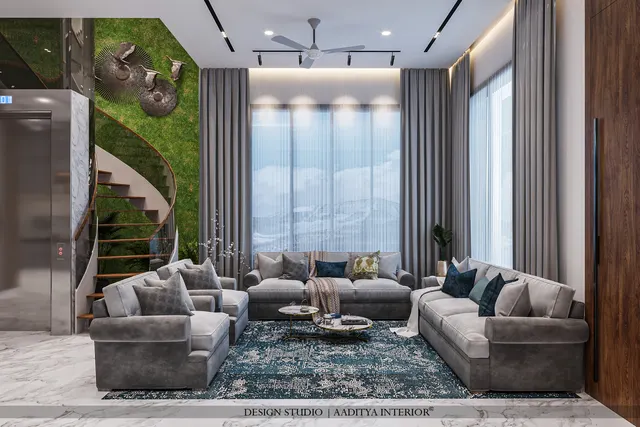
A living green wall can be spectacular, but it is a small piece of engineering, not a decoration. It needs a waterproof backing so the wall behind stays dry, a structural frame fixed to masonry or RCC, an irrigation system — usually a drip line on a timer — a drain or tray at the base, enough light (almost always supplementary grow lights indoors) and regular maintenance. When saturated, a living wall can weigh several tens of kilograms per square metre, so the fixing must be designed for it. A preserved moss wall, by contrast, uses real moss that has been treated so that it no longer grows: it needs no water or light, weighs little and costs less to maintain, but it is not alive and should not be sprayed or placed in damp areas.
| Option | Alive? | Needs | Maintenance | Indicative cost (October 2026) |
|---|---|---|---|---|
| Potted plants grouped on stands | Yes | Light by zone, saucers | Watering weekly; repotting yearly | ≈ ₹300–4,000 per plant with pot |
| Built-in planter box with drainage | Yes | Waterproofing, drain outlet, light | Watering, feeding, pruning | Varies with size and finish; plan with the civil work |
| Living green wall (modular or felt, drip irrigated) | Yes | Membrane, irrigation, drain, grow lights, fixing | Monthly visits by the supplier; plant replacement | ≈ ₹1,200–3,000 per sq ft installed |
| Preserved moss wall | No (preserved) | Dry, indirect light; no water | Occasional dusting; avoid humidity and sun | ≈ ₹700–1,800 per sq ft |
| Artificial plants and walls | No | Nothing, but UV-stable product near windows | Dusting; fades over time | Varies widely; looks artificial up close |
For most homes, potted plants grouped on stands and shelves, placed by light zone, give the best result for the money and can be rearranged as the family learns what thrives. A built-in planter — beside a staircase, under a skylight or along a balcony edge — gives a more permanent green element and must be detailed like a small wet area. A living wall makes sense in a double-height space, a lobby or a commercial interior where a maintenance contract is accepted from the start. Preserved moss suits places where real plants cannot live, such as a windowless corridor or a reception wall, and should be understood as a natural material finish, not as a garden.
Natural materials and natural analogues
Biophilic design is not only about living things. Natural materials — wood, stone, clay, lime, cane, jute, cotton, wool, bamboo — engage touch and sight in ways that synthetic finishes rarely do: grain, veining, irregular texture, small variations in colour and the way they age. In Indian interiors, these materials are local, often affordable and closely tied to craft traditions. A teak or sheesham dining table, a kota or kadappa stone floor, lime plaster or limewash walls, terracotta jaali blocks, cane-backed chairs, jute rugs and handloom cotton curtains create a room that feels natural even before a single plant is added.
Natural analogues extend this to patterns and forms: leaf and flower motifs in jaali and block prints, curved and organic furniture shapes, the branching geometry of a tree in a light fitting, colours drawn from earth, leaf, sky and stone. The pattern of complexity and order is visible in many Indian crafts — a bandhani or ajrakh print, a carved jharokha, a rangoli — which are intricate in detail but built on a clear underlying grid. Interiors that use one or two such patterns, carefully placed against calm backgrounds, read as natural; interiors that cover every surface with leaf-print wallpaper read as a theme.
| Material | Biophilic quality | Where it works in Indian homes | Watch out for |
|---|---|---|---|
| Solid wood or veneer (teak, oak, ash, sheesham) | Grain, warmth to touch, ages well | Dining tables, wall panelling, doors, ceilings | Termites and moisture; use treated timber and good finishes |
| Natural stone (kota, kadappa, sandstone, marble) | Coolness underfoot, veining, texture | Floors, window sills, counters, courts | Acid stains on marble; slipperiness when polished and wet |
| Lime plaster or limewash | Soft, mottled, breathable surface | Feature walls, bedrooms, heritage-style homes | Needs skilled application; damp walls must be fixed first |
| Terracotta and clay | Earthy colour, handmade irregularity | Jaali blocks, tiles, planters, lamps | Porous; seal where stains are a risk |
| Cane, rattan, bamboo | Woven texture, light and airy | Chair backs, wardrobe shutters, lampshades | Dry AC rooms can make cane brittle; humid rooms invite mould |
| Jute, cotton, wool, linen | Soft texture, natural fibres | Rugs, curtains, upholstery, cushions | Jute sheds and stains; choose blends for heavy use |
Light, air and water: nature you feel
Daylight is the most powerful biophilic element and the one most often wasted. Rooms should be planned so that the main seating and working positions have a view of the window and of the sky, without glare. Sheer curtains, jaalis and louvres soften harsh Indian sun into diffuse, shifting light; heavy blackout curtains belong in bedrooms, not in the living room. In bungalows, a skylight over a stair or a light well brings sky into the middle of the plan; this site's guides use about ₹40,000–1,50,000 for a skylight or light shaft with glazing, frame and vent. Artificial lighting can follow nature too: warm light around 2700–3000 K in the evening, and in workspaces, tunable lighting that is cooler and brighter during the day and warmer at night supports the body's daily rhythm.
Air and breeze are biophilic too. The pattern of thermal and airflow variability recognises that people enjoy the small, changing movements of natural air — a breeze that rises and falls, a cooler spot in the shade — more than a constant, uniform temperature. Designing for cross-ventilation, with openings on two walls and shaded windows that can stay open, is therefore part of biophilic design, not a separate engineering topic; this site's articles on cross-ventilation and passive cooling explain how. Ceiling fans, a shaded balcony and a jaali that catches wind all contribute.
Water, finally, is the element most associated with calm. In Indian homes it can be as simple as a brass or stone urli with floating flowers and diyas near the entrance, or a small recirculating fountain whose sound masks distant traffic. Any water feature indoors must be easy to empty and clean, and should be cleaned weekly; in humid cities such as Surat or Mumbai, standing water breeds mosquitoes within days, so open features need moving water, regular emptying or both. Large water features in interiors also add humidity, which is welcome in dry, air-conditioned rooms and unwelcome in a monsoon living room.
Prospect, refuge and mystery: nature in the shape of a room
Some of the most powerful biophilic patterns have nothing to do with plants. Prospect is the pleasure of a long, open view; refuge is the comfort of a sheltered place with one's back protected. People are drawn to spots that offer both — a window seat, a desk in an alcove facing out, a verandah under deep eaves overlooking a garden. A window seat about 450 mm high and 500–600 mm deep, with cushions, a reading light and shelves at either side, gives both in the smallest flat. A canopy bed, a lowered ceiling over a reading corner or a jhoola in a shaded balcony does the same.
Mystery is the pull of a partly hidden view: a curved passage, a jaali that half reveals the room beyond, a glimpse of greenery around a corner. It encourages movement and makes a home feel larger than it is. Risk or peril — the safe thrill of standing at a high edge — is the pattern to use most carefully: a mezzanine overlooking a double-height living room or a glass panel at a balcony edge can provide it, but only with railings at 1000–1100 mm, toughened laminated glass in tested systems and gaps that a child cannot pass through, as described in this site's railing and glass guides.
Mistakes that make biophilic interiors fail
Biophilic interiors fail in predictable ways in Indian homes. Plants are chosen for the photograph rather than the light, and die within months. Living walls are installed without waterproofing, drainage or a maintenance contract, and leave damp walls and dead plants. Preserved moss is placed in a humid bathroom or in direct sun, and browns. Water features breed mosquitoes. Natural materials are used where they cannot survive — untreated wood near a wet area, jute in a dining room where food is spilled, cane in a damp corner. And a single feature — a green wall behind the television — is expected to make a room biophilic while the room itself has no view, no breeze and no natural light.
The way to avoid these failures is to treat biophilic design as a set of conditions rather than a set of objects: light, air, view, material, water and spatial experience first, and plants placed where those conditions support them. A room that has a good view, filtered daylight, cross-ventilation, a natural material palette and a comfortable window seat is already biophilic. Plants then become the living finishing layer, not the whole design.
Where biophilic design is heading
Biophilic design is moving from feature walls into building standards and city planning. Wellbeing-focused building standards and green ratings increasingly reward daylight, views, natural ventilation and planting, and corporate offices in Indian cities have adopted biophilic interiors to attract staff back to the workplace. Hospitals and schools are paying attention to views and gardens because of the evidence on recovery and attention. In housing, developers are offering sky gardens, planted balconies and shared green terraces, and the best of them are planned with irrigation, drainage and maintenance rather than added as landscaping afterwards.
New products help: low-maintenance hydroponic planters, self-watering systems, efficient full-spectrum grow lights, sensors that tell a family when a plant needs water, bio-based and recycled materials, and lighting that tracks daylight. The best biophilic interiors of the next decade, though, will probably look less like jungles and more like well-planned Indian homes of the past — courts, jaalis, verandahs, breeze and natural materials — with modern comfort added.
Rules for a biophilic interior
- Start with conditions: view, daylight, breeze and natural materials before buying a single plant.
- Map the light in each room and choose plants by zone — bright within about 1 m of the window, medium to about 3 m, low beyond.
- Use several patterns together — a view, plants, a natural palette, filtered light and a refuge spot — rather than one big feature.
- Pot every plant with drainage and a saucer; water by the soil, not by the calendar, and less in the monsoon.
- Treat a living wall as a wet installation: waterproofing, drip irrigation, drain, grow lights, a structural fixing and a maintenance contract.
- Use preserved moss only in dry, indirect light, and never spray it.
- Keep indoor water moving and clean it weekly to avoid mosquitoes.
- Check plant toxicity if the home has pets or small children.
- Design safe edges for any prospect-and-peril feature: 1000–1100 mm railings and tested glass systems.
Frequently asked questions
What is biophilic interior design?
It is a design approach that connects the people in a building with nature — through plants, daylight, fresh air, water and views, through natural materials and nature-inspired forms, and through spatial qualities such as an open outlook and sheltered corners. It is broader than adding plants, and works best when several of these elements are used together.
Which plants are best for a biophilic living room in India?
It depends on the light. Near a bright window, areca palm, rubber plant and herbs do well; one to three metres from the window, monstera, peace lily and syngonium suit; further in, snake plant, ZZ plant and money plant tolerate low light. Check each plant's toxicity if there are pets or small children.
Do indoor plants purify the air?
Only to a very small degree in a real home. Laboratory studies such as NASA's 1989 work used small sealed chambers; later reviews concluded that the number of plants needed to clean the air of a room as effectively as normal ventilation is impractically high. Plants improve wellbeing and the look of a room, but ventilation and source control are what keep indoor air clean.
How much does a vertical garden cost in India?
Indicatively in October 2026, an indoor living green wall with modules or felt pockets, drip irrigation and drainage costs about ₹1,200–3,000 per sq ft installed, plus grow lights where daylight is weak and a maintenance contract. A preserved moss wall costs about ₹700–1,800 per sq ft and needs almost no maintenance, but it is not alive.
Can biophilic design work in a small flat?
Yes. A view to a planted balcony, plants chosen for each light zone, sheer curtains, cross-ventilation, a natural material palette, a small window seat and a brass urli with flowers can make even a 1BHK feel connected to nature without a green wall.
Sources & standards
- Edward O. Wilson — Biophilia (Harvard University Press, 1984)
- Stephen R. Kellert, Judith Heerwagen and Martin Mador (eds.) — Biophilic Design: The Theory, Science and Practice of Bringing Buildings to Life (Wiley, 2008)
- Terrapin Bright Green — 14 Patterns of Biophilic Design (2014)
- Roger S. Ulrich — View through a window may influence recovery from surgery, Science, 1984
- Cummings and Waring — Potted plants do not improve indoor air quality: a review and analysis of reported VOC removal efficiencies, Journal of Exposure Science and Environmental Epidemiology (published online 2019)
- Bureau of Indian Standards — National Building Code of India 2016, Part 8 (lighting and natural ventilation) and IS 3646 (interior illumination)
- International WELL Building Institute — WELL Building Standard, concepts on light, air and mind
- Price ranges: indicative October 2026 estimates, consistent with this site's interior styling and skylight guides — confirm locally before budgeting