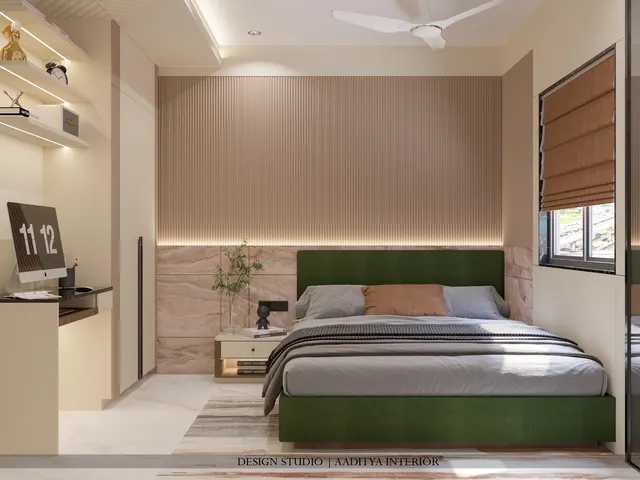
In an Indian home the ceiling fan runs for more hours than almost any other appliance. Even in air-conditioned homes it is switched on through most of the year, and in Surat's humid summers and monsoon months it often runs day and night. Yet the fan is usually the last thing anyone plans: the electrician fixes whatever 1200 mm model the family bought, in the centre of the room, at whatever height the downrod in the box allows.
The results are familiar. A single fan in a long living room leaves the dining end still. A large fan in a small bedroom blasts papers off the table on speed two. A fan under a low false ceiling hangs with its blades barely above head height. A heavy designer fan is hung from a hook that was never designed for it, or from the false-ceiling frame. And a fan placed right above a downlight throws a flickering shadow across the room every evening.
This article sets out the numbers that decide fan size and position: the sweep that suits each room area, the height of the blades above the floor, the gap to the ceiling and walls, the downrod length for each ceiling height, how the hook should be built, and what energy-efficient fans cost and save. Where safety is concerned — hooks, heights and wiring — the guidance is deliberately conservative, and the final check belongs to a qualified electrician and, for hooks in existing slabs, a structural engineer.
From punkah to BLDC: a short history
Before electricity, the Indian answer to still air was the punkah — a large cloth-covered frame hung from the ceiling and swung back and forth by a rope, pulled by an attendant outside the room. Colonial bungalows, courts and offices used punkahs through the nineteenth century, and their position over the bed, the desk or the dining table set a pattern that survives today: the fan goes over the place where people sit or sleep.
Electric ceiling fans appeared in the United States in the 1880s and spread to India in the early twentieth century, first in public buildings and wealthy homes. Through the second half of the century the Indian ceiling fan settled into a standard form: a three-blade, 1200 mm sweep fan with an induction motor and a step or electronic regulator, built to the Indian Standard for electric ceiling type fans, IS 374. The most recent changes are efficiency-driven. Brushless DC (BLDC) motors, which use a fraction of the power of an induction motor, have become common since the late 2010s, and the Bureau of Energy Efficiency's star-labelling programme now covers ceiling fans, so buyers can compare air delivery against power.
How a ceiling fan actually cools
A fan does not lower the air temperature; it moves air across the skin, which speeds up the evaporation of sweat and the loss of heat by convection. The result is a cooling effect that people commonly describe as feeling a few degrees cooler at the same temperature. Thermal comfort standards such as ASHRAE Standard 55 recognise this by allowing higher indoor temperatures to remain comfortable when air speed is increased. In humid climates like coastal Gujarat, Mumbai or Chennai, where sweat evaporates slowly, that air movement matters even more.
Three numbers describe how well a fan does this. Sweep is the diameter of the circle traced by the blade tips, in millimetres — 1200 mm is the familiar "48-inch" fan. Air delivery is the volume of air the fan moves, in cubic metres per minute, measured under standard test conditions; it appears on the BEE label and in catalogues. Service value is air delivery divided by power input (m³/min per watt): the higher it is, the more efficient the fan. A fan with a large sweep but low air delivery may look generous but move little air; a well-designed fan of the right size moves more air at lower speed and with less noise.
The air from a ceiling fan comes down in a column roughly the width of the sweep, spreads across the floor and returns up the sides of the room. People sitting under or near the blades feel the strongest breeze; the effect drops off with distance, and corners beyond about 1.5–2 m from the blade tips feel little. This is why fan size and fan position cannot be separated.
Fan size by room area: the chart
The chart below gives the sweep that suits each band of room area. It reflects the ranges published by Indian fan manufacturers and the practice of designers; it is a guide, not a code requirement. Round rooms and squares suit one fan best; long rooms need two. Ceiling height, how many people use the room and whether there is an air-conditioner also shift the choice, as explained after the table.
| Room area (carpet) | Typical rooms | Recommended sweep | Inches (approx.) | Notes |
|---|---|---|---|---|
| Up to about 50 sq ft (≈ 4.5 m²) | Utility, small store, walk-in wardrobe | 600–750 mm | 24–30 in | Often a wall fan or an exhaust fan works better |
| 50–75 sq ft (≈ 4.5–7 m²) | Small study, pooja room, cabin | 750–900 mm | 30–36 in | Keep blades well clear of shelves and lamps |
| 75–110 sq ft (≈ 7–10 m²) | Kitchen, small bedroom, children's room | 900–1050 mm | 36–42 in | In kitchens, keep away from the hob flame |
| 110–180 sq ft (≈ 10–17 m²) | Most bedrooms, small living rooms, dining | 1200 mm | 48 in | The standard Indian fan; suits 10 × 12 to 12 × 14 ft |
| 180–300 sq ft (≈ 17–28 m²) | Large master bedrooms, living rooms | 1400 mm, or two 1200 mm | 56 in | Two fans if the room is long and narrow |
| 300–450 sq ft (≈ 28–42 m²) | Living–dining, large halls | Two fans of 1200–1400 mm | 48–56 in | Place one over each seating zone |
| Above 450 sq ft (≈ 42 m²) | Halls, offices, banquet spaces | One fan per about 150–200 sq ft, or HVLS fans | — | Commercial rooms need a ventilation design |
Some rules of thumb follow from the chart. If the room's length is more than about one and a half times its width — a 10 × 18 ft living room, a 12 × 22 ft living–dining — use two smaller fans rather than one large one, each centred on its zone. A larger fan is not always better: in a 10 × 10 ft bedroom a 1400 mm fan has its blade tips only about 850 mm from each wall, which is too close for comfort and for safety. And in rooms with many people — a family room where twelve people gather at festivals, a small office, a classroom — size up or add a fan, because each person adds heat.
Position: over the people, not the room centre
In a bedroom, the fan is best centred over the bed or slightly towards its foot, so air reaches the sleepers without a direct blast on the face. In a living room, centre it over the main seating group, which is often not the room centre once a TV wall and a circulation path are subtracted. In a dining room, centre it over the table. In kitchens, keep the fan away from the hob, because a strong downdraft disturbs the gas flame, blows heat around and fights the chimney; a small fan near the work zone or the dining end is better than one directly above the cooktop.
Lights need coordinating with fans. A downlight or pendant directly above or just below the blades produces a strobing shadow when the fan runs. Keep downlights outside the sweep circle by at least 300 mm, or use cove and wall lighting in rooms where a fan runs all evening. Pendants and chandeliers must never hang within reach of the blades; plan them for rooms or zones without a fan, or use a fan with an integrated light.
Heights and clearances
The single most important safety dimension for a ceiling fan is the height of the blades above the floor. This blog, in line with common Indian practice, recommends the blades sit at least about 2400 mm above the finished floor, and ideally 2400–2700 mm in most rooms. Below 2400 mm, a person raising an arm, lifting a child, changing a bedsheet or carrying a long object risks contact with moving blades. In rooms with bunk beds, loft beds, raised platforms or high cupboards, measure from the highest surface people can stand or sit on, not from the floor.
Above the blades, a gap of about 250–300 mm to the ceiling lets the fan draw air from above; a fan hugging the ceiling moves noticeably less air. Around the blades, keep the tips at least about 450 mm from walls and from the tops of wardrobes and shelves, and preferably 600 mm or more; closer than that, the airflow is disturbed and anything stored on a high shelf is at risk. The table summarises these and a few related clearances.
| Clearance | Recommended | Why |
|---|---|---|
| Blade height above finished floor | ≥ 2400 mm (ideally 2400–2700) | Keeps raised hands and carried objects clear of the blades |
| Blades above a bunk or loft bed mattress | Do not place a fan above an upper bunk unless the blades are well above reach | A person sitting up can reach the blades |
| Blades to ceiling | ≈ 250–300 mm | Fan needs air above it to work efficiently |
| Blade tips to walls | ≥ 450 mm, preferably ≥ 600 mm | Airflow and safety; avoids shelves and curtain tops |
| Blade tips to light fittings and pendants | ≥ 300 mm outside the sweep | Prevents strobing shadows and contact |
| Between two fans (tip to tip) | ≥ 600–900 mm | Avoids turbulent, noisy overlap |
| Fan to hob or chimney | Not directly above; keep several metres away where possible | Gas flame and chimney capture are disturbed |
Downrod length for each ceiling height
Indian flats are typically built with about 2.8–2.9 m clear height to the slab, and many lose 150–300 mm under a false ceiling. That leaves little room: a fan with a short downrod already drops about 300–400 mm from the ceiling to the blades, so in a 2.75 m room the blades end up at about 2.35–2.45 m, right at the safe limit. The table gives approximate downrod lengths and resulting blade heights; the exact figure depends on the fan's motor and canopy height, which manufacturers publish as "overall height" or "drop".
| Clear ceiling height | Typical downrod | Approx. blade height | Comment |
|---|---|---|---|
| 2.6 m or less (e.g. under a false ceiling) | None — low-profile (hugger) fan | ≈ 2.3–2.35 m | Below the 2.4 m guideline: avoid over beds and work areas, or choose wall-mounted or other cooling |
| 2.75 m | Short rod ≈ 100–150 mm | ≈ 2.35–2.45 m | Check the fan's drop carefully; choose a compact motor |
| 2.9–3.0 m | Standard rod ≈ 150–300 mm | ≈ 2.45–2.6 m | Typical Indian apartment; comfortable |
| 3.3 m | ≈ 300–450 mm | ≈ 2.6–2.7 m | Older bungalows, commercial floors |
| 3.6 m | ≈ 600–900 mm | ≈ 2.6–2.7 m | High-ceiling bungalows |
| 4.5 m and more (double height) | ≈ 1200–1800 mm, or wall/HVLS fans | ≈ 2.7–3.0 m | Long rods need a rigid, stabilised fixing; ask the manufacturer |
The hook: the part that must never fail
A ceiling fan is a rotating mass hanging over people's heads, and it does not only pull straight down: an unbalanced or wobbling fan applies cyclic loads to its hook every second it runs, year after year. A typical 1200 mm fan weighs about 4–7 kg; decorative fans with heavy motors, wooden blades or integrated lights can weigh 8–15 kg or more. The fixing must carry that weight with a generous margin, and it must be anchored in the structural slab — never in brickwork near the ceiling, never in a gypsum, POP or PVC false ceiling, and never in the metal grid that holds that ceiling.
New construction
In a new building, the fan hook should be placed before the slab is cast. Common practice in India is a fan box — a metal or PVC junction box with a hook of mild steel rod — fixed to the slab shuttering at each planned fan point and tied to the reinforcement, so the hook is embedded in concrete and the conduit for the fan wiring runs straight into the box. The exact detail — rod diameter, how it is anchored to the slab steel, the box type — should follow the structural engineer's or the site engineer's specification. The position of every fan hook should be fixed on the electrical drawing before casting, coordinated with the furniture layout, because moving a cast-in hook later means drilling into the slab.
Existing slabs and false ceilings
Where a fan must go in a new position in an existing home, the usual solution is a hook on an anchor fastener drilled into the RCC slab. The anchor should be of a type and size rated for overhead suspended loads, installed to the manufacturer's instructions, with its rated capacity well above the fan's weight to allow for vibration; drilling must avoid cutting the slab's reinforcement. In a home with any doubt about slab thickness, cover or condition — old buildings, precast or hollow-core slabs, slabs showing cracks or rust stains — a structural engineer should decide. Where a false ceiling is installed, the downrod passes through a neat opening in the ceiling to the hook in the slab above; the false ceiling carries none of the fan's weight. A small framed opening or a collar ring around the downrod keeps the finish neat.
Fixing and maintenance
At the fan itself, the downrod is held to the hook bracket and to the motor by a bolt or clevis pin locked with a split pin or safety pin; these pins must never be left out. Rubber bushes in the hanger reduce noise and vibration. Heavy decorative fans should have a secondary safety cable from the motor body to the hook. A fan that wobbles should be switched off and balanced or checked — usually a bent blade, a loose blade screw or an unlocked pin — rather than left running. Once a year, when the blades are cleaned, the hook, pins and canopy screws should be inspected.
Air delivery, star ratings and BLDC fans
Two fans of the same sweep can move very different amounts of air and use very different amounts of electricity. The BEE star label shows the fan's rated air delivery and its service value, and is the fairest way to compare models. BLDC fans use an electronically controlled brushless motor that typically draws around 28–35 W at full speed, against roughly 70–80 W for a conventional 1200 mm induction fan, while delivering similar air. They also run well on inverter power and usually come with a remote; they need a suitable controller and should not be used with an old step regulator, which can damage the electronics.
| Feature | Conventional induction fan (1200 mm) | BLDC fan (1200 mm) | What it means |
|---|---|---|---|
| Power at full speed | ≈ 70–80 W | ≈ 28–35 W | BLDC uses less than half the power |
| Typical air delivery | ≈ 200–240 m³/min | ≈ 200–240 m³/min | Compare the figure on the BEE label |
| Speed control | Step or electronic regulator | Remote or built-in controller | Do not use an old regulator on a BLDC fan |
| Inverter backup | Runs, but drains the battery faster | Runs much longer on the same battery | Useful where power cuts are common |
| Indicative price (Oct 2026) | ≈ ₹1,800–4,000 for branded basic models | ≈ ₹3,500–8,000; designer models more | BLDC premium is repaid by power savings |
| Typical running cost at 12 h/day and ₹8/unit | ≈ ₹2,450–2,800 a year | ≈ ₹1,000–1,250 a year | Saves roughly ₹1,500 a year per fan |
The running-cost figures assume twelve hours a day at full speed all year and an illustrative tariff of ₹8 per unit; actual savings depend on hours of use, the speed setting and the local tariff. Even so, the arithmetic is clear: in a 3BHK with five fans running long hours, BLDC fans can save several thousand rupees a year, so the price premium is usually recovered within a few years.
Cost: fans, points and hooks
Fan costs have three parts: the fan itself, the electrical point that feeds it, and the hook and fixing. This blog's electrical and lighting guides price a branded 1200 mm BLDC fan at about ₹3,500–8,000 and a light or fan point at about ₹900–1,800 including wiring, a switch and the box; the hook is usually included in the electrical contractor's point rate for new construction. The table below uses those bands (indicative October 2026, excluding GST).
| Item | Indicative cost (Oct 2026) | Notes |
|---|---|---|
| 1200 mm BLDC fan, branded | ₹3,500–8,000 each | Designer and wooden-blade models cost more |
| 1200 mm induction fan, branded basic | ₹1,800–4,000 each | Cheaper to buy, costlier to run |
| Fan point (wiring, switch, box) | ₹900–1,800 per point | Part of the electrical budget, not extra |
| Fans for a 2BHK (4 BLDC fans) | ≈ ₹14,000–32,000 | Plus points in the wiring budget |
| Fans for a 3BHK (5 BLDC fans) | ≈ ₹17,500–40,000 | Plus points in the wiring budget |
| Extra downrod for a high ceiling | Usually a few hundred to a couple of thousand rupees | Buy the maker's own rod for that model |
| New hook on an anchor in an existing RCC slab | Typically a small item in the electrician's labour | Structural check first where the slab is in doubt |
Where ceiling fans are going
Three trends are already shaping how fans are planned. Efficiency first: BLDC motors and star labelling are pushing the standard fan towards half the power use of the old induction fan, which matters in a country with hundreds of millions of fans running long hours. Smarter control: remote, app and voice control, timers and sleep modes are now common, and some fans adjust speed to room temperature. Larger, slower fans: in commercial and institutional spaces, high-volume low-speed (HVLS) fans several metres in diameter move large volumes of air quietly and are increasingly used with air-conditioning to raise thermostat settings. For homes, the lesson from all three is the same: size and place the fan properly, and pair it with the AC rather than replacing one with the other.
Rules for sizing and fixing a ceiling fan
- Size by room area: about 900–1050 mm for rooms up to 110 sq ft, 1200 mm for 110–180 sq ft, 1400 mm or two fans above that.
- Use two fans in rooms longer than about one and a half times their width, one centred on each zone.
- Centre the fan over where people sit or sleep, not automatically in the middle of the room.
- Keep the blades at least 2400 mm above the floor (and above any bunk or platform people use), about 250–300 mm below the ceiling and at least 450 mm from walls.
- Check the fan's overall height before buying for a room with a false ceiling or a ceiling below about 2.8 m.
- Hang every fan from a hook anchored in the RCC slab — never from a false ceiling, its frame or brickwork.
- Fit the safety and split pins, add a safety cable for heavy fans, and stop any fan that wobbles until it is checked.
- Use BEE star-labelled or BLDC fans, keep downlights outside the sweep, and have all wiring done by a licensed electrician.
Frequently asked questions
Which fan size is best for a 12 × 12 ft room?
A 12 × 12 ft room is 144 sq ft, so a 1200 mm (48-inch) fan is the right size. Centre it over the bed or the seating area, keep the blade tips at least 450 mm from the walls and the blades at least 2400 mm above the floor.
What is the minimum height of a ceiling fan from the floor?
This blog recommends the blades be at least about 2400 mm (about 7 ft 10 in) above the finished floor, and ideally 2400–2700 mm. Measure from the highest surface people stand or sit on — a bunk, a platform or a stair — not just the floor. If a low ceiling makes this impossible, consider a low-profile fan placed away from beds and work areas, or another form of cooling.
Can a ceiling fan be fixed to a false ceiling?
No. The fan must hang from a hook anchored in the RCC slab above. The downrod passes through an opening in the false ceiling, which carries none of the fan's weight. Gypsum, POP and PVC ceilings and their metal frames are not designed for a rotating, vibrating load.
Is a BLDC fan worth the extra cost?
Usually yes for fans that run many hours. A BLDC fan draws about 28–35 W against about 70–80 W for a conventional fan, saving roughly ₹1,500 a year per fan at twelve hours a day and ₹8 per unit. The price premium is typically recovered within a few years, and BLDC fans run much longer on an inverter.
Should I put one big fan or two small fans in a living room?
For a square living room up to about 180–250 sq ft, one 1200–1400 mm fan is enough. For a long living–dining room, or any room longer than about one and a half times its width, two 1200 mm fans — one over the sofa and one over the dining table — give much more even air movement.
Sources & standards
- Bureau of Indian Standards — IS 374 (electric ceiling type fans and regulators), IS 732 (code of practice for electrical wiring installations), IS 456 (plain and reinforced concrete)
- National Building Code of India 2016, Part 8, Section 1 (lighting and natural ventilation) and Section 2 (electrical and allied installations)
- Bureau of Energy Efficiency — star labelling programme for ceiling fans (label shows air delivery and service value)
- ASHRAE Standard 55 — thermal environmental conditions for human occupancy (elevated air speed)
- Fan manufacturers' published sweep-to-room-size charts and overall-height data (described generically)
- Neufert, Architects' Data — room heights and human reach dimensions
- Price ranges: indicative October 2026 estimates — confirm locally before budgeting