The seaside home is one of the most photographed interiors in India: white walls, blue accents, cane chairs, linen curtains lifting in the breeze. It is also one of the most quickly ruined. Within two or three monsoons, a coastal flat in Mumbai, Goa, Kochi, Chennai, Vizag or the Gujarat coast can show rust bleeding from hinges, swollen wardrobe shutters, black mould behind the bed, peeling paint, pitted chrome taps and an air-conditioner whose copper coil has corroded through. None of this is bad luck. It is what salt-laden, humid air does to materials that were specified for an inland city.
India has a very long coastline, and millions of homes sit within a few kilometres of the sea. Gujarat alone has the longest coastline of any Indian state, from Kutch through Saurashtra to Surat, Daman and Valsad. Yet most interiors in these places are built with the same board, hardware, fabrics and paints as homes in Pune or Indore. The coastal look is then added on top, as colour and accessories. The result looks right for a year and fails after five.
This article treats coastal interior design the other way round: start from the climate and the materials, then build the style on top. It covers the traditions of India's coastal regions, how salt and humidity attack a home, the materials and hardware grades that survive, the layout and ventilation decisions that keep a seaside home fresh, indicative costs for the upgrades that matter, and a maintenance routine that keeps it all working.
What the sea does to a home
Four forces act on a coastal interior at the same time. The first is salt. Breaking waves throw fine droplets of seawater into the air; the water evaporates and leaves microscopic salt particles that the wind carries inland and deposits on every surface. Salt is hygroscopic — it attracts moisture — so a salty surface stays damp longer, and a damp, salty film on steel or copper is exactly what drives corrosion. The effect is strongest on the sea-facing side, within the first few hundred metres of the shore, and reduces with distance, but it remains noticeable for several kilometres in many places.
The second force is humidity. Coastal Indian cities commonly sit at high relative humidity for much of the year, and during the monsoon the air can stay close to saturation for weeks. Wood-based boards absorb moisture and swell, fabrics and leather grow mould, paint films blister and lift, and any cold surface — an air-conditioned wall, a cold-water pipe, the back of a wardrobe against an external wall — collects condensation. The third force is wind, which drives rain sideways through window gaps and loads glass and doors. The fourth is sand and sun: fine sand abrades floors and sliding tracks, and the strong light reflected from water and sand fades fabrics and timber faster than inland.
The practical conclusion is that a coastal interior must do three things before it does anything decorative: keep surfaces dry, choose materials that tolerate salt and moisture when they do get wet, and make every part easy to clean, because salt and sand will keep arriving. The style follows from those three rules surprisingly naturally — light colours, washable fabrics, natural fibres, open layouts and simple hardware are what the climate asks for anyway.
India's coastal traditions: how seaside homes were built before
Long before air-conditioning, India's coastal communities developed house forms that handled heat, humidity and monsoon rain with remarkable skill. They differ from region to region, but share a few habits: steep or deep roofs that throw rain far from the walls, verandahs and porches that shade the openings, raised plinths that keep floors dry, walls of local stone or lime that breathe, and timber shutters and louvres that let air move while keeping rain out. A contemporary coastal interior borrows from these traditions far more convincingly than from imported beach-house catalogues.
| Coast | Traditional building features | What a modern interior can borrow |
|---|---|---|
| Gujarat coast, Daman and Diu | Lime-plastered walls, timber balconies, Portuguese-influenced houses in Daman and Diu, courtyards in older towns | Lime or mineral finishes, carved timber accents, shaded balconies, courtyard-facing rooms |
| Konkan (Maharashtra) | Laterite stone walls, Mangalore-tiled sloping roofs, deep front verandahs, wooden pillars | Exposed laterite or textured plaster, terracotta, timber columns, verandah-style sit-outs |
| Goa | Laterite and lime houses, balcão porches with built-in seats, oyster-shell window panes, bright lime-washed façades | Built-in window seats, shell or frosted panes for soft light, bold colour on a few walls |
| Kerala and Malabar | Steep tiled roofs, laterite, teak and jackfruit wood, central nadumuttam courtyard, wide eaves | Timber ceilings, courtyard or light well, oxide floors, wide shaded openings |
| Coromandel (Tamil Nadu, Puducherry) | Thinnai platforms at the entrance, colonnaded verandahs in Puducherry's French quarter, lime-washed walls | Raised seating ledges, arcaded or louvred verandahs, pale lime-washed walls |
| Odisha and Bengal coast | Thatched or tiled roofs, mud and lime walls, verandahs on raised plinths, cyclone-conscious low forms | Robust, simple detailing; secure shutters; raised floors in flood-prone areas |
Two lessons stand out. First, these houses breathe: lime plaster, laterite and timber let moisture pass through and dry out, rather than trapping it behind a sealed skin. Second, they shade every opening. A Goan balcão, a Konkan verandah or a Kerala eave keeps sun and driving rain off the windows, so that shutters can stay open for air even in the monsoon. A modern flat on the twelfth floor cannot have a verandah on every window, but it can respect both lessons through finishes, overhangs, blinds and layout.
Materials that survive near the sea
Material choice decides how a coastal interior ages. The table below compares the common choices for furniture, joinery, floors, walls, fabrics and fittings. The rule running through it is simple: prefer materials that are either inert to salt and water (glazed tiles, stone, glass, good-quality aluminium, high-grade stainless steel), or that tolerate wetting and dry out without damage (marine plywood, teak, natural fibres), and avoid materials that swell, rust or rot.
| Element | Good near the sea | Use with care | Avoid |
|---|---|---|---|
| Carcass board | 18 mm marine or BWP plywood (IS 710); WPC or PVC board in wet zones | BWR plywood (IS 303) in air-conditioned, dry rooms | MR-grade plywood, particle board and plain MDF on external walls |
| Solid wood | Teak, well-seasoned and sealed; other durable hardwoods | Rubberwood and pine indoors only, sealed | Unseasoned timber; open-grain wood left unsealed |
| Shutter finish | Laminate with sealed edges, PU or acrylic with edge banding all round | Veneer with good PU coats | Unsealed edges, painted MDF near windows |
| Flooring | Vitrified tiles, natural stone (Kota, granite), terracotta sealed, oxide flooring | Engineered wood in air-conditioned rooms | Laminate wood flooring in ground-floor or humid rooms |
| Walls | Lime or mineral finishes, washable acrylic emulsion, textured plaster | Wallpaper only in conditioned rooms | Vinyl wallpaper on external walls (traps moisture) |
| Fabrics | Linen, cotton, linen-cotton blends, outdoor-grade acrylic for sit-outs | Silk and velvet in conditioned rooms | Heavy, lined drapes that never dry; leather in damp rooms |
| Loose furniture | Cane, rattan, teak, powder-coated aluminium, synthetic wicker outdoors | Upholstered sofas with removable, washable covers | MS frames that are not galvanised; particle-board furniture |
| Lighting and electrical | Fittings with IP-rated, sealed housings near openings; good earthing | Decorative brass that will tarnish | Unsealed fittings on balconies and sea-facing walls |
Boards and joinery
The single most important upgrade in a coastal home is the board used for wardrobes, kitchen and bathroom cabinets. Marine or BWP plywood to IS 710 uses a waterproof phenolic glue and stricter rules on core veneers, and it tolerates repeated wetting far better than MR-grade boards. Indicative October 2026 rates for 18 mm marine or BWP plywood are about ₹120–180 per sq ft of board, against about ₹90–130 for BWR plywood to IS 303. In a coastal home, Aaditya Interior recommends marine or BWP plywood for every carcass that touches an external wall, a wet area or the floor, and BWR plywood only for joinery in air-conditioned, interior locations. Edges matter as much as the board: every cut edge should be banded or sealed, including the hidden back and bottom edges, because moisture enters through unsealed edges first.
Metals and hardware
Hardware fails first near the sea. Hinges, drawer channels, handles, curtain rods, window stays, towel rails and even screws can rust within a season if they are mild steel with a thin plating or a low grade of stainless steel. The table below summarises the common options. In general, the closer the home is to the shore and the more directly a fitting faces the sea breeze, the higher the grade it needs.
| Metal or finish | Behaviour near the sea | Use for | Indicative cost note |
|---|---|---|---|
| SS 202 (low-nickel stainless) | Can show rust spots quickly in salty, humid air | Not recommended for coastal homes | Cheapest stainless option |
| SS 304 | Good in most interiors; may tea-stain on sea-facing exteriors | Interior hardware, kitchen fittings away from the breeze | Standard branded hardware price |
| SS 316 (with molybdenum) | Markedly better resistance to chlorides and salt spray | Balcony railings, window and door hardware, sea-facing fittings | Typically a premium over SS 304; worth it within sight of the sea |
| Aluminium, anodised or powder coated | Good if the coating is intact; corrodes where coating is damaged | Window and door frames, outdoor furniture, louvres | Ask for coastal-grade coating and pre-treatment |
| Mild steel, galvanised and painted | Acceptable only with full galvanising and a sound paint system | Structural frames, gates, grilles | Repaint cycle shorter than inland |
| Brass and bronze | Do not rust but tarnish and develop patina | Decorative handles, lamps where patina is welcome | Higher price; lacquer or polish to keep bright |
| Chrome-plated taps | Plating can pit if salt and water sit on it | Bathrooms with regular wiping | Choose good-brand plating; dry after use |
Air-conditioners deserve a special note. The outdoor unit's coil sits directly in the salty breeze, and standard coils can corrode faster near the sea. Several manufacturers offer coils with anti-corrosion coatings, often described as coastal or blue-fin protection, and outdoor units should be placed where they are sheltered from direct sea spray but still have free air around them. Rinsing the outdoor coil with fresh water during service visits helps, as long as the technician does it.
The coastal look, done properly
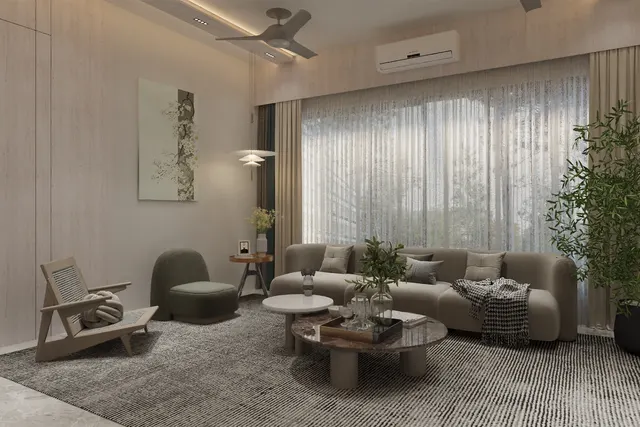
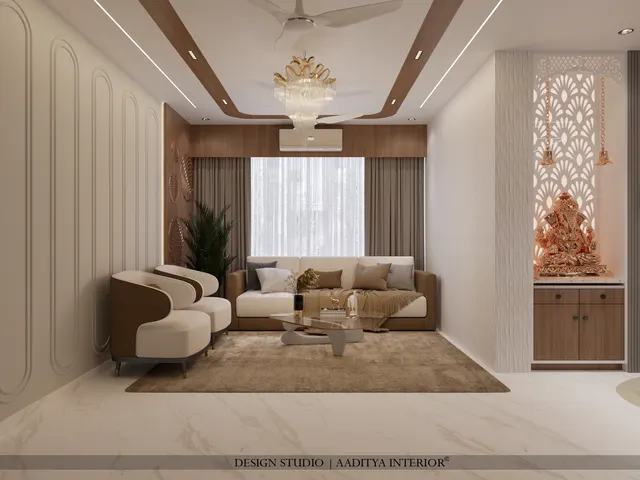
Once the climate is respected, the coastal style itself is easy to get right. It is a relaxed, light, natural interior, and in India it works best when it draws on local materials rather than on Mediterranean or New England clichés. The palette starts with warm whites and sand tones on walls, because light colours reflect heat and make rooms feel cooler, and because they hide salt and dust better than dark finishes. Blues and greens appear as accents — a painted door, cushions, a tiled splashback — rather than on every surface. Natural textures do most of the work: cane and rattan chairs, jute and sisal rugs, linen curtains, terracotta, lime plaster, oxide floors, teak.
Avoid the obvious props — anchors, ships' wheels, rope-wrapped mirrors and painted shells — or use them sparingly. A seaside home feels coastal because of light, air and material, not because of nautical decoration. A large window with a deep sill to sit on, a sheer curtain moving in the breeze, a cool stone floor underfoot and a few pieces of locally made furniture say more than any number of anchors.
Furniture and layout
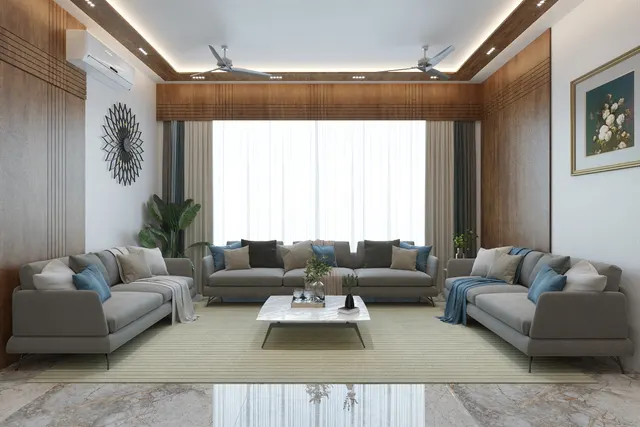
Coastal living rooms work best when they are planned around the breeze. Sea breezes in Indian coastal cities usually build during the day and are strongest in the afternoon, and catching them — while keeping out the low western sun where the sea faces west — is the main layout decision. Keep the path between the sea-facing opening and an opening on the opposite side clear of tall furniture. Place the sofa parallel to the airflow rather than across it, use low-backed chairs near windows, and keep bookcases and tall units on the walls that run along the breeze, not across it. A ceiling fan over each seating group, at about 2400–2700 mm above floor, extends comfort on still days.
Choose furniture with legs rather than solid plinths, so that air moves under it and floors can be mopped easily. Upholstery should have removable, washable covers in linen or cotton. Cane and rattan suit the style and the climate, but sag and discolour if left in direct sun and rain, so keep them on covered sit-outs rather than open terraces. Rugs should be flat-woven cotton, jute or outdoor polypropylene that can be washed or aired, rather than thick wool piles that hold moisture.
Detailing against damp and mould
Most coastal mould appears in three places: behind wardrobes on external walls, behind beds and headboards pushed against outside walls, and in air-conditioned rooms where cool surfaces meet humid air. All three can be prevented at the design stage. The principle is to leave an air gap between cold or damp surfaces and the furniture in front of them, to let that gap breathe, and to avoid sealing moisture into a wall with impermeable finishes on both sides.
The wardrobe detail in Fig. 4 is a standard Aaditya Interior coastal specification: the carcass stands 25–50 mm away from the external wall, on a plinth with ventilation slots, with an open top or a vented ledge so that air can rise behind it; the board is marine or BWP plywood with every edge sealed; and the shutters are louvred or have discreet slots at top and bottom so that air inside the wardrobe changes. A small, low-wattage wardrobe heater or a pouch of moisture absorber helps in the monsoon, and clothes should never be stored damp. Beds and headboards against external walls benefit from the same 25–50 mm gap.
In air-conditioned rooms, condensation forms where cool air meets warm, humid surfaces — on the outside of a supply duct, on a cold-water pipe, or on the inner face of a wall cooled from one side. Insulate refrigerant and drain pipes fully, keep the indoor unit's drain sloping and clear, and avoid setting air-conditioners colder than needed; a moderate setting combined with a dehumidifying mode is usually more comfortable in humid coastal weather than a very cold setting. A standalone dehumidifier — indicatively ₹12,000–35,000 depending on capacity — is a useful addition for a closed storeroom, a library or a ground-floor room in a very humid location.
Costs: the coastal upgrades worth paying for
Building a coastal interior properly costs more than an inland one, but the extra is concentrated in a few items and is small compared with the cost of replacing failed joinery and hardware after a few years. The table gives indicative October 2026 figures for the upgrades that matter most. They are ranges for typical Indian metros and tier-2 cities, and should be confirmed with local suppliers before budgeting.
| Upgrade | Instead of | Indicative cost (October 2026) | Why it pays back |
|---|---|---|---|
| 18 mm marine / BWP plywood (IS 710) for carcasses | MR or BWR plywood | ≈ ₹120–180 per sq ft of board (BWR ≈ ₹90–130) | Swelling and delamination are the commonest coastal failures |
| SS 316 hardware on sea-facing doors, windows and railings | SS 202 or plated MS | A premium over SS 304; varies by brand and item | Rust staining and seized hinges appear within one or two seasons otherwise |
| Exterior weather-shield paint on sea-facing walls | Ordinary exterior emulsion | ≈ ₹17–26 per sq ft with primer and two coats | Holds colour and resists driving rain and salt |
| Anti-corrosion coated AC coils | Standard coil | Usually a modest premium on the unit price | Coil corrosion is a common cause of early AC failure near the sea |
| Dehumidifier for a closed room | Nothing | ≈ ₹12,000–35,000 by capacity | Protects books, clothes, leather and instruments in the monsoon |
| Cane or rattan lounge chair | Upholstered armchair | ≈ ₹8,000–25,000 | Breathes, dries quickly and suits the style |
| Linen or cotton curtains, unlined, on SS or aluminium rods | Lined polyester drapes on MS rods | Varies with fabric; often similar to mid-range drapes | Dry quickly, wash easily, no rust streaks |
Maintenance through the seasons
Even the best-specified coastal home needs routine care, because salt and sand keep arriving. The good news is that the routine is simple and cheap compared with repairs. The calendar below suits most Indian coastal cities, where the south-west monsoon arrives in early or mid summer; on the Coromandel coast, which also receives heavy rain from the north-east monsoon later in the year, the monsoon tasks should be repeated for that season.
| When | Task | Why |
|---|---|---|
| Weekly | Wipe sea-facing hardware, taps and glass with a damp cloth, then dry | Removes the salt film before it starts corrosion |
| Monthly | Vacuum sand from sliding tracks; run fans and open wardrobes on a dry day | Prevents worn rollers and stale, damp storage |
| Before the monsoon | Check window gaskets, drip grooves, sealant joints and terrace drains; service AC units | Most leaks start at failed gaskets and blocked drains |
| During the monsoon | Use dehumidifiers or AC dry mode in closed rooms; keep wardrobe vents clear; air bedding on dry days | Holds humidity down and prevents mould |
| After the monsoon | Inspect for mould behind furniture; clean with a suitable mould remover; touch up paint | Catches problems while they are small |
| Every 2–3 years | Recoat external timber, re-oil teak furniture, check railing and grille paint | Coatings wear faster near the sea |
| Every 4–6 years | Repaint sea-facing exterior walls; replace worn hardware with higher grade | Restores the protective layer before damage spreads |
Where coastal design is heading
Coastal homes in India face growing pressure from stronger storms, heavier rain events and, in low-lying areas, flooding. Designers are responding in several ways. Raised plinths, flood-tolerant ground-floor finishes such as tiles and stone, and electrical points placed higher on ground floors are becoming more common in flood-prone neighbourhoods. Window and door systems with better gaskets and higher wind-load ratings are more widely available. Hardware manufacturers increasingly offer coastal-grade ranges in SS 316 and in specially coated finishes. And there is renewed interest in traditional materials — lime plaster, laterite, terracotta and oxide floors — not only for their character but because they let walls breathe and dry.
Planning rules matter too. Development close to the shore in India is regulated by Coastal Regulation Zone notifications, which restrict what can be built within defined distances of the high-tide line. Anyone building or substantially altering a home near the coast should confirm the applicable rules with the local planning authority and a qualified architect before starting work. For interiors, the direction is clear: robust fixed parts, breathable finishes, natural ventilation first, and soft, washable layers on top.
Rules for a coastal interior that lasts
- Specify 18 mm marine or BWP plywood (IS 710) for every carcass on an external wall, in a wet area or touching the floor.
- Seal or band every cut edge of every board, including hidden back and bottom edges.
- Use SS 316 hardware within sight of the sea, and at least SS 304 elsewhere; never SS 202 or plated mild steel.
- Leave a 25–50 mm ventilated air gap behind wardrobes, beds and panelling on external walls.
- Shade sea-facing windows with a 600–900 mm chhajja or a balcony, with a drip groove, so they can stay open in the rain.
- Plan furniture around the breeze: a clear path from inlet to outlet, tall units on side walls only.
- Choose washable, breathable fabrics — linen and cotton — and flat-woven rugs that can be aired.
- Budget for a simple maintenance routine: weekly wiping, pre-monsoon checks and periodic repainting.
Frequently asked questions
Which plywood is best for a house near the sea?
Marine or BWP plywood to IS 710 is the right choice for wardrobes, kitchen and bathroom cabinets and any joinery on external walls in a coastal home. BWR plywood to IS 303 can be used for interior joinery in air-conditioned, dry rooms. Whichever board is used, all edges must be sealed, and the plywood should carry a verifiable ISI mark.
Does stainless steel rust near the sea?
Lower grades can. SS 202 often shows rust spots quickly in salty air, and SS 304 can develop light brown tea staining on surfaces exposed directly to sea spray. SS 316, which contains molybdenum, resists chlorides much better and is the usual recommendation for railings, window hardware and fittings on the sea face. Regular wiping with fresh water extends the life of any stainless fitting.
How do you prevent mould in a coastal home?
Keep air moving and surfaces dry. Ventilate daily on dry days, leave air gaps behind furniture on external walls, use louvred or vented wardrobe shutters, run a dehumidifier or the AC's dry mode in closed rooms during the monsoon, insulate cold pipes, and avoid impermeable finishes such as vinyl wallpaper on external walls.
What colours suit a coastal interior in India?
Warm whites, sand, stone and pale grey for walls, with blues, greens, terracotta or ochre as accents. Light colours reflect heat and hide salt and dust better than dark ones. Regional traditions also offer bolder options, such as the bright lime-washed façades of Goan houses, which work well on a single feature wall or a front door.
Is wooden flooring a good idea in a beach house?
Laminate wood flooring is a poor choice in humid, ground-floor or sea-facing rooms because its core can swell. Engineered wood can work in air-conditioned rooms with good installation. For most coastal homes, vitrified tiles, natural stone such as Kota or granite, sealed terracotta or oxide flooring are more durable and stay cooler underfoot.
Sources & standards
- Bureau of Indian Standards — IS 710 (marine plywood), IS 303 (plywood for general purposes), IS 6911 (stainless steel plate, sheet and strip)
- Bureau of Indian Standards — National Building Code of India 2016, Part 8 (lighting and natural ventilation) and Part 11 (approach to sustainability)
- Ministry of Environment, Forest and Climate Change — Coastal Regulation Zone Notification (2019) and earlier CRZ notifications
- Bureau of Energy Efficiency — Eco-Niwas Samhita (energy conservation building code for residential buildings), guidance for warm-humid climates
- Neufert, Architects' Data — climate and ventilation principles for warm-humid regions
- Manufacturer technical literature — stainless steel grade selection for marine and coastal environments (described generically)
- Price ranges: indicative October 2026 estimates — confirm locally before budgeting