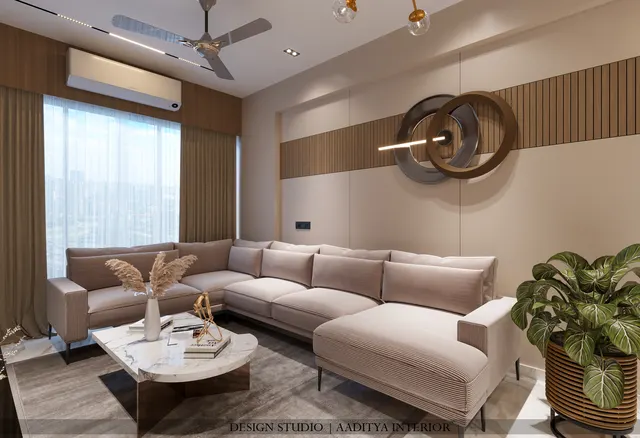
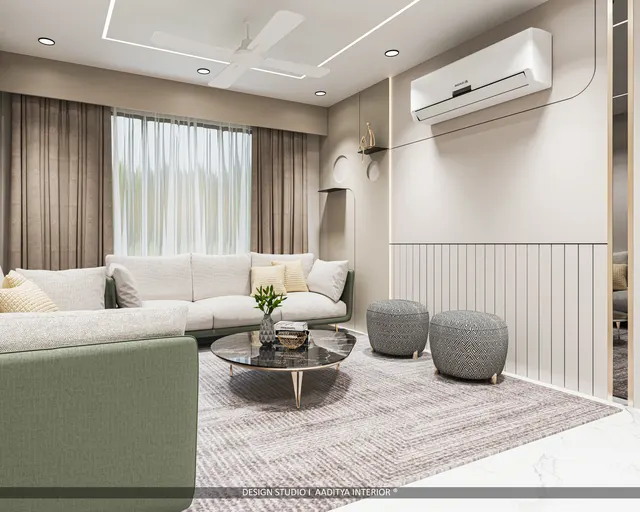
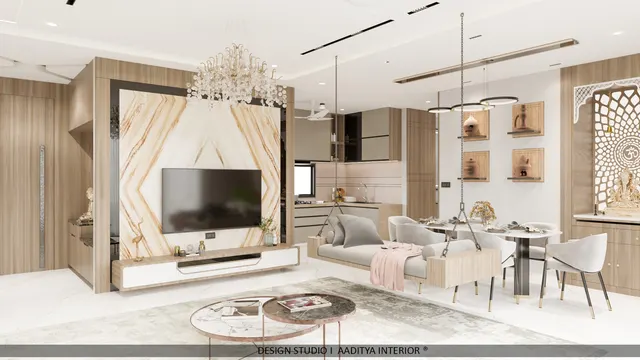
Jaali, brass and wood are the three materials most Indian families reach for when they say they want their home to "feel Indian". They are the materials of the haveli doorway, the temple lamp, the grandmother's carved almirah and the brass urli of flowers at the entrance. Put together well, they give a modern flat warmth, depth and a sense of belonging that no imported style can match. Put together carelessly, they produce the opposite: a dark, heavy, dust-collecting room that looks like a handicraft emporium, where every surface is carved, every shelf holds a brass figure and every partition is a CNC jaali.
The difference is rarely the budget. It is proportion and detailing. Contemporary Indian ethnic design — sometimes called modern ethnic or Indian contemporary — keeps the background calm and modern: plain walls, flush storage, good daylight, clean lines. Then it gives each of the three traditional materials one clear job. Wood is the warm base. Jaali is the filter between spaces and between inside and outside. Brass is the line and the heirloom. When each material does its own job, and only that, the room reads as Indian without reading as a theme.
This article looks at where the three materials come from in Indian building and craft, how they are made and specified today, how to balance them in a room, and the dimensions, details and indicative October 2026 costs that make a contemporary ethnic interior work. It goes deeper on materials than this blog's guide to modern Indian interior design, and stays consistent with the jaali, Art Deco and veneer guides on prices.
What contemporary Indian ethnic design means
Traditional Indian interiors were rarely cluttered in the way their modern imitations are. A Gujarati haveli room was often quite bare: a lime-plastered wall, a carved timber column or doorway, a niche with a brass lamp, a swing, a few chests and a cotton durrie. Richness came from a few superbly made elements against plain surfaces. The modern "ethnic" interior that fills every surface with carving and brass is a much later idea, largely driven by the handicraft trade and by the wish to display. Contemporary Indian ethnic design returns to the older logic and combines it with modern planning.
| Approach | Background | Jaali | Brass | Wood | Typical result |
|---|---|---|---|---|---|
| Traditional / heritage | Lime plaster, stone, carved timber structure | Stone or timber, part of the building | Lamps, vessels, bells in daily use | Structural and carved: columns, brackets, doors | Rich but coherent; hard to reproduce in a flat |
| Themed ethnic | Patterned walls, dark wood everywhere | On every partition and door | Many small figures and decorative pieces | Carved panels on every shutter | Heavy, dark, dusty; dates quickly |
| Contemporary Indian ethnic | Plain warm walls, flush storage | One screen per space, sized to its job | Thin lines plus a few large heirlooms | One warm species as base; one carved feature | Warm, calm, unmistakably Indian |
| Modern minimal | White and grey, flat finishes | None, or a token panel | Little or none | Light laminate or veneer | Clean but placeless |
The key word is restraint. A contemporary ethnic room usually has one hero element — a carved door, a jaali screen, a brass-inlaid floor, a swing, a large urli — and supporting elements that are simpler versions of the same materials. It plans storage so that everyday clutter is hidden, which leaves the hero and a few heirloom objects free to be seen. And it is lit warmly, at 2700–3000 K, because wood and brass look dead under cold white light.
Where the three materials come from
Jaali: the filter
The jaali — a pierced screen of stone, wood, clay or metal — is one of the defining elements of Indian architecture, from the carved stone windows of the Sidi Saiyyed Mosque in Ahmedabad to the latticed jharokhas of the Hawa Mahal in Jaipur and the brick jaali walls of Laurie Baker in Kerala. It filters light and glare, lets air through, and gives privacy by contrast: from a bright street, a person sees the screen, not the darker room behind it. This blog's article on the Indian jaali covers its history and patterns in detail; here, the interest is in how the jaali works alongside wood and brass in a modern room.
Brass: the line and the heirloom
Brass — an alloy of copper and zinc — has been worked in India for centuries for lamps, vessels, bells, locks, hinges and temple fittings. Bronze (copper and tin) and bell metal or kansa (a high-tin bronze) sit in the same family and the same households. Moradabad in Uttar Pradesh is so closely associated with brassware that it is popularly called Peetal Nagri, the brass city, and in Gujarat Jamnagar is a major centre for the manufacture of brass parts and fittings. Kerala's tall brass oil lamps, Tamil Nadu's temple bronzes, Rajasthan's engraved trays and the brass bells and urlis of temples everywhere give brass a meaning in Indian homes that goes beyond decoration: it is the metal of ritual, hospitality and inheritance.
Wood: the warm base
Timber was the structural and decorative heart of many Indian vernacular houses: the carved teak columns, brackets and facades of the pol houses of Ahmedabad and the havelis of Gujarat and Rajasthan, the deodar and walnut of Himalayan houses, the jackwood and teak roofs of Kerala's nalukettu homes, and the painted wooden furniture of craft traditions such as Sankheda in Gujarat's Vadodara district, known for its lacquered teak furniture. Teak and sheesham (Indian rosewood) became the classic furniture woods of the twentieth century; today, mango wood, acacia and plantation-grown species carry much of the handcrafted furniture trade, while veneers over engineered boards bring the look of fine timber to built-in storage.
The 60–30–10 balance
Designers use a simple rule of thumb to keep an ethnic room calm: about 60 per cent of what the eye sees should be plain background — walls, ceiling, most of the floor, flush storage; about 30 per cent should be the dominant warm material, usually wood in furniture, a feature wall or a ceiling; and about 10 per cent should be accent — brass, pattern, colour and craft objects. The jaali usually counts within the 30 per cent if it is wood and within the accent if it is brass-finished metal. The percentages are not to be measured with a tape; they describe visual weight, and they are a useful check when a room starts to feel heavy.
Fig. 1 shows the rule on a typical 4200 mm living-room wall. The wall itself is plain warm plaster or a matte paint. A low wooden console, 2400 mm long and about 650 mm high, carries the television or art and provides closed storage below. A single jaali screen, about 900 mm wide and full height, separates the living area from the foyer or dining. Brass appears only as a thin edge on the console, a slim frame on the screen, a lamp and an urli. Nothing is carved except, perhaps, the console's handles or a single panel. The result looks unmistakably Indian, but it is quiet.
| Share of visual weight | What goes in it | Typical materials | Common error |
|---|---|---|---|
| About 60 % — background | Walls, ceiling, most of the floor, flush storage fronts | Warm white or cream paint, lime plaster, matte laminate, Kota or light vitrified floor | Dark wood or patterned paper on every wall |
| About 30 % — warm base | Furniture, one feature wall or ceiling, the jaali screen | Teak, sheesham, mango wood, teak or walnut veneer, cane | Mixing four or five wood tones in one room |
| About 10 % — accent | Brass lines and objects, textiles, colour, craft pieces | Brass, bronze, kansa, handloom, block prints, one painting | Dozens of small brass figures on every shelf |
Jaali in a contemporary ethnic room
In this style, a jaali earns its place by doing a job: separating a foyer from the living room, screening a dining area from the main door, softening a staircase, forming a pooja-unit door, or shading a window. Decorative jaali panels stuck onto walls with nothing behind them do not filter anything and usually look like an afterthought. The most successful contemporary jaalis use one pattern family across the home, an openness of about 30–40 per cent for partitions, and a material that matches the room's wood or brass rather than adding a new colour.
Material choice follows the location. In a dry living room, CNC-routed MDF or HDHMR painted in a warm off-white or a wood tone is economical and smooth. A solid-wood or veneered jaali in a teak frame gives the warmest, most traditional result. Laser-cut mild steel or aluminium with a brass-tone powder coat or PVD finish allows much finer patterns and suits pooja doors, staircases and balconies. Stone jaalis in sandstone or marble are the heritage choice, beautiful but heavy — an upper-floor stone screen always needs a structural engineer's confirmation.
| Jaali material | Look in an ethnic room | Indicative installed cost (₹/sq ft, Oct 2026) | Best place |
|---|---|---|---|
| MDF or HDHMR, CNC routed, painted | Soft, smooth, takes any colour | ₹350–950 | Living–dining partitions, ceiling panels |
| Solid wood or veneered board in teak frame | Warmest, most traditional | Above the MDF band; depends on species and carving | Foyer screens, pooja doors, headboards |
| Mild steel, laser cut, brass-tone powder coat | Fine pattern, metallic glow | ₹450–1,000 | Staircases, balconies, pooja doors |
| Stainless steel with PVD gold or bronze | Luxurious, constant colour | ₹1,200–3,500 | Lobby-scale screens, hotels, statement partitions |
| Sandstone or marble, CNC plus hand finish | Heritage, carved depth | ₹1,500–6,000+ | Ground-floor screens, temples, courtyards |
| Terracotta jaali blocks | Rustic, earthy, breathing | ₹60–250 per block (material) | Balcony and courtyard walls, facades |
Fig. 2 shows a typical foyer screen. The frame is a hardwood section of about 50–75 × 75–100 mm, grooved to take an 18 mm jaali panel. A horizontal rail between 1800 and 2100 mm hides the joint between two sheets — a 2700 mm screen cannot be cut from a single 2440 mm board — and gives the eye a resting line. Brass is limited to a slim strip on the rail and the top edge. The frame is anchored into the slab and floor through concealed plates, because a 2700 mm screen fixed only into a false ceiling will wobble every time it is touched.
Brass: finishes, uses and care
Brass has two lives in a contemporary ethnic interior. The first is architectural: thin inlay strips in a stone or wood floor, edge trims on furniture and panelling, handles and hinges, the frame of a mirror or a jaali. The second is the heirloom object: a tall lamp, an urli, a bell, a set of vessels, a pair of door fittings from an old house. Both work best in small quantities. A few running metres of brass line and three or four good objects per room are usually enough; a room with brass on every edge looks like a showroom, and a shelf with twenty small brass figures looks like a shop.
| Brass finish or alternative | Look | Maintenance | Best use | Indicative cost (Oct 2026) |
|---|---|---|---|---|
| Raw or polished solid brass | Bright gold that darkens to a warm patina | Polish regularly if brightness is wanted; patina is natural | Heirloom objects, lamps, dry-room inlay | Objects ≈ ₹500–8,000 per piece; more for large urlis and lamps |
| Lacquered brass | Stays bright longer | Lacquer wears at touch points and must be redone | Handles, decorative trims | Slightly above raw brass |
| Antique or oxidised brass | Dark, aged, matte | Low; touch points gradually brighten | Hardware in traditional rooms, lamps | Similar to raw brass |
| Brass strip inlay in stone or terrazzo | Fine gold line in the floor | Ground and polished with the floor; tarnishes gently | Foyer borders, thresholds, medallions | ≈ ₹150–450 per running ft installed |
| PVD-coated stainless steel (gold, champagne, bronze) | Constant brass-like colour | Very low; resists humidity | Trims, handles, kitchens, bathrooms, coastal cities | Trim ≈ ₹300–900 per running ft |
| Brushed brass handles (full kitchen set) | Soft satin gold | Wipe clean; patina at touch points | Kitchen and wardrobe hardware | ≈ ₹3,000–8,000 per kitchen set |
Fig. 3 shows two of the most useful brass details. In a stone or Kota floor, a strip 2–5 mm wide and 10–15 mm deep is bedded in epoxy in a groove cut by waterjet or router, and the whole floor is ground and polished flush so the brass becomes a fine line in the stone. In solid wood, the tarkashi tradition of brass-wire inlay — associated especially with Mainpuri in Uttar Pradesh — hammers fine brass wire into grooves cut in dense wood such as sheesham, then scrapes and polishes the surface. A tarkashi-style tabletop, box or panel is a perfect accent piece: it carries brass and wood together at a scale the hand can appreciate.
One specification point saves a lot of disappointment: brass changes colour. Solid brass that is not lacquered oxidises to a warm, darker tone, and in humid and coastal cities such as Surat or Mumbai it does so faster. Many families love that patina on lamps and urlis but are unhappy when floor strips or handles darken. Decide in advance which brass should age and which should stay bright, and use PVD-coated steel wherever a constant colour is wanted, especially in kitchens and bathrooms.
Wood: species, veneers and finishes
Wood is the largest of the three materials in most ethnic rooms, and the most common mistake is using too many kinds of it. A floor in one tone, a TV unit in another, a dining table in a third and doors in a fourth produce a restless room. The contemporary approach is to choose one principal wood tone for the home — warm honey teak, a mid-brown sheesham or walnut, or a lighter mango or oak — and repeat it in furniture, panelling and doors, with perhaps one contrasting dark accent. Solid wood is used where it matters — dining tables, beds, a carved door, a swing — and veneer over engineered board carries the same tone into wardrobes and wall panelling at a sensible price.
| Wood | Colour and grain | Typical use in ethnic interiors | Strengths | Watch out for |
|---|---|---|---|---|
| Teak | Golden to mid-brown, straight grain, oily | Doors, frames, carved panels, outdoor furniture, veneer | Stable, durable, termite-resistant heartwood | Price; check plantation vs old-growth source |
| Sheesham (Indian rosewood) | Mid to dark brown with dark streaks | Solid furniture, carved and inlaid pieces, tarkashi | Dense, strong, takes fine detail and polish | Must be well seasoned or it cracks and moves |
| Mango wood | Light to mid-brown, sometimes spalted | Handcrafted furniture, consoles, trays | Affordable, sustainable by-product of old orchards | Softer; needs treatment against insects and fungus |
| Acacia (babool and imported species) | Warm brown, varied grain | Tables, stools, accessories | Hard and affordable | Grain and colour vary between pieces |
| Walnut veneer | Dark chocolate, rich figure | Wall panelling, TV units, bedroom wardrobes | Luxurious depth; pairs well with brass | Can darken a small room |
| Teak veneer | Honey-gold | Wardrobes, panelling, doors | Classic Indian warmth at a lower cost than solid | Polish quality decides the look |
Finishes matter as much as species. A matte or satin PU or melamine polish keeps the grain visible and looks contemporary; a high-gloss polish makes even good teak look like laminate. Oil and wax finishes are traditional and beautiful on solid furniture but need periodic renewal. Natural veneer shutters sit at about ₹600–1,100 per sq ft of shutter, and a single teak veneer sheet costs roughly ₹2,500–6,500 depending on cut and grade (indicative October 2026), consistent with this blog's veneer guides. Carved solid-wood elements — a main door, a headboard panel, a reclaimed haveli bracket — are best kept to one per room so they read as features.
Room by room
Living room
Choose one hero: a jaali screen to the foyer, a carved door used as a headboard-style panel behind the sofa, a brass-inlaid floor medallion or a swing in a double-height corner. Keep the TV wall simple — a wooden console and a plain or lime-plastered wall — and put brass in two or three objects and the lamp. A handloom rug or durrie carries the pattern; curtains stay plain.
Foyer
The foyer is where an ethnic interior makes its first impression and where it can be boldest, because the space is small and visited briefly. A wooden console of 900–1200 mm, a brass urli of flowers, a mirror in a carved or brass frame and a jaali screen to the living room give the full vocabulary in one glance. A brass strip in the floor marking the threshold is a small detail that guests notice.
Pooja space
The pooja unit is the natural home for all three materials: a wooden or veneered carcass, a jaali door or back panel lit from behind, brass bells, lamps and a brass-edged platform. Because the pooja unit is used daily with lamps and incense, its materials must tolerate heat and soot: keep 300 mm or more between any diya and the jaali or wooden shelf above, use metal or stone for the lamp ledge, and ventilate the space.
Dining and bedroom
In the dining room, a solid-wood table is the natural hero, with a crockery unit in the same wood and perhaps cane or jaali shutters on the upper section. Brass serving bowls and kansa thalis used for festive meals can be displayed in one lit niche rather than spread across shelves. In the bedroom, an upholstered or carved wooden headboard, a pair of brass reading lamps and handloom bed linen are enough; bedrooms should be the calmest rooms, so jaali and heavy carving are best kept out unless they screen a window or a dressing area.
| Room | Hero element | Supporting jaali / brass / wood | Indicative cost of the ethnic elements (Oct 2026) |
|---|---|---|---|
| Living room | Jaali screen or carved door panel | Wooden console, brass lamp and urli, handloom rug | Jaali ₹350–1,000 per sq ft; console and objects by choice |
| Foyer | Brass-inlaid threshold or floor medallion | Console 900–1200 mm, framed mirror, urli | Brass inlay ≈ ₹150–450 per running ft |
| Pooja space | Backlit jaali doors | Teak veneer carcass, brass bells, stone ledge | Priced like premium cabinetry plus lighting ₹150–300 per running ft |
| Dining | Solid-wood table | Crockery unit with cane or jaali shutters, kansa and brass serving ware | Cane shutters ≈ ₹800–1,800 per sq ft |
| Bedroom | Wooden headboard wall | Brass lamps, handloom linen | Veneer panelling ≈ ₹600–1,100 per sq ft |
| Double-height or balcony | Swing (jhoola) | Teak or sheesham seat, brass chains | ≈ ₹60,000–2,50,000+; engineer to confirm hook |
Mistakes that turn ethnic into clutter
Most failed ethnic interiors fail in the same few ways. They have several heroes competing in one room; they mix many wood tones; they use imitation craft — printed carving, plastic brass, "handloom-look" prints — instead of a few real pieces; they light everything with cold white panels; and they display every object the family owns. The fixes are simple, and they cost less than the mistakes.
| Mistake | What it looks like | Fix |
|---|---|---|
| Too many heroes | Jaali, carved door, swing and mural in one room | One hero per room; move the others to rooms that have none |
| Wood tone chaos | Four different browns on floor, furniture and doors | One principal wood tone, one contrasting accent at most |
| Brass everywhere | Gold trims on every shutter and many small figures | Brass as thin lines and three or four heirloom objects |
| Decorative jaali with no job | Panels glued to a wall | Use jaali only where it filters light, air or view |
| Imitation craft | Printed carving, metallic plastic, fake stone | Plain good materials plus one genuine crafted piece |
| Cold lighting | 6000–6500 K panels flatten wood and brass | 2700–3000 K in living rooms and bedrooms, accent light on the hero |
| No closed storage | Every shelf full of objects | Close most storage; keep one display niche per room |
Where contemporary ethnic design is heading
Three shifts are visible. The first is a move from decorative ethnic towards material ethnic: instead of motifs printed or carved onto every surface, designers rely on real materials — lime plaster, Kota stone, teak, kansa, handloom — and on a few pieces of genuine craft commissioned from makers. The second is digital craft: CNC routing, laser cutting and waterjet inlay have made jaalis and brass lines affordable, and the better studios now design their own patterns rather than downloading catalogue files, often drawing on regional motifs. The third is sustainability: reclaimed timber from old houses, plantation-grown and certified woods, recycled brass and repairable furniture fit naturally into a style whose best traditions were always about long-lived, repairable things.
The risk ahead is the same as in any popular style — that it becomes a set of products rather than a way of designing. A home will not feel Indian because it contains a jaali, a brass urli and a sheesham chair; it will feel Indian because its rooms are planned for Indian life, shaded for Indian sun, and furnished with a few materials and objects that carry meaning for the family who lives there.
Rules for a contemporary Indian ethnic interior
- Keep about 60 per cent of each room plain and calm, 30 per cent warm wood and 10 per cent brass, pattern and craft.
- Choose one hero per room — jaali, carved door, inlaid floor or swing — and keep everything else simpler.
- Use jaali only where it does a job: screening, filtering light or air, or forming a door; aim for 30–40 per cent openness.
- Pick one principal wood tone for the whole home and use veneer to carry it into built-in storage.
- Use brass as thin lines (2–5 mm strips, slim trims) and three or four heirloom objects, not as a surface.
- Decide which brass may patina and which must stay bright; use PVD steel for kitchens, bathrooms and coastal homes.
- Anchor full-height jaali screens into slab and floor, and get an engineer for stone screens and swings.
- Light with warm 2700–3000 K sources and put an accent light on the hero.
- Plan closed storage first so that heirlooms, not clutter, are what the eye sees.
Frequently asked questions
What is contemporary Indian ethnic interior design?
It is a style that combines a calm, modern background — plain walls, flush storage, good light — with a few genuine Indian materials and crafts, most often jaali, brass and wood. Each material has a clear role, and the room usually has one hero element, so it feels Indian without looking themed or cluttered.
How do I make my home look ethnic but modern?
Keep most surfaces plain and light, choose one warm wood tone, add one jaali screen where it does a job, use brass only as thin lines and a few objects, and light the room warmly. Replace many small decorative items with two or three meaningful pieces such as a brass lamp, an urli or a carved panel.
Which wood is best for an Indian ethnic look?
Teak and sheesham are the classic choices: teak for doors, frames and carved panels, sheesham for dense solid furniture and inlay work. Mango wood is an affordable option for handcrafted pieces. For wardrobes and panelling, teak or walnut veneer on BWR plywood or HDHMR gives the same look at a lower cost.
Does brass decor tarnish, and how do I maintain it?
Yes. Unlacquered brass oxidises to a darker patina, faster in humid and coastal cities. Polish objects with a brass cleaner when brightness is wanted, or let them age naturally. Lacquered brass stays bright until the lacquer wears. For handles, trims and anything in a kitchen or bathroom, PVD-coated steel keeps a constant brass colour with very little care.
Is a jaali partition a good idea in a small flat?
Yes, if it does a job — screening the living room from the main door or separating dining from living — and is about 30–40 per cent open so light passes through. In a small flat, keep to one screen, choose a light colour or a wood tone that matches the furniture, and fix it firmly to slab and floor.
Sources & standards
- UNESCO World Heritage Centre — Historic City of Ahmedabad (inscribed 2017): official description
- Bureau of Indian Standards — IS 303 (plywood for general purposes), IS 12406 (medium density fibreboard), IS 1708 (methods of testing small clear specimens of timber)
- Bureau of Indian Standards — National Building Code of India 2016, Part 6 (structural design: timber and bamboo) and Part 8 (lighting and ventilation)
- Geographical Indications Registry, Government of India — registered GI crafts including Sankheda furniture (Gujarat)
- Development Commissioner (Handicrafts), Ministry of Textiles — information on brassware, metal craft and wood inlay clusters
- Aaditya Interior blog — The Story of the Indian Jaali; Art Deco Interior Design; Modern Indian Interior Design (for consistent cost ranges)
- Price ranges: indicative October 2026 estimates — confirm locally before budgeting