Most Indian homes buy curtains in one go, at the end of the interior project, from one shop, in one or two fabrics for every window. The result is predictable. The living room has the same heavy curtain as the bedroom and feels dark at noon; the bedroom curtain leaks light around the edges at six in the morning; the kitchen has a fabric curtain beside the hob that turns yellow with oil within a year; the bathroom has a cloth curtain that never dries; and the balcony has nothing at all, so the west sun bakes the living room every afternoon.
Windows in different rooms do different jobs. A living room window is about daylight, view, privacy from the building opposite and the look of the room in the evening. A bedroom window is about darkness, sleep and morning sun. A kitchen window is about ventilation, grease and steam. A bathroom window is about privacy and moisture. A balcony is about sun, rain and dust. A curtain or blind that is right for one is often wrong for the next, and the extra thought costs nothing at the planning stage.
This article goes room by room through an Indian home and suggests the window treatment that suits each — type, fabric or blind material, mounting, sizes and indicative October 2026 costs. It builds on this blog's companion guides on curtain and blind costs, curtain fabrics and linings, and curtain rod height and width, and keeps their numbers consistent; here the focus is on ideas and choices for each room.
From chik and jharokha to sheer-and-blackout
Indian homes controlled sun and privacy long before curtains arrived. Bamboo and reed chiks hung in verandahs and doorways, rolled up by day and dropped in the afternoon, let breeze through while cutting glare; khus mats were hung and wetted in summer to cool incoming air by evaporation; wooden shutters, louvred windows and jaalis did the work in havelis and bungalows. Fabric curtains on rods became common in colonial and post-independence homes, and through much of the twentieth century a single heavy curtain on a rod was the usual Indian window.
The modern pattern — a sheer for daytime privacy and a heavier lined or blackout curtain for evening and night, often on a double ceiling track — spread with apartment living, air-conditioning and larger windows. Blinds arrived first in offices, as vertical and aluminium venetian blinds, and moved into homes as roller, zebra, roman and wooden blinds. Today motorised tracks and blinds are common in larger homes, and outdoor roller and zip blinds have revived the old idea of shading the window outside the glass, where it works best against heat.
| Era | Typical window covering | What it did well | What it left behind |
|---|---|---|---|
| Traditional | Bamboo chik, khus mats, wooden shutters, jaali | Shade outside the opening; breeze; cooling | Little darkness or insulation |
| Colonial to 1970s | Heavy curtain on a rod; wooden shutters | Privacy and a formal look | Dark rooms by day; dust |
| 1980s–2000s | Single curtain on a rod or track; office blinds | Easy, inexpensive | One fabric for every room |
| 2000s–2020s | Sheer + lined or blackout on double tracks; roller, zebra, roman blinds | Day privacy, night darkness | Light leaks at edges if detailed poorly |
| Now and next | Motorised tracks and blinds; outdoor zip blinds; smart control | Comfort, automation, heat control outside the glass | Needs power points and planning early |
Curtains or blinds: the basic choice
Curtains are soft, add texture and colour, absorb sound, frame a window and can cover a whole wall of glass. They need wall space beside the window to stack back, they collect dust and they need washing or dry cleaning. Blinds are neat, compact, sit within or just outside the window frame and suit small windows, windows above counters and furniture, and rooms where fabric would get wet or greasy. They show less softness and give less acoustic benefit. Many of the best rooms use both: a blind for daily light control and a curtain for softness and the evening look.
| Covering | Indicative cost (Oct 2026) | Strengths | Weaknesses | Rooms it suits |
|---|---|---|---|---|
| Lined curtains on a track (per window) | ₹6,000–10,000 economy; ₹10,000–20,000 mid; ₹20,000–40,000 premium | Soft, acoustic, frames the window, full-height drama | Needs stack-back space; dust; washing | Living, dining, bedrooms |
| Sheer or voile on a second track | Fabric ₹200–450 economy to ₹1,000–2,500+ per metre | Daytime privacy with light | No privacy at night when lit inside | Living, dining, bedrooms, study |
| Roller blind | ₹80–200 per sq ft | Neat, compact, many fabrics including sunscreen | Light gaps at edges if inside-mounted | Study, kitchen, kids' rooms, offices |
| Blackout roller blind | ₹120–250 per sq ft | Near-total darkness | Edge leaks without side channels | Bedrooms, media rooms |
| Zebra / day–night blind | ₹150–350 per sq ft | Adjustable stripes of sheer and solid | Dust on stripes; cheap fabric sags | Living rooms, bedrooms |
| Roman blind | ₹200–450 per sq ft | Soft folds, can be lined or blackout | Needs 75–100 mm recess depth | Bedrooms, kids' rooms, dining |
| Aluminium venetian | ₹90–200 per sq ft | Wipeable, moisture-tolerant, tilt control | Slats dent and clatter | Kitchens, bathrooms, utility |
| Wooden or faux-wood venetian | ₹300–700 per sq ft | Warm look, tilt control | Heavy; real wood warps in wet rooms | Living rooms, studies |
| Bamboo chik / outdoor roller | ₹80–250 per sq ft | Shade outside the room, breeze | UV fading; mounting outdoors | Balconies, verandahs, sit-outs |
Living room: layered, full height and generous
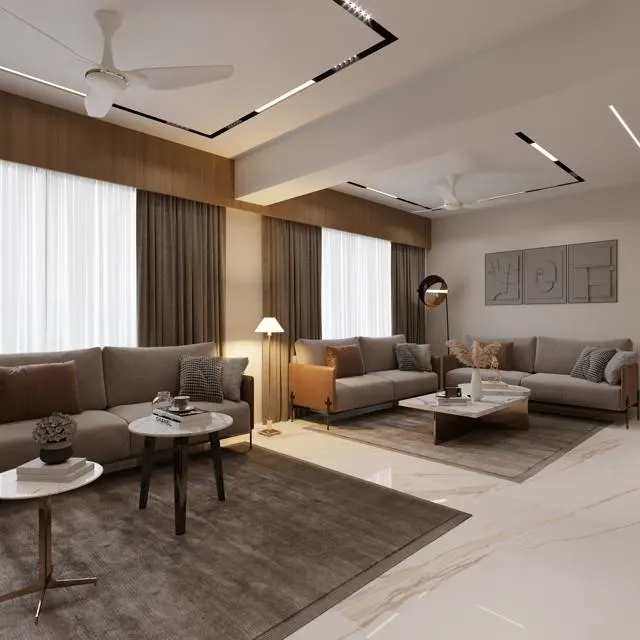
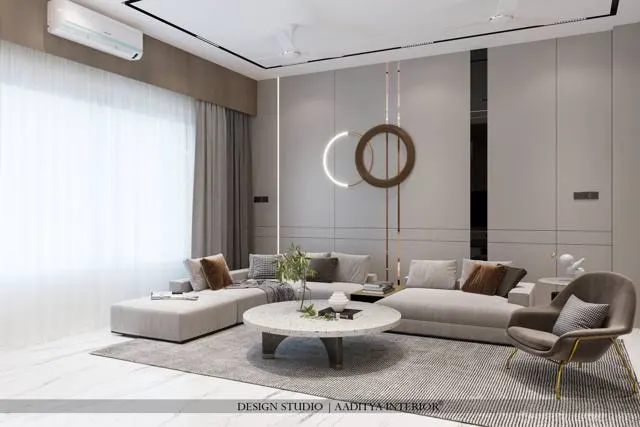
The living room needs the most flexible window treatment in the home, because it is used from morning to midnight. By day the family wants daylight and some privacy from the flats opposite; in the evening it wants a softer, closed room; and during afternoon sun it wants glare cut without total darkness. The standard Indian answer — a sheer on the inner track and a lined main curtain on the outer track, both on a ceiling-mounted double track — works because each layer covers one need. A zebra blind or a sunscreen roller blind can replace the sheer where a cleaner look is wanted.
Proportion matters as much as fabric. Curtains should run from just below the ceiling or from a concealed ceiling pocket to about 10–15 mm above the floor, so the room looks taller. The track should extend 150–300 mm beyond the window frame on each side, more on large windows, so the curtains stack back clear of the glass and do not steal daylight. Fullness of about 2 to 2.5 times the track length gives rich folds; less looks mean, more looks heavy. A ripple-fold or pinch-pleat header gives a tailored look; eyelet curtains are cheaper and casual but need a rod and take more stack-back space.
Living-room ideas that work
- Floor-to-ceiling linen-look curtains in warm white or oatmeal with a white sheer: calm, bright and timeless.
- A full curtain wall: run the track wall to wall, so a small window reads as a large one and the wall becomes soft.
- Sheer plus wooden venetian: venetians for daytime glare control, a sheer or light curtain for softness.
- Zebra blind plus side panels: a zebra blind does the work; two fixed decorative curtains frame the window.
- Motorised ripple-fold on a large sliding door: the curtain glides in even waves and never needs tugging.
Where the living room faces the building opposite at close range, choose a denser sheer or a privacy sheer rather than a fine voile; at night, when the room is lit, even dense sheers become see-through, which is why the second, opaque layer is needed. Where the living room faces west, the afternoon sun is the main problem, and a blind or shade outside the glass — dealt with in the orientation section below — does far more than any curtain.
Dining room: lighter, simpler, easy to clean
The dining area is usually part of the living room in Indian flats, so its windows should match the living room in fabric and height. Where it has its own window, a lighter treatment works: a single lined curtain in a washable fabric, a roman blind in a cotton or linen-look fabric, or a sheer alone if privacy is not an issue. Keep heavy pleated fabrics away from dining tables where food is served daily; they collect smells and splashes. If the dining window is near the kitchen door, a roman or roller blind is easier to keep clean than a full curtain.
Bedrooms: darkness, edges and morning sun
Sleep is the brief in a bedroom, and darkness comes from detail more than fabric. A blackout-lined curtain on a rod 100–150 mm above the window still lets light spill over the top, past the sides and through the centre gap. The fixes are simple when planned early: mount the track in a ceiling pocket or close to the ceiling, so there is no gap above; extend the track well beyond the window so the curtains overlap the wall on each side; use a centre overlap of about 100–150 mm or an overlap arm on the track; and bring the hem close to the floor. For blinds, outside-mounted blackout roller blinds that overlap the frame, or blinds running in side channels, cut edge leaks dramatically.
Master bedroom
The master bedroom deserves the softest, most considered treatment: a blackout-lined main curtain, ideally on a ceiling track, with a sheer on a second track for daytime. Velvet, chenille or heavier linen-look fabrics drape well and absorb sound. Where the wardrobe and bed leave little wall beside the window, a blackout roller or roman blind inside the window frame with a single decorative curtain is an elegant alternative. In larger rooms, motorising the blackout layer — about ₹12,000–35,000 per window for motor and track, indicatively — is a genuine comfort for daily use, provided a power point is planned in the curtain pocket during electrical work.
Children's rooms
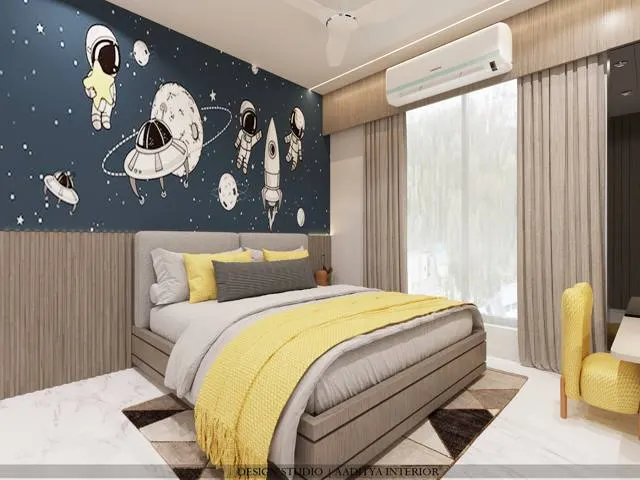
Children's rooms need darkness for afternoon naps and early bedtimes, durability, washability and, above all, cord safety. Looped cords on blinds and curtains are a known strangulation hazard for young children, so choose cordless or motorised blinds, wand-operated tracks, or blinds with cord tensioners and cleats fixed high — commonly advised at about 1500–1600 mm or more above the floor — and keep cots and beds away from windows. Roman or roller blinds in a blackout fabric with a cheerful, washable curtain in front work well; avoid fragile sheers that small hands pull down. Patterned fabrics hide fingerprints better than plain pale ones.
Elders' and guest rooms
For elderly parents, ease of use matters most: light curtains on a smooth-running track with a draw rod or wand, or motorised blinds with a simple remote or wall switch, so nobody has to stretch or tug. A sheer that lets in daylight without glare helps vision. Guest rooms can use simpler blackout roller blinds with a decorative curtain; they are used less often, so durability and low maintenance count for more than drama.
Kitchen and utility: wipeable and away from the flame
Fabric curtains do not belong in a kitchen where a gas hob is in use. They pick up grease and smells, and a curtain that can blow towards a flame is a fire hazard. The kitchen window usually sits above the counter, at a sill height of about 1050–1200 mm over an 850–900 mm counter, and it is often opened for ventilation. The best coverings are those that can be wiped and that stay put: an aluminium venetian blind, a PVC or polyester roller blind with a wipeable finish, a fixed frosted film for privacy, or nothing at all on windows that face a private side. If a hob is close to the window, choose a metal venetian or film, and keep any blind fully raised while cooking.
Utility and wash areas are similar: wet, often semi-open and used for drying clothes. PVC venetians, PVC roller blinds or simple outdoor bamboo blinds where the area opens to the outside are practical. Avoid wooden venetians and fabric roman blinds in any room where water or steam is regular.
Bathrooms and powder rooms: privacy without fabric
Bathroom windows in Indian flats are usually small ventilators placed high, at a sill of about 1800 mm, and many are already fitted with frosted or patterned glass. Often the best covering is none: a good frosted or fluted glass or a frosted window film gives privacy and lets the window open for ventilation. Where a larger window faces neighbours, a PVC or aluminium venetian blind, or a moisture-resistant roller blind in a PVC-coated fabric, is the practical answer. Fabric curtains and wooden blinds suffer in bathrooms; they absorb moisture, grow mould and stain. In a powder room, a small roman blind in a water-tolerant synthetic fabric can add softness if the room has an exhaust fan and no shower.
Study, home office and media room
Screens and glare do not mix. A study or home office needs control of daylight more than darkness: a sunscreen roller blind, which cuts glare and heat while keeping the view, or a wooden or aluminium venetian that can be tilted to bounce light to the ceiling. Place desks perpendicular to the window rather than facing it or with the window behind the screen. A media room or home theatre, by contrast, needs true darkness and sound absorption: blackout-lined velvet or chenille curtains at about 2 times fullness, on a ceiling track that runs wall to wall, often with a motor. Heavy curtains of this kind also help acoustics, as this blog's home theatre guide explains.
Pooja room, staircase and double-height windows
A pooja room rarely needs a heavy curtain; a sheer or a light cotton curtain in a warm colour, or a translucent roman blind, keeps the space bright and calm. Keep fabric well away from diyas and lamps. Staircase windows and tall double-height windows are hard to reach and often catch strong sun; motorised roller blinds, motorised tracks or fixed sheers on a long track are practical, and any fixings must be planned before scaffolding is removed. On very tall windows, ask the supplier about the maximum drop and width of a single blind, and about wind and weight on long tracks.
Balconies, sit-outs and verandahs: shade outside the room
The balcony is where Indian homes recover the old chik idea. An outdoor bamboo chik, a PVC chik, or an outdoor roller blind in a UV-stable mesh fabric shades the balcony, cuts glare into the living room behind and keeps some rain and dust off, while still letting breeze through. Where the balcony faces west, this outer layer is the single most effective cooling measure for the living room — far better than any heavy curtain inside, because the heat is stopped before it reaches the glass. Wind-rated zip blinds, which run in side channels, suit higher floors where ordinary blinds would flap. Some housing societies have rules about the appearance of balcony coverings, so check before buying.
| Orientation | Sun pattern in Indian cities | Main problem | Best treatment |
|---|---|---|---|
| North | Little direct sun; steady, glare-free light | Privacy, not heat | Sheers, light curtains, roller or zebra blinds; keep open by day |
| East | Strong, low morning sun | Early waking in bedrooms; morning glare | Blackout-lined curtains or blackout blinds in bedrooms; zebra or sunscreen blinds elsewhere |
| South | High sun in summer, lower in winter | Moderate heat; manageable with a chhajja | Overhang plus sheer and lined curtain; roman blinds |
| West | Low, hot afternoon sun | Heat and glare when rooms are in use | Outdoor chik, roller or zip blind outside the glass; lined or blackout curtains inside |
| Facing a building at close range | Any | Privacy by day and night | Denser sheer or zebra blind plus opaque layer for evenings |
Mounting, headers and sizes that apply in every room
A few dimensions repeat in every room, and getting them right is what separates a tailored window from a shop-bought one. The table below collects them; the companion rod-height guide explains each in detail. Inside-mounted blinds look neat but need enough recess depth and leave small light gaps; outside-mounted blinds and curtains overlap the frame and control light better.
| Item | Typical dimension | Why |
|---|---|---|
| Rod or track height | ≥ 100–150 above the frame, or 50–100 below the ceiling | Makes the window look taller; reduces light over the top |
| Track or rod width | 150–300 beyond the frame each side | Curtains stack back clear of the glass |
| Curtain hem | 10–15 above the finished floor | Clean look; no dust collection; easy cleaning |
| Curtain fullness | ≈ 2–2.5 × track length | Even folds without excess weight |
| Centre overlap (blackout) | ≈ 100–150 | Stops the centre light gap |
| Ceiling curtain pocket | ≈ 150–200 deep for a double track | Hides tracks; allows sheer plus main curtain |
| Roman blind recess depth | ≈ 75–100 | Folds need room inside the recess |
| Outside-mounted blind overlap | ≈ 50–100 each side | Reduces edge light leaks |
| Header style | Look | Fullness | Best rooms | Note |
|---|---|---|---|---|
| Eyelet (grommet) | Casual, deep even folds | ≈ 1.5–2 × | Bedrooms, kids' rooms, budget living rooms | Needs a rod; wider stack-back |
| Pinch pleat | Tailored, classic | ≈ 2–2.5 × | Living, dining, master bedroom | Works on track or rod |
| Ripple fold (wave) | Modern, even waves | ≈ 2–2.5 × (set by the carrier spacing) | Living rooms, large glass, motorised | Needs a ripple-fold track |
| Rod pocket | Gathered, informal | ≈ 2–2.5 × | Sheers, small windows | Hard to draw often; best for fixed panels |
| Tab top | Relaxed, casual | ≈ 1.5–2 × | Kids' rooms, informal spaces | Pulls unevenly on the rod |
Budgeting room by room
The same window can cost a few thousand rupees or several tens of thousands, depending on fabric, lining, track and motor. The bands below, from this blog's curtain and blind cost guide, are indicative October 2026 figures for a 3BHK in a metro or tier-2 city before GST; motorisation is extra at about ₹12,000–35,000 per window. Aaditya Interior usually advises spending most of the budget on the living room and master bedroom, and choosing simple, durable blinds for kitchens, bathrooms and utility areas.
| Room (3BHK) | Economy | Mid-range | Premium | Typical treatment |
|---|---|---|---|---|
| Living room (2 large windows or a sliding door) | ₹12,000–20,000 | ₹25,000–45,000 | ₹50,000–1,00,000+ | Sheer + lined or blackout; ripple fold at premium |
| Master bedroom (1–2 windows) | ₹6,000–12,000 | ₹12,000–30,000 | ₹30,000–70,000 | Blackout + sheer; motorised at premium |
| Two other bedrooms | ₹10,000–18,000 | ₹20,000–40,000 | ₹40,000–80,000 | Blackout curtains or blackout roller blinds |
| Kitchen and utility | ₹2,000–4,000 | ₹3,000–6,000 | ₹6,000–12,000 | Aluminium venetian or roller blind |
| Bathrooms (2–3 small windows) | ₹3,000–6,000 | ₹4,500–9,000 | ₹9,000–18,000 | PVC or aluminium venetian, frosted film |
| Balcony / sit-out | ₹2,000–5,000 | ₹5,000–12,000 | ₹12,000–30,000 | Bamboo chik or outdoor roller blind |
| Indicative total, 3BHK | ≈ ₹0.35–0.65 lakh | ≈ ₹0.7–1.4 lakh | ≈ ₹1.5–3.1 lakh+ | Before GST and motorisation |
Where window coverings are going
Three trends are clear. Motorisation is moving from luxury villas to ordinary apartments, with battery-powered blinds and tracks that do not need wiring and smart controls that close the west-facing blinds automatically in the afternoon. Outdoor shading is returning, as zip blinds and external roller blinds are recognised as the most effective way to keep heat out, especially as summers grow hotter. And fabrics are improving: solution-dyed and performance polyesters that resist fading, sunscreen fabrics that cut glare while keeping views, and recycled-content textiles. The room-by-room logic does not change — each window still has its own job — but the tools to do each job well are getting better and cheaper.
Rules for choosing curtains and blinds room by room
- Decide each window's job first — light, darkness, privacy, heat or moisture — and choose the covering from that.
- Layer living rooms: a sheer or sunscreen blind by day, an opaque lined curtain for evenings.
- For bedrooms, get darkness from the detailing: ceiling pocket, wide track, centre overlap and outside-mounted blinds.
- Keep fabric out of kitchens near the hob and out of wet bathrooms; use aluminium, PVC or film instead.
- Choose cordless, motorised or high-cleated cords in children's rooms, and keep cots away from windows.
- Shade west windows outside the glass with chiks, outdoor rollers or zip blinds.
- Mount tracks high and wide, hem curtains 10–15 mm off the floor and allow 2–2.5 times fullness.
- Plan power points in curtain pockets during electrical work if motorisation is even a possibility.
- Spend on the living room and master bedroom; keep service rooms simple and durable.
Frequently asked questions
Which is better for a bedroom, curtains or blinds?
For darkness, both work if detailed well. Blackout-lined curtains on a ceiling track with overlaps give softness and sound absorption; blackout roller blinds mounted outside the frame or in side channels are neater and cheaper. Many bedrooms combine a blackout blind with a decorative curtain.
What are the best blinds for a kitchen window?
Aluminium venetian blinds and PVC or polyester roller blinds with a wipeable finish are the most practical. They tolerate grease and steam, can be cleaned easily and do not hang loose near the hob. Wooden blinds and fabric roman blinds are best kept out of kitchens.
Are curtains or blinds better for a small living room?
Floor-to-ceiling curtains on a ceiling track that runs wider than the window make a small living room look taller and larger, especially in light colours. Blinds save the wall space beside the window and look neater where furniture sits close to the window. A light sheer with a slim blind is a good compromise.
How do I stop the afternoon sun in a west-facing living room?
Shade the glass from outside: a bamboo chik, outdoor roller blind or zip blind on the balcony or outside the window stops heat before it enters. Inside, lined or blackout curtains help, and a sunscreen blind cuts glare. A curtain alone cannot stop most of the heat once it has passed the glass.
Are blinds safe for children's rooms?
Choose cordless or motorised blinds where possible. If a blind has cords or chains, use a tensioner fixed to the wall or a cleat fixed high out of reach, and keep cots, beds and furniture children can climb away from windows.
Sources & standards
- National Building Code of India 2016, Part 8 (Building Services — lighting and natural ventilation)
- Bureau of Energy Efficiency — Eco-Niwas Samhita (Energy Conservation Building Code for residential buildings), guidance on shading and openings
- Neufert, Architects' Data — window and furnishing dimensions
- Manufacturer technical data for roller, venetian, roman, zebra and outdoor zip blinds and curtain tracks, described generically
- International child-safety guidance on window blind cords (for example, the cord-safety requirements in EN 13120), described generally
- Aaditya Interior blog — Curtains and Blinds Cost Guide; Curtain Fabric Types and Linings; Curtain Rod Height and Width Guide
- Price ranges: indicative October 2026 estimates — confirm locally before budgeting