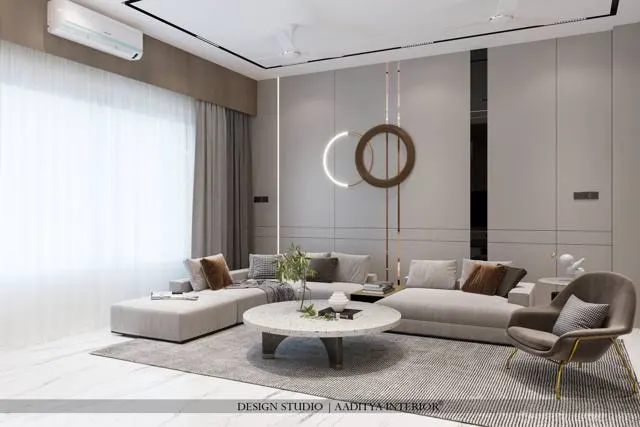
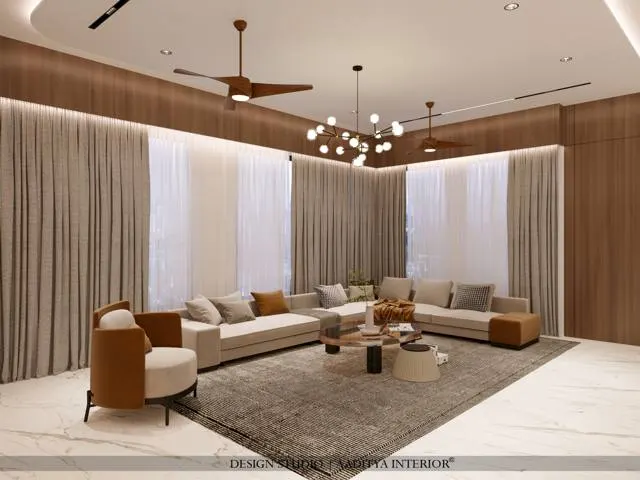
Indian flats are getting smaller while the furniture people want to fit into them is not. A 10 × 11 ft bedroom has to hold a queen bed, a wardrobe and a dresser; a 12 × 14 ft living room has to seat guests, host a TV and lead to the dining table. Designers have many tools for making such rooms feel larger — light colours, low furniture, hidden storage, good lighting — but none works as dramatically, or as cheaply, as a well-placed mirror. A mirror does not just reflect a room; it borrows space from the other side of the glass.
Mirrors are also among the most misused elements in Indian interiors. A small mirror hung in the middle of a large wall looks like a lost object. A mirror wall opposite the TV doubles the screen's glare. A mirror facing a cluttered utility passage doubles the clutter. A huge mirror glued to a damp wall with the wrong adhesive turns black at the edges within a year, or worse, falls. The difference between these and a mirror that genuinely opens up a room is a handful of rules about what the mirror sees, how big it is, and how it is fixed.
This article explains how mirrors create the illusion of space, traces their history from polished metal to the Sheesh Mahal, and then sets out twelve mirror ideas by room, with practical sizes in mm, fixing details, the types of mirror glass to choose, Vastu and comfort considerations, costs in October 2026 and the mistakes to avoid.
How a mirror creates space
A flat mirror creates an image that appears to lie as far behind the glass as the object is in front of it. Stand 2 metres from a mirror and your reflection seems to be 2 metres behind it — 4 metres away. In a room, that means a mirror on one wall makes the room appear to continue through the wall for the same distance, by the same depth as the room itself. The brain reads that reflected room as real space as long as the edges of the mirror are not obvious and the image is continuous with the room. That is why large, frameless or thinly framed mirrors, especially those that run to a corner or from floor to ceiling, create the strongest illusion, while a small framed mirror reads as an object on the wall.
The second effect is light. A good silvered mirror reflects most of the light falling on it, so a mirror beside or across from a window redistributes daylight into the darker parts of a room. In a deep Indian living room lit by one window at the balcony end, a mirror on a side wall near that window can visibly brighten the far end. The third effect is the view: a mirror that reflects a window, a garden, a balcony or a lit artwork doubles something pleasant, and the eye travels into it.
The illusion fails in three situations. When the mirror is too small, its frame is the main thing the eye sees and the reflection reads as a picture. When it reflects clutter — an open kitchen, a shoe rack, a laundry line — the room feels busier, not bigger. And when it reflects a bright source straight into the eyes — the afternoon sun through a west window, a downlight, a TV — it creates glare, and people end up covering it. Every placement decision below is a way of avoiding those three failures.
From polished metal to Sheesh Mahal: a short history
The earliest mirrors were polished stone and metal. Obsidian mirrors are known from very early sites in Anatolia, and polished bronze and copper mirrors were used in ancient Egypt, Mesopotamia, China and the Indian subcontinent. Kerala still makes the Aranmula kannadi, a hand-made metal-alloy mirror whose polished face reflects from the front surface rather than through glass; it is protected by a geographical indication and remains a celebrated craft object.
Glass mirrors backed with a reflective metal layer spread in Europe in the late medieval and Renaissance periods, and Venetian glassmakers on Murano became famous for them; for centuries large mirrors were luxury goods. Their most famous use in a room is the Hall of Mirrors at the Palace of Versailles, completed in the 1680s, where a wall of mirrors faces a wall of windows over the gardens — the same principle a designer uses today when placing a mirror opposite a window. In the nineteenth century, the chemist Justus von Liebig developed a method of depositing a thin layer of silver on glass chemically, which made good mirrors far cheaper and safer to produce, and modern silvered mirror glass descends from that process.
India developed its own spectacular tradition of mirror decoration. The Sheesh Mahal, or palace of mirrors, appears in several Rajput and Mughal palaces; the one at Amer Fort near Jaipur, with ceilings and walls inlaid with countless small pieces of convex mirror set in plaster, is the best known. In Gujarat, Kutch and Rajasthan, small mirror pieces — abhla — are stitched into embroidery and set into mud-and-plaster relief on the walls of village homes, where they sparkle in lamplight. The Indian tradition used mirror less to enlarge space than to multiply light and create shimmer, and both ideas still appear in modern interiors.
| Era | Mirror type | How it was used | What it teaches |
|---|---|---|---|
| Ancient | Polished stone, bronze, copper | Personal grooming, ritual objects | A mirror is precious — place it with intent |
| Traditional India | Metal mirrors (Aranmula kannadi), mirror pieces in plaster and textile | Ritual, ornament, shimmer in lamplight | Small mirrors multiply light rather than space |
| Renaissance to 17th century Europe | Glass with metal backing, Venetian mirrors | Luxury rooms; Hall of Mirrors at Versailles | Mirror opposite windows doubles light and view |
| 17th century India | Convex mirror pieces in Sheesh Mahal interiors | Palace ceilings and walls | Mirror as a jewel-like surface |
| 19th–20th century | Chemically silvered glass | Affordable mirrors everywhere; Art Deco mirror walls | Large mirrors became an everyday design tool |
| Today | Clear, low-iron, tinted, antique, LED-integrated | Space, light, mood, function | Choose the glass to suit the job |
Three placement rules
Rule 1 — Reflect light, a view, or a long axis
Before fixing any mirror, stand where the family will usually sit or walk and look at the wall where the mirror will go: what will it show from there? The best answers are a window or balcony, a garden or sky, a lit artwork or feature wall, or the long axis of the home — the view down a corridor or through a doorway. Placing a mirror on a wall at right angles to the main window is usually the best compromise: it reflects the window and spreads daylight deeper into the room without throwing direct sun back at people.
Rule 2 — Make it read as an opening, not an object
For a space-enlarging effect, a mirror should be large in proportion to the wall: roughly two-thirds of the width of the furniture beneath it, the full width of an alcove, or floor-to-ceiling on a narrow wall. Frameless mirrors with polished or bevelled edges, mirrors that meet a corner or the ceiling, and panelled mirrors in a grid all read as surfaces rather than objects. A decorative framed mirror can still be beautiful, but it is a piece of art, not a space-maker.
Rule 3 — Avoid glare, clutter and awkward reflections
Do not place a large mirror opposite a west-facing window that receives low afternoon sun, opposite the TV, or where it reflects downlights into the eyes of people seated. Avoid reflecting the kitchen work zone, a toilet door, a shoe rack or a utility balcony. In bedrooms, many people prefer not to see themselves from the bed, and common Vastu guidance also advises against a mirror facing the bed or the main door and against two mirrors facing each other; these preferences are easy to respect by putting mirrors on side walls or inside wardrobe shutters, as this site's Vastu mirror guide explains.
Twelve mirror ideas that make rooms bigger
| Idea | Best room | Typical size (mm) | Why it works | Watch out for |
|---|---|---|---|---|
| Floor-to-ceiling mirror on a side wall | Narrow living room, dining | 1200–2600 wide × full height | Room reads nearly twice as wide | Must be safety-backed and mechanically fixed |
| Mirror panel grid behind the sofa | Living room | Panels 300–600 square or 400 × 800 | Joints make it read as a wall finish | Fingerprints at sofa height; keep bottom 150–250 above sofa back |
| Mirrored wardrobe shutters | Small bedroom | Full shutter, 450–600 wide × 2100–2400 | Bedroom wall disappears; doubles as dressing mirror | Do not face the bed; consider one or two shutters only |
| Arched floor mirror | Bedroom, living corner, foyer | 600–900 wide × 1500–2100 | Reads like an extra window | Lean only if anchored to the wall |
| Mirrors flanking a window | Living, dining, bedroom | 300–600 wide strips, window height | Widens the window and spreads light | Side reveals must be dry and flat |
| Mirror at the end of a corridor | Passages, foyers | Full width of the corridor end | Corridor appears to continue | Light the end wall so the reflection is bright |
| Mirror over a console | Foyer, living | 600–1000 wide; bottom 100–200 above console | Reflects the room as you enter | Avoid facing the main door directly |
| Mirror strips or fluted mirror beside TV or headboard | Living, bedroom | 100–300 wide strips | Adds depth without big reflections | Do not place opposite the TV screen |
| Dining wall mirror | Dining | Width of the table or more | Doubles the table and pendant light | Keep chairs from hitting it; safety film |
| Bathroom full-width mirror | Bathroom | Full vanity width, 900–1200 high | Small bathrooms open up dramatically | Moisture-resistant mirror; edge sealing |
| Antique or tinted mirror wall | Bar, dining, powder room | Feature panels | Depth with a soft, moody reflection | Not for grooming; hides less dust than you think |
| Mirrored furniture | Bedroom, living | Side tables, consoles, cabinet shutters | Furniture appears lighter | Chips at edges; keep away from kids' play areas |
Living room
The living room offers the most space for a mirror and the greatest risk of glare. The classic placement is a mirror panel wall behind the sofa, which reflects the room and the window in front of it, but it should be kept clear of the TV's reflection: if the TV faces the sofa, the mirror behind the sofa will show the screen. Where the TV wall is opposite the sofa, a side-wall mirror or mirror strips flanking the window are safer. A mirror panel grid, with panels of 300–600 mm, reads as a wall finish rather than a giant mirror and is easier to transport and fix than one large sheet.
Bedroom
In a small bedroom, mirrored wardrobe shutters are the most efficient mirror of all: they make the wardrobe wall visually disappear and double as the dressing mirror, with no extra wall needed. Two cautions apply. A full wall of mirrored shutters directly facing the bed is uncomfortable for many people and is discouraged by common Vastu guidance; mirroring only one or two shutters on the side of the wardrobe, or mounting the mirror inside a shutter, avoids that. And mirrored shutters should use 4–6 mm mirror with safety backing film, bonded to the shutter with a neutral-cure mirror adhesive, because shutters are slammed far more often than walls are touched. An arched mirror leaning in a corner is an alternative where the wardrobe is elsewhere, but it must be anchored to the wall so that it cannot topple.
Dining room and foyer
A mirror on the long wall of the dining area doubles the table and the pendant light above it, and in a combined living–dining room it reflects the living area back to the diners. Keep at least 900–1000 mm between the table edge and the mirror wall so that chairs pulled back do not strike the glass, and use a safety-backed mirror. In the foyer, a mirror over a console lets residents check their appearance before going out and reflects the home to those entering; this site's foyer and Vastu guides suggest placing it on a side wall rather than directly facing the main door, with its centre at about 1500 mm.
Corridors, bathrooms and powder rooms
A mirror at the end of a short corridor, lit by a wall-washer or a picture light, makes the corridor appear to continue into another room. In bathrooms, a full-width mirror above the vanity, running from the counter or backsplash to about 2000–2100 mm, makes even a 5 × 7 ft bathroom feel open; moisture-resistant, copper-free mirror with sealed edges lasts longest, and the lighting should come from the sides rather than above, as explained in this site's bathroom mirror lighting guide. Powder rooms are the place for drama: an antique or bronze-tinted mirror wall in a small powder room gives a sense of depth and mood that would be too much in a living room.
Choosing the mirror glass
The mirror type follows from the job, as this site's guide to mirror types explains in detail. Where people check their appearance, accuracy matters, so the mirror should be clear or low-iron. Where the aim is depth and atmosphere, tinted or antique mirror is often more flattering and hides the edge of the illusion. Thickness is usually 5–6 mm for wall mirrors and 4–6 mm for shutters; thinner glass distorts more and breaks more easily.
| Mirror type | Look | Best for space-making | Indicative cost (October 2026) |
|---|---|---|---|
| Clear silvered, 5–6 mm | Neutral, slightly green at the edge | Most walls, wardrobe shutters, bathrooms | ≈ ₹150–400 per sq ft fixed |
| Low-iron (ultra-clear) | Brightest, truest colour | Dressing zones, white interiors, large walls | ≈ ₹300–600 per sq ft fixed |
| Grey or bronze tinted | Softer, warmer or cooler reflection | Living feature walls, bars, dining | ≈ ₹200–450 per sq ft fixed |
| Antique, factory pattern | Mottled, vintage | Powder rooms, bars, panelled walls | ≈ ₹400–900 per sq ft fixed |
| Antique, hand-distressed | Artisan, unique | Statement walls in premium homes | ≈ ₹900–2,000+ per sq ft |
| Bevel edge (standard 20–25 mm) | Sparkling edge, classic | Panel grids and frameless mirrors | ≈ ₹60–120 per running ft extra |
Avoid acrylic mirror sheet for large space-making walls. It is light and shatter-resistant, which makes it useful in children's rooms and gyms in small pieces, but it flexes and distorts the reflection, and a distorted reflection destroys the illusion of a continuous room.
Fixing large mirrors safely
Glass mirrors are heavy — about 2.5 kg per square metre for every millimetre of thickness, so roughly 12.5 kg per m² for 5 mm and 15 kg per m² for 6 mm. A 1200 × 2400 mm mirror in 6 mm glass weighs over 40 kg. Fixing that weight with blobs of the wrong silicone on a painted, slightly damp wall is the most common cause of mirror failure in Indian homes: acetic-cure silicone attacks the silver backing and causes black edges, paint peels away under the load, and the mirror slides or falls.
The reliable detail, shown in Fig. 3, has four parts. A 12 mm BWR plywood backing screwed and plugged into the masonry gives a flat, dry, uniform surface and isolates the mirror from damp in the wall. A neutral-cure mirror adhesive applied in vertical strips — never acetic silicone, which smells of vinegar and corrodes the silver — bonds the mirror while leaving an air gap behind it. An aluminium channel at the bottom carries the weight, and clips at the top and sides hold the panel if the adhesive ever fails. A safety backing film on the rear face holds the pieces together if the mirror breaks, which is essential in living rooms, dining walls, wardrobe shutters and anywhere children play. In the October 2026 bands used on this site, safety film adds about ₹30–80 per sq ft and ply backing with channel and clips about ₹80–200 per sq ft.
Size also matters for logistics. Before ordering a single floor-to-ceiling sheet, check that it can travel in the lift or turn on the staircase landing of the building; many large mirrors in Indian apartments are panelled precisely because the one-piece sheet could not be carried in. Panels with neat polished or bevelled joints, or a deliberate grid, are often the more elegant solution in any case.
Where to put mirrors in a small bedroom
Fig. 4 shows the options in a typical 3050 × 3350 mm bedroom with one window. The best positions reflect the window or the room's longest dimension without facing the bed or the door; the poor positions face the bed, catch hot sun, or show the bathroom door.
What mirror decor costs: October 2026
Mirror walls are priced per square foot of glass fixed, plus edge work and fixing extras. The bands below are the same indicative October 2026 figures used in this site's mirror type and gym guides, so that they can be compared directly.
| Item | Indicative cost | Unit | Main variables |
|---|---|---|---|
| Clear silvered mirror, 5 mm, polished, fixed | ₹150–400 | per sq ft | Brand, copper-free, size, wall preparation |
| Low-iron mirror, fixed | ₹300–600 | per sq ft | Availability; usually ordered to size |
| Tinted mirror (grey, bronze), fixed | ₹200–450 | per sq ft | Tint, thickness, brand |
| Antique mirror, factory pattern | ₹400–900 | per sq ft | Pattern density, base tint |
| Bevel edge (standard 20–25 mm) | ₹60–120 | per running ft | Width, glass thickness |
| Safety backing film | ₹30–80 | per sq ft extra | Film grade, factory or site applied |
| Plywood backing with aluminium channel and clips | ₹80–200 | per sq ft extra | Board grade, panel size, wall condition |
| Safety-backed mirror wall, complete (gym-type) | ₹250–500 | per sq ft | With channels and clips |
As a worked example, a mirror panel wall of 2400 × 1200 mm (about 31 sq ft) behind a sofa, in clear 5 mm mirror panels with polished V-groove joints, costs roughly ₹4,650–12,400 for the fixed mirror at ₹150–400 per sq ft, plus about ₹930–2,480 for safety film and ₹2,480–6,200 for ply backing, channel and clips — about ₹8,000–21,000 in total, before any bevelling. The same wall in bronze tint would be roughly ₹6,200–14,000 for the glass alone. Compared with most feature-wall treatments, a mirror wall is one of the most cost-effective ways to change how a room feels.
Mistakes to avoid
| Mistake | Result | Better |
|---|---|---|
| Small mirror centred on a big wall | Reads as a lost object | Size to about two-thirds of the furniture or the full alcove |
| Mirror opposite the TV | Glare and double screens | Side wall or strips beside the window |
| Mirror reflecting clutter or the kitchen | Room feels busier | Check the view from the sofa and the door before fixing |
| Mirror facing a west window | Sun and heat reflected at people | Side wall to the window, or sheer curtains |
| Acetic silicone on painted or damp wall | Black edges; mirror slips | Ply backing, neutral-cure adhesive, channel and clips |
| No safety film in living or kids' areas | Dangerous shards if broken | Safety backing film on every large mirror |
| One huge sheet that cannot be carried in | Delays, breakage, re-ordering | Check lift and stair access; panel the wall |
Where mirror design is going
Mirror design is moving in two directions at once. On one side, technology: bathroom and dressing mirrors with integrated LED lighting, demisting pads, touch controls and, in some products, displays; low-iron glass that gives a truer, brighter reflection; and better copper-free silvering that resists the humidity of Indian bathrooms. On the other, craft: the return of antique and smoked mirrors, fluted and reeded mirror strips, arched and organic shapes, and the Indian mirror-work tradition reinterpreted in modern mosaic panels and Sheesh Mahal-inspired powder rooms. Both trends share the same lesson the Hall of Mirrors taught: a mirror is most powerful when it brings light and a view deeper into a room.
Rules for mirrors that make rooms bigger
- Decide what the mirror will reflect from where people sit and walk — a window, a view, a lit wall or a long axis.
- Make it big: about two-thirds of the furniture width, a full alcove, or floor to ceiling on a narrow wall.
- Prefer side walls to a window; avoid facing west sun, the TV, clutter, the bed and the main door.
- Keep the bottom edge 150–250 mm above a sofa back and 100–200 mm above a console.
- Use clear or low-iron mirror where people check their appearance; tinted or antique for mood.
- Fix every large mirror on a ply backing with neutral-cure adhesive, a bottom channel, top clips and safety film.
- Check lift and staircase access before ordering a single large sheet; panel the wall if in doubt.
- Light the reflected surface — a mirror in a dark corner only doubles the darkness.
Frequently asked questions
Where should a mirror be placed to make a room look bigger?
On a wall at right angles to the main window, or on the long side wall of a narrow room, so that it reflects daylight and the view and makes the room appear to continue. The end wall of a corridor is another strong position. Avoid walls where the mirror would reflect the TV, direct sun, clutter or the bed.
Does a mirror opposite a window make the room brighter?
Yes, it reflects daylight and doubles the view, which is the principle of the Hall of Mirrors at Versailles. In Indian homes, though, a mirror directly opposite a west or south window can throw harsh sun and heat back into the room. A side-wall position usually gives most of the brightness with less glare.
How big should a mirror above a sofa be?
About two-thirds of the sofa's width — roughly 1400 mm for a 2100 mm sofa — with the bottom edge 150–250 mm above the sofa back. A panelled mirror wall running the full width of the sofa wall is an even stronger space-maker, provided it does not reflect the TV.
Are mirror walls safe in homes with children?
They can be, if the mirror is 5–6 mm glass with safety backing film, fixed on a ply backing with a bottom channel and clips rather than adhesive alone, and the edges are polished. Avoid mirrored furniture with exposed edges in play areas, and consider acrylic mirror only for small, low pieces where impact is likely.
Is a mirror facing the bed bad?
Common Vastu guidance advises against it, and many people also find it uncomfortable to see movement in a mirror at night. The practical solution is simple: put the bedroom mirror on a side wall, inside a wardrobe shutter or on a shutter that does not face the bed.
Sources & standards
- Bureau of Indian Standards — IS 16231 (use of glass in buildings, safety), IS 14900 (float glass), IS 2553 (safety glass)
- National Building Code of India 2016 — Part 6 (structural design, glass and glazing) and Part 8 (lighting)
- Château de Versailles — official description of the Hall of Mirrors
- Department of Archaeology and Museums, Government of Rajasthan — Amer Fort and its Sheesh Mahal
- Geographical Indications Registry, Government of India — Aranmula Kannadi
- Neufert, Architects' Data — furniture and wall clearances in living rooms and bedrooms
- Price ranges: indicative October 2026 estimates — confirm locally before budgeting