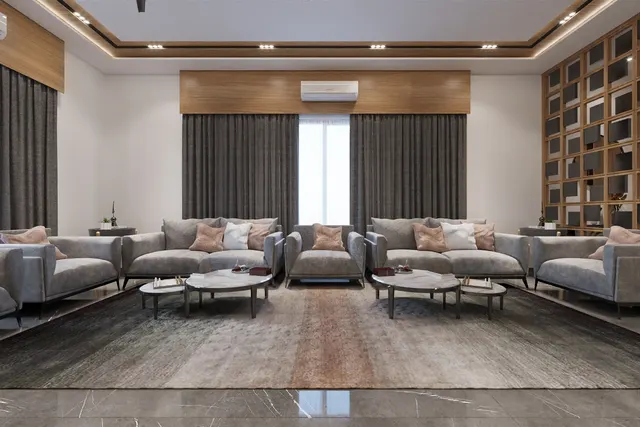
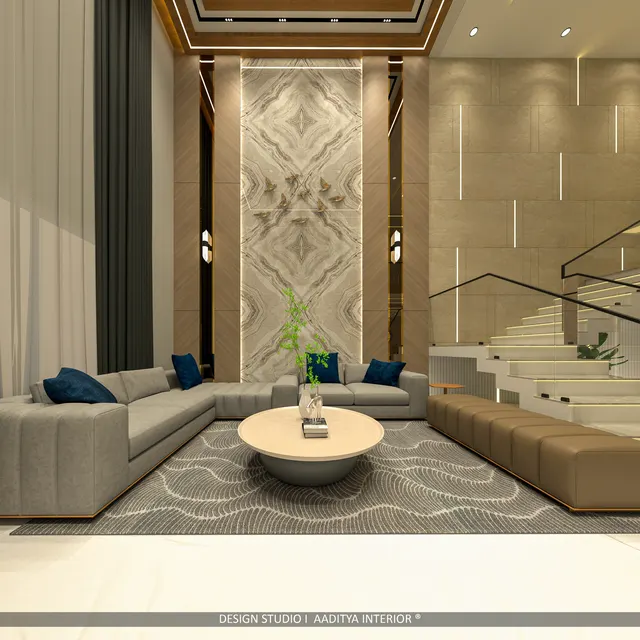
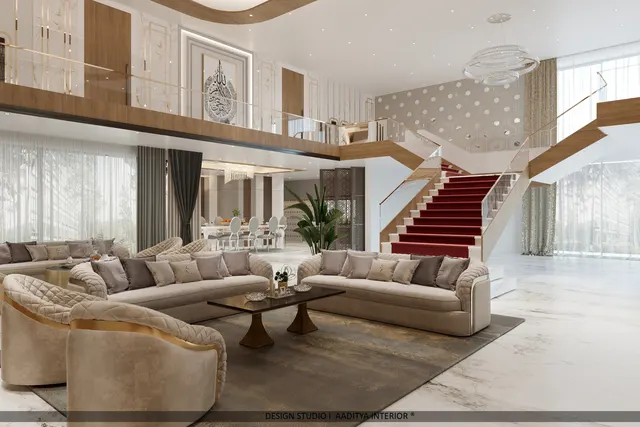
Bare walls are the most common unfinished business in Indian homes. The interiors are complete — false ceiling, wardrobes, modular kitchen, sofa — and the walls stay empty for years, or receive a single small frame hung too high, or a crowded cluster of calendar prints and family photographs that never quite looks intentional. The reason is rarely money. It is uncertainty: what to hang, how big, how many pieces, and how to arrange them so that the wall looks composed rather than accidental.
This article answers those questions with ideas and with numbers. It covers the layouts that work for gallery walls, how to size art to a sofa, bed or console, the Indian art traditions that make walls distinctive — from Madhubani and Warli to Gujarat's own Mata ni Pachedi, Rogan and Lippan work — and how to frame, light and protect art in a humid Indian climate. It builds on this site's Wall Art Hanging Height Guide, which sets the heights; here the focus is on what to choose and how to compose it.
The rules are deliberately simple. A wall looks finished when the art has the right scale for the furniture and wall around it, when a group is arranged on a consistent spacing and reads as one shape, and when there is a theme — of colour, subject, frame or medium — that ties the pieces together. Everything else is taste.
Walls that tell stories: a short history of art at home in India
Indian homes decorated their walls long before framed pictures arrived. In the Mithila region of Bihar, women painted the walls and floors of their homes with ritual images for weddings and festivals; that tradition, carried onto paper in the twentieth century, became the Madhubani painting now sold worldwide. In Maharashtra, the Warli community painted scenes of village life in white on mud walls. In Kutch, mud-and-mirror relief — Lippan kaam — decorated the walls of round bhunga houses. The merchant havelis of Shekhawati in Rajasthan were covered with painted frescoes inside and out. Art was part of the wall, not something hung on it.
Framed pictures came with print. In the late nineteenth century, the painter Raja Ravi Varma set up a lithographic press, and his images of gods and goddesses, printed cheaply in large numbers, entered ordinary homes. Calendar art and framed devotional prints followed, and for much of the twentieth century the typical Indian wall carried a deity print, a family photograph and a calendar. Contemporary homes have widened the palette — original paintings, photography, textiles, folk art, sculpture — and the gallery wall, an arrangement of many pieces composed as one, has become one of the most requested features in living rooms and staircases.
Gallery wall layouts: seven ways to arrange a group
Every gallery wall is a variation on a few basic layouts. Choosing the layout first, before buying or framing anything, prevents the most common result — a collection of mismatched pieces that refuses to settle into a shape. The spacing figures below match this site's hanging-height guide: 50–75 mm between frames in tight groups, 75–150 mm in looser rows.
Grid
Identical frames, identical gaps, rows and columns. A grid of four, six or nine prints is the calmest gallery wall and the easiest to get right, because every measurement repeats. It suits botanical prints, architectural drawings, a series of photographs or a set of small folk paintings in matching frames. Keep the gaps exactly the same — 50–75 mm — because in a grid one crooked frame is instantly visible.
Salon
Mixed sizes, shapes and frames, packed closely with roughly even gaps, and the outer edges kept roughly straight. The salon wall is the most personal layout — family photographs beside a small painting, a textile fragment, a mirror, a brass plate — and it rewards a theme: one frame colour, or one colour palette across the art, or one subject. Lay it out on the floor first, starting with the largest piece slightly off-centre, and build outwards.
Centre-line row, ledge, triptych and symmetry
A centre-line row aligns the centres of mixed-size pieces on one horizontal line; it suits corridors and long walls. A picture ledge — a shelf 60–100 mm deep with a lip — lets frames lean and overlap, and is ideal for renters and for collections that change. A triptych splits one image or three related pieces into equal panels with 50–100 mm gaps; it fills a long wall above a sofa or bed with strong, simple order. A symmetrical arrangement mirrors pieces around a central element — a large painting, a mirror or a window — and suits formal living rooms, dining rooms and pooja-adjacent walls.
Staircase walls
A staircase is a natural gallery, and the seventh layout. The frames follow the pitch of the stair, with their centres about 1450–1500 mm above the nosing line, so that each picture sits at eye level for someone standing on the step below it. Keep the frames clear of the handrail and its hand zone, and avoid heavy glass frames where people may brush against them. Family photographs and a series of prints work well, because the eye moves along the stair.
Scale: how big should the art be?
Most wall art in Indian homes is too small. A 300 × 400 mm print above a 2100 mm sofa looks like a postage stamp. The rule of thumb that works is that a single piece or the outer rectangle of a group should be about two-thirds to three-quarters of the width of the furniture beneath it. On an open wall with no furniture, the art or group should occupy roughly 50–75 per cent of the wall width between natural boundaries such as doors, windows or corners. Heights follow the hanging guide: centre about 1450–1500 mm above the floor on an open wall, and a 200–300 mm gap between a sofa back or headboard and the bottom of the frame.
| Furniture below | Typical width (mm) | Art or group width (≈ 2/3–3/4) | Gap above furniture | Ideas that suit |
|---|---|---|---|---|
| Three-seater sofa | 2130–2290 | 1400–1700 mm | 200–300 mm above the back | Triptych, one large canvas, 6–9 piece grid |
| Two-seater sofa / diwan | 1520–1830 | 1000–1350 mm | 200–300 mm | One large piece, pair of verticals |
| Queen bed | ≈ 1650–1750 incl. frame | 1100–1300 mm | 200–300 mm above headboard | Calm single piece, textile, light frames only |
| King bed | ≈ 1950–2050 incl. frame | 1300–1550 mm | 200–300 mm | Pair or triptych, Pichwai panel |
| Console or sideboard | 1200–1800 | 800–1350 mm | 150–250 mm above the top | Mirror with flanking pieces, ledge display |
| Dining table (art on the long wall) | 1500–2100 | 1000–1500 mm | Centre at 1300–1400 mm | Still life, food or market scenes, large photograph |
| Open wall, no furniture | Wall width | 50–75 % of the wall | Centre at 1450–1500 mm | Statement piece or full gallery wall |
Indian art traditions for modern walls
Mass-produced canvases from online catalogues look the same in every flat. Indian folk and classical traditions give a wall character and a story, support living artists, and work surprisingly well in contemporary interiors — a black-and-white Warli panel in a white Japandi living room, a Gond tiger in a children's room, a Pichwai lotus panel above a bed. Buying directly from artists, cooperatives, government emporia and crafts fairs helps ensure authenticity and that the maker is paid fairly.
| Tradition | Region | Look | Works well in |
|---|---|---|---|
| Madhubani (Mithila) | Mithila region, Bihar | Dense line work, double outlines, no empty space; bright or black-and-red | Living rooms, dining, foyer |
| Warli | Palghar–Thane belt, Maharashtra | White figures of circles, triangles and lines on earth-red or brown | Minimal and Japandi rooms, children's rooms |
| Gond | Madhya Pradesh | Animals and trees filled with dots and dashes; vivid colour | Children's rooms, playful living rooms |
| Pichwai | Nathdwara, Rajasthan | Painted cloth with lotus ponds, cows and Krishna themes; gold accents | Above beds, dining walls, near pooja spaces |
| Kalamkari | Srikalahasti and Machilipatnam, Andhra Pradesh | Pen-drawn or block-printed cloth in natural dyes | Textile hangings, bedrooms |
| Tanjore (Thanjavur) | Tamil Nadu | Gesso relief, gold foil, rich colours, deities | Formal living rooms, pooja-adjacent walls |
| Pattachitra | Odisha (Raghurajpur and nearby villages) | Fine narrative paintings on cloth or palm leaf | Corridors, study, reading corners |
| Phad | Bhilwara region, Rajasthan | Long scroll narratives of folk deities in red, yellow and green | Long walls above sofas or benches |
| Mata ni Pachedi | Ahmedabad, Gujarat | Temple cloth in red, black and white with the mother goddess and stories | Living rooms, staircase walls |
| Rogan | Nirona, Kutch, Gujarat | Castor-oil paint drawn with a stylus; symmetrical tree-of-life motifs | Small framed pieces, bedrooms |
| Lippan kaam | Kutch, Gujarat | Clay relief with small mirrors, white or coloured | Feature walls, foyers, pooja backdrops |
Mixing traditions in one gallery wall rarely works; mixing one tradition with plain photography or line drawings often does. A strong approach is to let one large folk piece be the anchor and surround it with smaller, quieter pieces that share its colours. For walls near the pooja unit or in prayer rooms, devotional art follows family tradition; the design questions are only scale, light and protection from diya smoke.
Beyond paintings: other things that make good wall art
- Textiles — a framed Patola or Ajrakh fragment, a Kantha quilt, a Kutch embroidery panel or a woven Bhujodi shawl hung from a timber batten.
- Mirrors — a single large mirror or a cluster of small framed mirrors brings light into dark corridors and foyers.
- Brass and metal — plates, thalis, bells and urlis arranged as a cluster; Moradabad brassware and dokra figures add warmth.
- Architectural salvage — an old carved door panel, a jharokha frame or a jaali fragment mounted as a relief.
- Photography — black-and-white family photographs in matching frames, or a single large landscape print.
- Typography and maps — a city map of Surat or Ahmedabad, an old railway map, a calligraphy piece in Gujarati, Hindi or Urdu.
- Plates and ceramics — blue pottery from Jaipur or Khurja ceramics arranged in a salon cluster.
- Three-dimensional pieces — wall sculptures, macramé, cane or bamboo weaves, dried-flower frames.
Room-by-room ideas
| Room | Idea | Scale and placement | Avoid |
|---|---|---|---|
| Living room | One large anchor piece or a triptych above the sofa; gallery wall on the longest wall | Group 2/3 of sofa width; bottom 200–300 above sofa back | Many small frames scattered on different walls |
| Dining | Still life, a large photograph, or a Pichwai or Madhubani piece on the long wall | Centre about 1300–1400 for seated viewing | Glass-fronted art right beside the wash basin |
| Master bedroom | Calm, low-contrast art above the bed; textile panels | Light frames, secured with two fixings | Heavy glass frames directly above the pillows |
| Children's room | Gond or Warli animals, alphabet and map prints, a pin board | Hang lower — centre about 1100–1200 for young children | Glass glazing within reach — use acrylic |
| Foyer | A mirror with a console, or one bold piece facing the main door | Centre 1450–1500; visible from the door | Clutter at the entrance |
| Staircase | Family photographs or a print series following the stair | Centre 1450–1500 above nosing | Frames inside the handrail zone |
| Corridor | Centre-line row of shallow frames, or a picture ledge | Frames less than about 50 mm deep | Projecting 3D pieces in narrow passages |
| Home office | Maps, architectural drawings, a pin board behind the desk | Above or beside the screen, not behind the camera clutter | Busy patterns behind video calls |
Frames, mats and glazing
The frame and mat decide how serious a piece looks. A wide mat — the card border between the art and the frame — gives even a small print presence and keeps glazing off the surface. A thin black, white, natural wood or brass-toned frame suits most contemporary rooms; ornate gilt frames suit Tanjore and classical pieces. Original works on paper should have an acid-free mat and backing, because ordinary card yellows and stains the paper over time. Acrylic glazing is lighter and safer than glass for large frames, children's rooms and staircases; anti-reflective and UV-filtering glazing cost more but protect valuable pieces and remove glare from windows opposite.
| Art size | Dimensions (mm) | Typical mat width (mm) | Approx. frame outer size (mm) | Use |
|---|---|---|---|---|
| A4 | 210 × 297 | 50–60 | 330 × 420 | Small grids, children's art, certificates |
| 8 × 10 in | 203 × 254 | 50–60 | 320 × 370 | Photographs |
| A3 | 297 × 420 | 70–85 | 500 × 640 | Gallery walls, prints |
| 12 × 16 in | 305 × 406 | 70–85 | 500 × 600 | Photographs, folk paintings on paper |
| A2 | 420 × 594 | 75–100 | 620 × 800 | Statement prints, posters |
| 18 × 24 in | 457 × 610 | 75–100 | 660 × 820 | Posters, larger paintings |
| A1 | 594 × 841 | Often no mat; float or thin frame | 650 × 900 | Large single piece above a sofa |
| 24 × 36 in | 610 × 914 | Often no mat | 660 × 960 | Canvas or poster; triptych panels |
Light, sun and humidity: protecting art in Indian homes
Indian homes are hard on art. Strong daylight fades inks, watercolours and textile dyes; humidity in coastal and monsoon months encourages mould and the brown spotting on paper called foxing; dust and kitchen grease settle on frames. A few precautions make art last far longer. Hang works on paper and textiles away from direct sunlight, or use UV-filtering glazing. Avoid exterior walls that stay damp in the monsoon, bathrooms and the wall beside the kitchen hob. Use acid-free mats and sealed backs for anything valuable, and small bumpers to hold the frame 3–6 mm off the wall. Canvas paintings should not be glazed; dust them gently with a soft brush. In air-conditioned homes, the rooms are kinder to art than the outside climate — but switching AC on and off daily, with windows opening between, is not.
Lighting makes a modest piece look important. An adjustable accent spot or a track head with a narrow beam, high colour rendering (Ra 95 or more) and a warm-neutral colour temperature of 2700–3500 K is the usual choice, aimed at about 30 degrees from vertical to avoid glare on the glazing. Indicatively, a standard accent fitting costs about ₹1,200–3,000 and a premium one ₹2,500–8,000, and a track with three heads about ₹4,000–12,000 in October 2026 — the same bands as this site's hanging-height guide. Plan the electrical point during the interior work; a picture light added later usually means a visible wire.
Budgets
Art budgets range from a few hundred rupees for an unframed print to many lakhs for an established artist's original. The bands below are indicative October 2026 ranges for the kinds of pieces most homes buy; they vary with size, artist, gallery and framing, and should be treated as a starting point for planning, not a valuation.
| Type of piece | Indicative cost (Oct 2026) | Notes |
|---|---|---|
| Printed poster or art print, framed | ₹1,500–10,000 per piece | Size and frame decide most of the price |
| Limited-edition photographic or art print | ₹5,000–50,000+ | Ask for the edition number and paper type |
| Original folk painting on paper (Madhubani, Warli, Gond) | ₹2,000–50,000+ | Size and artist matter; buy from artists or cooperatives |
| Painted textile (Pichwai, Kalamkari, Mata ni Pachedi) | ₹5,000 to several lakh | Hand-painted Pichwai at the upper end |
| Original contemporary painting by an emerging artist | ₹15,000–2,00,000+ | Art fairs, college shows and galleries |
| Accent light for a single piece | ₹1,200–3,000 standard; ₹2,500–8,000 premium | Ra 95+, 2700–3500 K, narrow beam |
| Track with three heads for a gallery wall | ₹4,000–12,000 | Lets lights move as art changes |
| Picture ledge (60–100 mm deep, 1200–1800 long) | Verify locally | Carpenter-made in ply or solid wood |
A practical plan for a new flat is to budget for one significant piece for the living room — an original folk painting or a large textile — and fill the rest gradually. Aaditya Interior usually marks art positions, picture-light points and any backing panels in gypsum walls on the electrical and carpentry drawings, even when the art will be bought later, so that nothing needs to be chased into finished walls.
Where wall art is heading
The direction in Indian homes is towards fewer, larger and more personal pieces: one original painting rather than six catalogue canvases, and art that connects to place and family — a regional craft, a photograph of a grandparent's village, a map of the home city. Craft revival platforms and artist cooperatives make it easier to buy directly from makers. Digital frames and art displays that change images are appearing in living rooms, and rail-and-cable hanging systems let collections change without new holes. At the same time, walls themselves are becoming art again — limewash murals, Lippan relief, hand-painted Warli walls — returning to the older Indian idea that decoration belongs in the wall, not only on it.
Rules for wall art and gallery walls
- Choose the layout before buying the art: grid, salon, centre-line row, ledge, triptych, symmetry or staircase.
- Make a single piece or group about two-thirds to three-quarters of the furniture width below it.
- Hang the centre at about 1450–1500 mm on an open wall, and leave 200–300 mm above a sofa back or headboard.
- Keep 50–75 mm between frames in tight groups and 75–150 mm in looser rows — the same gap throughout.
- Tie a gallery wall together with one theme: frame colour, palette, subject or medium.
- Lay out the arrangement on the floor or with paper templates on the wall before drilling.
- Use acid-free mats, sealed backs and wall bumpers for paper and textiles; keep art out of direct sun and damp walls.
- Plan picture-light points and gypsum-wall backing panels during the interior work.
Frequently asked questions
How do I start a gallery wall?
Choose the wall and the layout, then gather pieces that share a theme. Cut paper templates to each frame size, tape them to the wall, adjust until the group reads as one shape with even gaps, and mark the hook positions through the paper before drilling. Start with the largest piece near the centre.
What size art should go above a sofa?
About two-thirds to three-quarters of the sofa's width. For a typical three-seater of 2130–2290 mm, that is a single piece or group of about 1400–1700 mm wide, with its bottom edge 200–300 mm above the sofa back.
Which Indian paintings are good for the living room?
Large Madhubani, Pichwai, Phad or Mata ni Pachedi pieces make strong anchors for living rooms, while Warli and Gond work well in minimal or playful rooms. Choose by colour and scale as much as by tradition, and buy from artists or cooperatives to ensure authenticity.
How far apart should pictures be in a gallery wall?
Keep 50–75 mm between frames in a grid or tight salon arrangement, and 75–150 mm in a looser row. Whatever gap is chosen, keep it consistent across the whole group.
How do I protect wall art from humidity?
Hang art on interior walls rather than damp exterior ones, avoid bathrooms and kitchens, use acid-free mats and sealed backs, and fix small bumpers to hold the frame a few millimetres off the wall so air can circulate. Keep paper and textiles out of direct sunlight.
Sources & standards
- Office of the Development Commissioner (Handicrafts), Ministry of Textiles — Indian craft and painting traditions
- Geographical Indications Registry, Government of India — registered GIs for Indian painting and craft traditions
- National Crafts Museum and Hastkala Academy, New Delhi — collections of Indian folk and tribal painting
- Calico Museum of Textiles, Ahmedabad — collection notes on Indian painted and printed textiles
- Ernst and Peter Neufert, Architects' Data — eye levels and viewing distances
- IS 3646 (Part 1) — code of practice for interior illumination
- ISO 216 — paper sizes A4, A3, A2 and A1
- Price ranges: indicative October 2026 estimates — confirm locally before budgeting