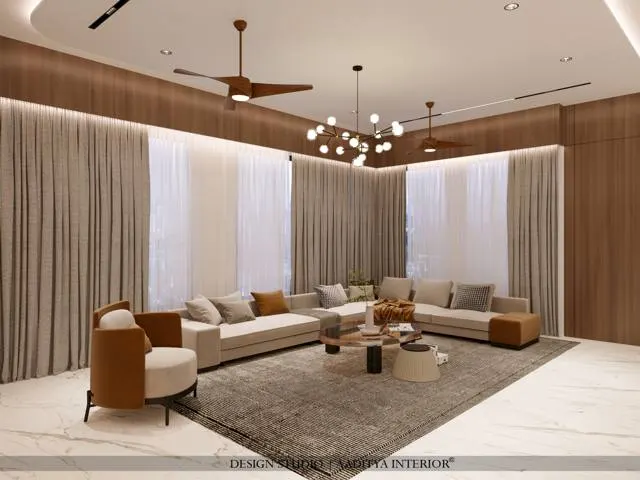
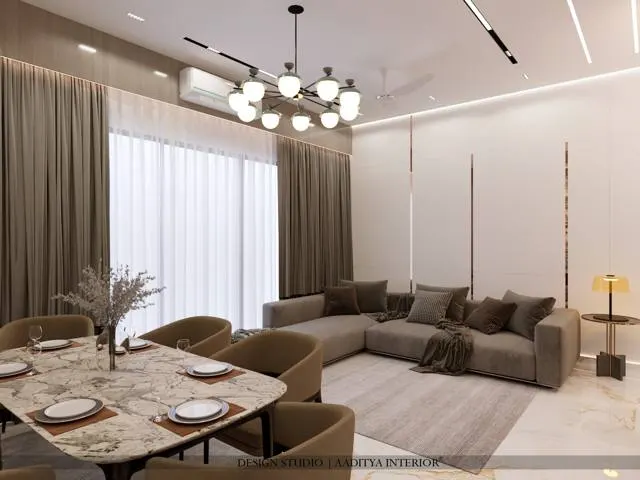
A rug is the cheapest way to change how a room feels and the easiest one to get wrong. In Indian homes the usual mistake is the same everywhere: a 4 × 6 ft or 5 × 7 ft rug floating in the middle of the living room, too small to touch the sofa, too large to read as a mat, with a coffee table perched on it like an island. The room looks sparse, the furniture looks disconnected, and the rug slides every time someone walks across it. The fix is almost always a larger rug placed with a rule — and the rules are simple once they are written down in millimetres.
Indian rooms add their own conditions. Living rooms in 2BHK and 3BHK flats are often 3000–3600 mm wide, with a TV wall on one side and a sofa on the other, so the rug must fit between two fixed lines. Bedrooms carry a wardrobe along one wall that eats 600 mm of floor. Floors are mostly vitrified tile, marble or Kota — hard, cool and slippery under a loose rug. Many families sit on the floor during festivals and gatherings, so a rug is furniture, not just decoration. Dust, humidity in coastal cities such as Surat and Mumbai, and weekly wet mopping all decide which materials last.
This guide sets out the standard rug sizes sold in India in feet and millimetres, the three placement rules for living rooms, the bed-size rules for bedrooms, dining and runner sizes, how thickness and underlay affect doors, and what each material costs in October 2026. Every rule is drawn as a dimensioned plan, so the numbers can be checked against a real room with a measuring tape and a roll of masking tape.
From dhurrie to wall-to-wall: a short history of rugs in Indian homes
India has woven floor coverings for a very long time, and two traditions run side by side. The first is the flat-woven dhurrie — cotton or wool woven on a simple loom without a pile, light enough to roll, wash and carry. Dhurries were laid for sitting, sleeping and eating across the country and remain the most practical rug for an Indian home, because they tolerate dust, can be washed and are reversible in many weaves. Rajasthan, Haryana, Punjab, Telangana and Uttar Pradesh all have strong dhurrie-weaving traditions, and Panipat in Haryana has long been known as a centre of handloom furnishings.
The second tradition is the knotted pile carpet. Persian-style carpet weaving was patronised at the Mughal court, and the Ain-i-Akbari, the record of Akbar's reign written by Abul Fazl, describes royal workshops producing carpets. From those court workshops the craft spread and settled into the regions that still dominate Indian carpet making: the Bhadohi–Mirzapur belt in Uttar Pradesh, often called India's carpet capital; Jaipur and the surrounding districts in Rajasthan; and Kashmir, known for fine wool and silk hand-knotted carpets. Today India is one of the world's major exporters of handmade carpets, and most hand-tufted and hand-knotted rugs sold in Indian cities come from these clusters.
Twentieth-century apartments brought wall-to-wall carpet into hotels, offices and some homes, but in India's dusty, humid climate fitted carpet never suited most houses. The modern Indian home has settled on a hard floor — vitrified tile, marble, Kota, wood or vinyl — with a loose rug that defines the seating or sleeping zone and can be lifted, washed or changed with the seasons. That is the setting this guide assumes.
Standard rug sizes in India
Rugs in India are sold mostly in feet, a legacy of the export trade, though some brands and imported ranges use metric sizes such as 160 × 230 cm and 200 × 300 cm. Sizes are nominal: a handmade 8 × 10 ft rug can be 50–75 mm shorter or longer than the label, and fringes are usually excluded from the stated length. Always check the actual dimensions on the tag or ask the seller for a measured size before planning a tight room.
| Nominal size (ft) | Approximate size (mm) | Area (sq ft) | Best for | Too small for |
|---|---|---|---|---|
| 2 × 3 / 3 × 5 | 610 × 910 / 910 × 1520 | 6 / 15 | Doormats, bedside, bathroom entry, pooja corner | Any seating group |
| 4 × 6 | 1220 × 1830 | 24 | Foot of a bed, reading corner, small study | A living room with a three-seater |
| 5 × 7 / 5 × 8 | 1520 × 2130 / 1520 × 2440 | 35 / 40 | Floating rug in a small living room, single bed, kids' room | A sofa plus two chairs |
| 6 × 9 | 1830 × 2740 | 54 | Compact living rooms of about 10 × 12 ft, double bed laid across | King beds, L-shaped sofas |
| 8 × 10 | 2440 × 3050 | 80 | Most 12 × 16 ft living rooms, queen bed, six-seater dining | Large L-shaped sofa groups |
| 9 × 12 | 2740 × 3660 | 108 | Large living rooms, king bed, eight-seater dining | — |
| 10 × 14 | 3050 × 4270 | 140 | Bungalow living halls, double-height rooms, big dining | — |
| Runner 2.5 × 8 / 3 × 10 | 760 × 2440 / 910 × 3050 | 20 / 30 | Passages, kitchen aisles, bed sides | — |
Round rugs are typically sold at 4, 5, 6 and 8 ft diameter (about 1220, 1520, 1830 and 2440 mm). They suit round dining tables, a single armchair corner, or a foyer, and can soften a room full of straight lines. A round rug under a round table should be at least 1200 mm larger in diameter than the table, so that pulled-out chairs stay on it.
Living room rugs: the three placement rules
There are only three good ways to place a rug under a seating group, and each one sets the rug size. The aim in every case is the same: the rug should tie the sofa, the chairs and the coffee table into one composition, so that the seating reads as a room within the room. A rug that touches none of the furniture does the opposite — it becomes a stray rectangle on the floor.
1. All legs on
Every piece of seating stands fully on the rug. This is the most luxurious, hotel-like look and the one that makes a large living room feel calm and anchored. It needs a big rug — typically 9 × 12 ft (2740 × 3660 mm) or larger — and a room of at least about 3600 × 4800 mm, preferably more, so that a border of bare floor remains around the rug. It suits bungalows, double-height halls and large 3BHK and 4BHK living rooms. In smaller rooms the rug runs almost wall to wall and looks like a badly fitted carpet.
2. Front legs on
The front legs of the sofa and chairs rest on the rug, and the back legs stand on the floor. The rug should slip about 150–200 mm under the front of each seat. This is the rule that works in most Indian flats: it connects the furniture, it lets the rug be smaller and cheaper, and it leaves the sofa back against the wall where it usually has to be. For a typical 3600 × 4800 mm living room with a three-seater and two chairs, the answer is an 8 × 10 ft (2440 × 3050 mm) rug; in a 3000 × 3600 mm room, a 6 × 9 ft (1830 × 2740 mm).
3. Floating
The rug sits only under the coffee table, with all seating off it. It works in two situations: very small living rooms where a larger rug would crowd the floor, and rooms where the seating is a built-in or a low diwan. The floating rug should still be large enough to reach close to the seating — the gap between the rug edge and the sofa front should be no more than about 150–300 mm — and it should be wider than the coffee table by at least 300 mm on each side. A 5 × 8 ft rug (1520 × 2440 mm) is the usual floating size; anything smaller looks like a bath mat.
Width: wider than the sofa
Whatever the placement, the rug should be wider than the sofa. A useful minimum is 150–200 mm beyond each end of the sofa, and 300 mm or more looks generous. A standard three-seater is about 1800–2290 mm long, so a 2440 mm wide rug is just enough for a compact sofa and a 3050 mm rug is comfortable for a full-size one. A rug that is narrower than the sofa makes the sofa look as if it is about to fall off a ledge.
Border: bare floor at the walls
Leave a band of bare floor around the rug — about 300–450 mm in a typical flat, and 450–600 mm in a large room. The border frames the rug and lets the floor material (marble, Kota, wood) still be seen. In very tight rooms the border can drop to 200 mm, but a rug that runs to within 50–100 mm of the walls looks like an ill-fitting carpet, and it collects dust in the gap that a mop cannot reach.
L-shaped sofas and diwans
An L-shaped sofa, common in Indian living rooms, needs the rug to reach under the front legs of both arms of the L. Measure the inside corner of the L to the far end of each arm; the rug should cover at least the inside rectangle plus 150–200 mm under each seat front. For an L of about 2700 × 1800 mm, that usually means an 8 × 10 ft rug; a larger L of 3000 × 2100 mm or more needs a 9 × 12 ft. A low diwan or baithak that people sit on cross-legged works best with a dhurrie that runs fully under it, because people will sit on the rug as much as on the furniture.
| Living room size (mm) | Approx. (ft) | Seating | Placement | Recommended rug |
|---|---|---|---|---|
| 2700 × 3300 | 9 × 11 | Two-seater + chair | Floating or front legs on | 5 × 7 or 5 × 8 ft (1520 × 2130 / 2440) |
| 3000 × 3600 | 10 × 12 | Three-seater + one chair | Front legs on | 6 × 9 ft (1830 × 2740) |
| 3300 × 4200 | 11 × 14 | Three-seater + two chairs | Front legs on | 6 × 9 or 8 × 10 ft |
| 3600 × 4800 | 12 × 16 | Three-seater + two chairs, or L-sofa | Front legs on | 8 × 10 ft (2440 × 3050) |
| 4200 × 5400 | 14 × 18 | L-sofa + two chairs | Front legs on or all legs on | 9 × 12 ft (2740 × 3660) |
| 4800 × 6000 and above | 16 × 20+ | Full group, often two zones | All legs on, or two rugs | 9 × 12 or 10 × 14 ft, or two 8 × 10 ft |
Large open living–dining halls in bungalows often need two rugs rather than one: one for the sitting group and one for the dining table. The two should not be identical in size; they should relate to their furniture. Keep at least 450–600 mm of bare floor between them so that each zone reads clearly, and choose rugs that share either a colour or a texture so the hall still feels like one room.
Bedroom rugs: sizing to the bed
In a bedroom the rug has a practical job: the first step out of bed on a cool tiled floor should land on something soft. That means the rug must extend beyond the sides of the bed, not hide under it. The two numbers to remember are the side overhang — 450–750 mm beyond each side of the bed — and the foot overhang — 450–900 mm past the foot. The rug should usually start just in front of the bedside tables, so the tables stand level on the floor and the rug covers roughly the lower two-thirds of the bed.
Indian mattress sizes are typically 72 × 30–36 in for a single, 72–78 × 48 in for a double, about 78 × 60 in (1525 × 1980 mm) for a queen and 78 × 72 in (1830 × 1980 mm) for a king. A bed frame adds 50–150 mm to each dimension, and an upholstered headboard can add more.
| Bed (mattress, mm) | One large rug under the bed | Side overhang achieved | Runners alternative | At the foot only |
|---|---|---|---|---|
| Single 915 × 1830 | 5 × 8 ft (1520 × 2440), length across the bed | ≈ 300 each side | One 2.5 × 6 ft runner on the open side | 3 × 5 ft |
| Double 1220 × 1830 | 6 × 9 ft (1830 × 2740) laid across | ≈ 760 each side | Two 2.5 × 6 ft | 4 × 6 ft |
| Queen 1525 × 1980 | 8 × 10 ft (2440 × 3050) laid across | ≈ 760 each side | Two 2.5 × 7 ft | 4 × 6 or 5 × 7 ft |
| Queen, tight room | 6 × 9 ft (1830 × 2740) laid across | ≈ 600 each side | Two 2 × 6 ft | 4 × 6 ft |
| King 1830 × 1980 | 9 × 12 ft (2740 × 3660) laid across | ≈ 915 each side | Two 3 × 8 ft | 5 × 8 ft |
| King, tight room | 8 × 10 ft (2440 × 3050) laid across | ≈ 610 each side | Two 2.5 × 7 ft | 5 × 7 ft |
Check the wardrobe before choosing. Most Indian master bedrooms have a 600 mm deep wardrobe along one wall, and the 750–900 mm clear zone in front of it should not have a thick-pile rug that catches shutters and the bottom drawer. If the bed sits close to the wardrobe, a pair of runners or a flat dhurrie is better than one large plush rug. In children's rooms a washable cotton dhurrie of 5 × 7 ft under the play area is more useful than a rug under the bed.
Dining rooms, passages and kitchens
A dining rug follows one rule: when a chair is pulled out to sit down, all four of its legs must still be on the rug. A chair needs about 600–750 mm behind the table edge to be pulled out, so the rug must extend at least 600 mm, and ideally 750 mm, beyond every edge of the table. A rug that is too small catches the back legs of the chairs every time someone stands up — the most irritating rug mistake of all.
| Dining table (mm) | Seats | Minimum rug (mm) | Nominal rug | Notes |
|---|---|---|---|---|
| Round 900–1000 dia. | 4 | 2100–2200 dia. | 7 ft round, or 6 × 9 ft | Square rug under a round table is fine |
| 1200 × 800 | 4 | 2400 × 2000 | 6 × 9 ft or 8 × 10 ft | Many 2BHK dining areas cannot fit this — skip the rug |
| 1500 × 900 | 6 (compact) | 2700 × 2100 | 8 × 10 ft | Most common Indian dining size |
| 1800 × 900 | 6 | 3000 × 2100–2400 | 8 × 10 ft | As drawn in Fig. 4 |
| 2100 × 1000 | 8 | 3300 × 2200–2500 | 9 × 12 ft | Bungalow dining halls |
| 2400 × 1100 | 8–10 | 3600 × 2300–2600 | 9 × 12 or 10 × 14 ft | Check the hall has 600 mm of border left |
If the dining area cannot fit a rug that large, leave it bare. A hard floor under a dining table is easier to clean after every meal — particularly with Indian food, where turmeric, oil and gravies are daily events — and a small rug under the table only adds a trip edge. Passages and kitchens take runners instead: 600–900 mm wide, ending 150–300 mm short of each end of the passage, and always on an anti-slip underlay. In a kitchen, a washable cotton or PET runner in front of the sink and hob is practical; a wool runner near the hob is not.
Thickness, underlay, doors and safety
Rug thickness matters more than most buyers realise. A flat dhurrie is 4–8 mm thick, a hand-tufted rug 12–20 mm, a hand-knotted wool rug 8–15 mm and a shaggy rug 30 mm or more. Add an underlay of 3–8 mm, and the total can easily exceed the gap under a door. Indian internal doors are typically hung with a 5–10 mm gap above the finished floor; a rug that sits in the swing of a door needs the door to be undercut, or the rug should be moved clear of the swing. On hard Indian floors an anti-slip underlay is not optional: a loose rug on polished marble, vitrified tile or Kota is a slipping hazard, especially for elderly family members and children.
| Rug type | Typical thickness (mm) | Underlay | Door swing | Safety note |
|---|---|---|---|---|
| Cotton dhurrie / flatweave | 4–8 | Thin rubber or PVC mesh, 2–3 mm | Usually passes a standard door gap | Slides easily without a grip pad |
| Jute / sisal | 6–12 | Felt-and-rubber, 3–5 mm | Check the door gap | Edges can curl; bind or tape |
| Hand-knotted wool | 8–15 | Felt-and-rubber, 3–6 mm | Often needs a 20 mm undercut | Heavy; stays flat once laid |
| Hand-tufted wool / viscose | 12–20 | Rubber grip, 3–5 mm | Keep out of door swings | Backing cloth can wear; avoid damp floors |
| Shaggy / high pile | 30–60 | Grip pad | Never in a door swing | Trip risk for elderly users; avoid on stairs |
| Outdoor PET / polypropylene | 4–10 | Usually none; check grip | Fine on balconies | Lets water drain; dries fast |
Materials and cost: what to buy for an Indian home
The material decides how a rug feels, how often it needs cleaning and how it survives humidity, dust and monsoon. Wool is resilient, naturally resists soiling and feels warm; it suits air-conditioned bedrooms and living rooms. Cotton dhurries are the most practical everyday rugs — light, washable and cool. Jute and sisal look natural and suit boho and Japandi rooms, but they stain with water and shed fibres. Viscose (often sold as art silk or bamboo silk) has a beautiful sheen but crushes, water-marks and is hard to clean — a poor choice for dining rooms or homes with pets. Machine-made polypropylene and polyester rugs are cheap, stain-resistant and easy to clean, but they flatten and can look synthetic.
| Material / construction | Feel and look | Cleaning | Humidity and monsoon | Indicative cost (₹ per sq ft, Oct 2026) | Best rooms |
|---|---|---|---|---|---|
| Machine-made polypropylene / polyester | Even, slightly synthetic | Easy; spot-clean, wash | Good | ₹60–180 | Kids' rooms, rentals, high traffic |
| Cotton dhurrie (flatweave) | Flat, light, cool | Washable (small sizes) | Good if dried properly | ₹80–250 | Living, kids, floor seating |
| Jute / jute-cotton | Natural, textured, coarse | Dry clean only; stains with water | Poor — can mould | ₹100–250 | Dry living rooms, bedrooms |
| Hand-tufted wool / wool-viscose | Soft, plush, cut or loop pile | Professional clean every 1–2 years | Fair — keep off damp floors | ₹250–600 | Living rooms, master bedrooms |
| Hand-knotted wool | Dense, durable, refined | Professional clean; lasts decades | Good if aired | ₹600–2,500+ | Formal living, heirloom pieces |
| Viscose / art silk | Lustrous, sheen | Hard; water-marks | Poor | ₹200–600 | Low-traffic bedrooms only |
| Outdoor PET / polypropylene | Flat, often printed or woven | Hose down and dry | Very good | ₹80–200 | Balconies, sit-outs, kitchens |
These prices are indicative October 2026 retail ranges for finished rugs in Indian cities; they vary widely with knot density, wool quality, design and brand, and handmade pieces bought directly from weaving clusters can cost less. A practical check: a 6 × 9 ft cotton dhurrie at ₹80–250 per sq ft is about ₹4,300–13,500, consistent with the ₹4,000–25,000 band used for main rugs elsewhere on this site; an 8 × 10 ft hand-tufted wool rug at ₹250–600 per sq ft is about ₹20,000–48,000. An anti-slip underlay adds roughly ₹30–80 per sq ft. Aaditya Interior usually budgets the main living-room rug in the loose furniture list rather than the civil or carpentry estimate, so it can be chosen last, once the sofa and floor finish are fixed.
Colour, pattern and the floor beneath
A rug should contrast with the floor, not disappear into it. On white marble or light vitrified tile, a rug with a mid-tone or dark ground gives definition; on dark wood or grey Kota, a lighter rug lifts the room. Large patterns suit large rugs and big rooms; small, busy patterns hide stains in family living rooms and dining areas. In small rooms, a rug with a defined border makes the room look smaller by drawing a frame inside it, while an all-over pattern or a plain field with a thin border keeps the floor feeling continuous.
Care, cleaning and the Indian climate
Vacuum woollen and tufted rugs once or twice a week with a suction-only head (no beater bar on hand-knotted rugs), shake or beat dhurries outdoors, and rotate every rug by 180 degrees every three to six months so sun and footfall wear it evenly. In the monsoon, keep rugs off floors that are being wet-mopped until the floor is fully dry, and air them on dry days; damp under a rug leads to musty smells and, in jute, mould. Before Diwali cleaning or a long trip, many families roll rugs with the pile inward and store them wrapped in cotton cloth, not plastic, with neem leaves or naphthalene-free moth repellent — wool is attractive to moths. Spills should be blotted, never rubbed; turmeric and oil stains on light wool are best handled by a professional cleaner rather than with household bleach.
| Task | Cotton / dhurrie | Wool (tufted or knotted) | Jute / viscose | Frequency |
|---|---|---|---|---|
| Routine dust removal | Shake or vacuum | Vacuum, suction only | Vacuum gently | Weekly |
| Rotation | Optional | Turn 180° | Turn 180° | Every 3–6 months |
| Spill response | Blot, then wash spot | Blot; cold water, mild wool detergent | Blot dry; no water on jute or viscose | Immediately |
| Deep clean | Machine or hand wash (small sizes) | Professional rug cleaner | Professional dry clean | Every 1–2 years |
| Monsoon care | Dry fully before laying | Air on dry days; keep off damp floors | Avoid ground floors with damp | June–September |
Where rugs are heading
Three trends are visible in Indian homes. The first is the return of the handmade flatweave — dhurries, kilims and panja weaves in contemporary colours — as people discover that they are washable, light and better suited to Indian floors than thick pile. The second is the rise of recycled and outdoor-grade yarns, especially PET from recycled bottles, which make rugs practical in balconies, kitchens and homes with pets. The third is custom sizing: weavers in Bhadohi, Panipat and Jaipur increasingly make rugs to order in non-standard sizes, so a rug can be sized exactly to a sofa group rather than to the nearest standard size. Custom rugs typically need several weeks to a few months to weave, so the order should be placed once the furniture layout is final.
Rules for choosing a rug size
- Size the rug to the furniture group, not to the empty floor: in a living room, at least the front legs of every seat should be on it.
- Make the rug 150–300 mm wider than the sofa at each end.
- Leave 300–600 mm of bare floor between the rug and the walls; never run a loose rug within 100 mm of the wall.
- Under a bed, let the rug run 450–750 mm beyond each side and 450–900 mm past the foot; keep bedside tables off it.
- Under a dining table, add 600–750 mm to every side so pulled-out chairs stay on the rug.
- Keep thick rugs out of door swings and the 750–900 mm zone in front of wardrobes.
- Always use an anti-slip underlay on marble, vitrified tile or Kota.
- When in doubt between two sizes, choose the larger one.
Frequently asked questions
What size rug should I get for my living room?
Measure the seating group, not the room. The rug should reach under at least the front legs of the sofa and chairs and extend 150–300 mm beyond the sofa's ends. In most Indian flats with a 12 × 16 ft living room this means 8 × 10 ft; in a 10 × 12 ft room, 6 × 9 ft; in large bungalow halls, 9 × 12 ft or bigger.
Is a 5 × 7 rug too small for a living room?
For a living room with a three-seater sofa, usually yes. A 5 × 7 ft rug works only as a floating rug in a small room with a two-seater, or under a coffee table where the seating is built in. If the sofa is longer than about 1800 mm, a 5 × 7 ft rug will look lost.
What size rug goes under a queen bed?
An 8 × 10 ft (2440 × 3050 mm) rug laid across the room, starting just in front of the bedside tables, gives about 760 mm on each side of a queen bed — ideal. In a tight room, 6 × 9 ft laid across still gives about 600 mm per side. Two 2.5 × 7 ft runners, one on each side, are a good alternative.
Should the rug go under the sofa?
Partly. The most practical arrangement in Indian homes is front legs on: the rug slides about 150–200 mm under the front of the sofa and chairs, while the back legs stay on the floor. Full under-sofa placement suits large rooms with a very large rug.
Are rugs a good idea in Indian weather?
Yes, if the material suits the room. Cotton dhurries and outdoor-grade PET rugs handle heat, dust and humidity well; wool suits air-conditioned rooms; jute and viscose need dry rooms. Air rugs regularly in the monsoon, keep them off damp floors and use an anti-slip underlay on hard floors.
Sources & standards
- Ernst and Peter Neufert, Architects' Data — furniture and circulation clearances for living, sleeping and dining spaces
- Time-Saver Standards for Interior Design and Space Planning — dining, seating and bed clearances
- National Building Code of India 2016, Part 3 (Development Control Rules and General Building Requirements) — minimum room sizes
- Abul Fazl, Ain-i-Akbari — account of carpet workshops at the Mughal court
- Carpet Export Promotion Council (Ministry of Textiles, Government of India) — Indian handmade carpet clusters
- Indian Institute of Carpet Technology, Bhadohi — carpet construction and terminology
- Manufacturer standard ranges for rug sizes, underlays and fibres, described generically
- Price ranges: indicative October 2026 estimates — confirm locally before budgeting