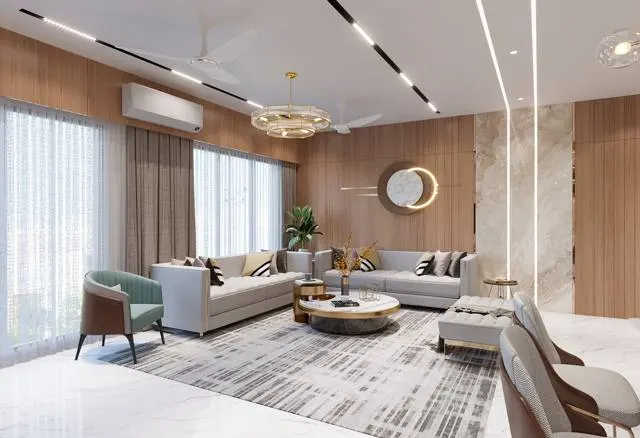
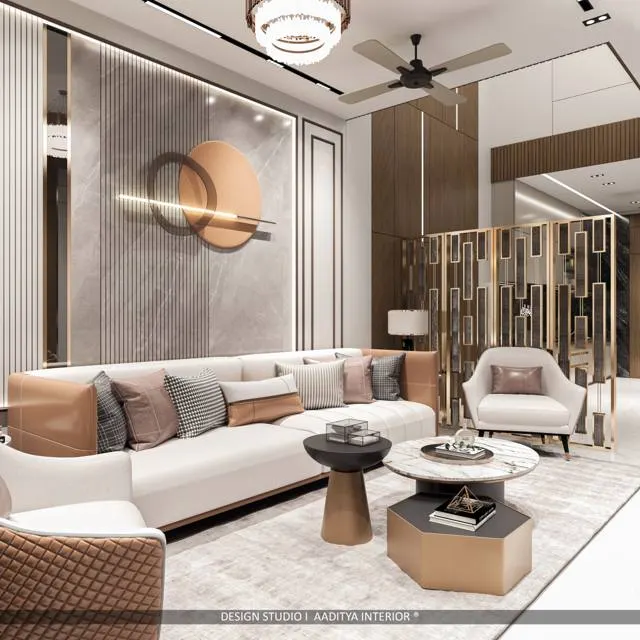
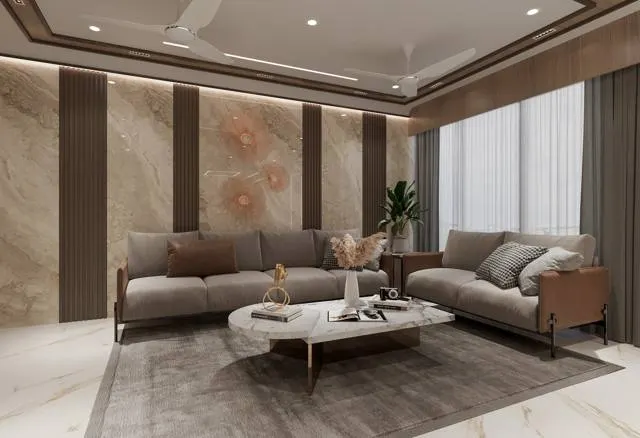
Some interior styles whisper. Hollywood Regency makes an entrance. Born in the homes of film stars and studio executives in Los Angeles in the 1930s, it combined the elegance of early nineteenth-century English Regency furniture with the confidence of the movie business: glossy lacquered walls, mirrored furniture, tufted velvet, brass and gilt, Greek key borders, chinoiserie, faux bamboo, and colours such as emerald, peacock blue, pink and black used without apology. The aim was a room that looked ready for a camera at any moment.
In India the style has an obvious appeal. Indian families enjoy colour, celebration and hosting, and many homes already have the bones of glamour — marble floors, high ceilings in bungalows, a formal living room kept for guests. But Hollywood Regency is also one of the easiest styles to get wrong. Done carelessly it becomes a showroom of shiny surfaces: mirrored walls that reflect clutter, velvet that collects Surat's dust and humidity, gold everywhere, and furniture that is all statement and no comfort. The difference between glamour and glitz is discipline — symmetry, a controlled palette, quality in a few places and restraint everywhere else.
This article explains where Hollywood Regency came from and how it differs from its close cousin Art Deco, lists its signature elements and how to source them in India, draws dimensioned living room, bedroom and foyer schemes, and gives indicative October 2026 costs, so the style can be used confidently rather than copied from a mood board.
Origins: from the Prince Regent to the film studios
The name joins two very different worlds. The Regency was the period when the future George IV ruled Britain as Prince Regent, formally from 1811 to 1820, though the Regency style is usually stretched to cover roughly the 1790s to the 1830s. Its furniture was neoclassical — slender, symmetrical, inspired by Greek and Roman forms — with sabre legs, Greek key and anthemion motifs, and a taste for the exotic. The Prince Regent's Royal Pavilion at Brighton, with its chinoiserie interiors and faux bamboo, showed how far that taste could go.
A century later, in Los Angeles, a new elite wanted homes that looked old-world and expensive yet suited California light and modern entertaining. Architects such as John Elgin Woolf designed houses with tall doors, mansard roofs and crisp classical detail, while decorators — among them William Haines, a former film actor who became one of Hollywood's best-known designers — filled them with lacquer, mirror, upholstered pieces and bold colour. On the East Coast, Dorothy Draper developed a related, larger-than-life manner she called Modern Baroque, famous for black-and-white floors, oversized plasterwork, cabbage-rose chintzes and saturated colour; her post-war redecoration of the Greenbrier resort in West Virginia remains the best-known example.
The style faded with mid-century minimalism but never disappeared. From the 2000s it returned strongly, led by designers such as Kelly Wearstler in Los Angeles, and it now sits within a broad family often called glam: decorative, colourful, reflective and comfortable. The modern version is usually lighter — fewer pieces, more white space — but keeps the core vocabulary.
Hollywood Regency versus Art Deco and other glamour styles
Hollywood Regency is often confused with Art Deco because both flourished in the 1930s and both love brass, lacquer and mirror. The difference is in the geometry and the source. Art Deco, covered in detail in this blog's Art Deco guide, is the style of the machine age: sunbursts, chevrons, stepped forms, streamlined curves. Hollywood Regency looks backwards to classical and Regency furniture — slender legs, Greek key borders, tufting, chinoiserie, scrolls — and adds Hollywood showmanship through scale and colour. A room can borrow from both, but it helps to know which one is leading.
| Style | Period and roots | Key shapes | Signature materials | Feel |
|---|---|---|---|---|
| Hollywood Regency | 1930s–50s Los Angeles; English Regency, chinoiserie | Classical silhouettes, Greek key, tufting, faux bamboo | Lacquer, mirror, velvet, brass, gilt, marble | Theatrical, colourful, symmetrical |
| Art Deco | 1920s–30s; Paris 1925 exposition | Sunbursts, chevrons, steps, fans, curves | Brass, figured veneer, terrazzo, lacquer, glass | Geometric, streamlined, luxurious |
| Modern Baroque (Dorothy Draper) | 1930s–50s, mainly USA East Coast | Oversized scrolls, plasterwork, big florals | Chintz, black-and-white marble, lacquer | Exuberant, large-scale, cheerful |
| Neoclassical | Late eighteenth century onward | Columns, pilasters, mouldings, urns | Painted wood, marble, plaster | Formal, calm, ordered |
| Contemporary glam | 2000s revival | Simplified classical forms, curved sofas | Velvet, brass, mirror, quartz, PVD steel | Polished, lighter, more neutral |
| Maximalism | 2010s onward | Layered patterns and collections | Anything — mixed patterns and textures | Abundant, personal, eclectic |
The ten signature elements
A room reads as Hollywood Regency when several of the following elements appear together within a symmetrical, carefully edited arrangement. Using only one or two of them gives a hint of the style; using all ten in a small flat gives a stage set. Aaditya Interior's usual advice is to choose three or four as the main voice of the room and let the rest appear only as small accents.
- High-gloss lacquer in a strong colour — on a wall, a cabinet, a console or a door.
- Mirror and mirrored furniture: a large framed mirror on axis, mirrored bedside tables or a mirrored console.
- Tufted and channel-quilted upholstery in velvet or satin — headboards, sofas, ottomans and benches.
- Polished brass and gilt — legs, frames, lamp bases, handles and thin trims, never everywhere at once.
- Greek key and other classical borders — on rugs, curtain leading edges, ceiling trims or floor inlays.
- Black-and-white floors — checkerboard marble or tile, often laid on the diagonal in foyers and bathrooms.
- Chinoiserie — hand-painted or printed wallpaper, ginger jars, pagoda motifs and faux bamboo furniture.
- Bold, saturated colour — emerald, peacock blue, coral, pink, black — set against crisp white.
- Oversized lamps and statement lighting — tall lamps in pairs, a crystal or brass chandelier, sconces.
- Strict symmetry — matching lamps, chairs, tables and mirrors arranged around a central axis.
Behind these elements sits one principle: everything is arranged for effect. Furniture floats in the room rather than lining the walls, a focal wall faces the entrance, and pairs of objects frame a centre. This is why the style works so well in formal living rooms, foyers, dressing rooms and powder rooms — the spaces where Indian families most enjoy making an impression.
Colour palettes that work
Hollywood Regency is colourful, but its colour is controlled. The classic recipe is a crisp white or soft ivory base, one saturated hero colour, black as a graphic accent, and metallics as jewellery. In Indian light — strong and warm for much of the year — very cold whites can look clinical and very warm ivories can turn yellow, so test paint samples on site in both daylight and evening light before committing. The table gives five palettes with an indicative split by visible surface area.
| Palette | Base (≈ 60 %) | Hero colour (≈ 25–30 %) | Accent (≈ 10 %) | Metallic | Best for |
|---|---|---|---|---|---|
| Emerald salon | Soft white | Emerald green lacquer or velvet | Black, white marble | Brass | Living rooms, bars |
| Peacock and gold | Ivory | Peacock or teal blue | Coral cushions | Antique gold | Formal living, dining |
| Blush glamour | Warm white | Dusty pink | Black lacquer, white | Polished brass | Bedrooms, dressing rooms |
| Black and white classic | White | Black lacquer and marble checker | Emerald or red accent | Gold or chrome | Foyers, powder rooms |
| Navy and chinoiserie | White | Navy walls or cabinetry | Blue-and-white ceramics | Brass | Studies, libraries, dining |
Living room: a symmetrical salon
The Hollywood Regency living room is organised around an axis. A focal wall — often lacquered, panelled or papered — faces the main entry or the main seating; a sofa is centred on it, flanked by a pair of side tables and a pair of tall lamps; a large mirror or artwork sits on the axis above; and a pair of accent chairs faces the sofa across a coffee table. In a typical Indian flat living room of about 12 × 16 ft, this arrangement fits comfortably if the sofa is kept to about 2100–2400 mm and the walkways are protected.
Two details make or break the wall. The mirror should be about two-thirds of the sofa's length or a little less, hung with its lower edge 250–300 mm above the sofa back, so that it relates to the furniture rather than floating on the wall. And the lamps should be tall enough — typically 750–900 mm overall on side tables of 550–600 mm — that the bottom of each shade sits roughly at the eye level of a seated person, which hides the bulb and spreads light across the faces of the people talking. Place the mirror where it reflects a window, a chandelier or a garden view, never a television or the kitchen door.
Bedroom: tufted headboard and mirrored side tables
The bedroom is where Hollywood Regency feels most natural in an Indian home, because softness, symmetry and a dramatic bed wall suit a private room. The core is a tall upholstered headboard — tufted, channel-quilted or with a scalloped or arched top — flanked by mirrored or lacquered bedside tables and a matching pair of lamps or wall sconces. The headboard is usually taller and more theatrical than in other styles, between about 1400 and 1700 mm high, so it holds the wall even in a room with a 2900–3000 mm ceiling.
Mirrored side tables look dramatic but show fingerprints and dust; in a busy household a lacquered side table with a mirrored top inset, or a table with brass legs and a lacquer top, gives a similar effect with less cleaning. Velvet headboards should be made with removable or at least vacuum-friendly covers and placed away from the air-conditioner's direct airflow, which deposits dust on the fabric. Choose performance velvet (polyester) rather than cotton velvet in humid cities; it resists crushing and mildew better.
Foyer and bathroom: the black-and-white floor
Nothing announces Hollywood Regency faster than a black-and-white floor. Dorothy Draper made it famous, and it remains the most graphic tool in the style. In an Indian foyer it can be laid in polished marble (white Indian marble with black granite or black marble), in honed stone, or — for budget projects — in matt or satin vitrified tiles. Laying the squares on the diagonal makes a small foyer look wider; a border band of black, sometimes with a Greek key inlay, frames the pattern and absorbs the cutting at the walls.
Scale matters. In a small foyer of about 1800 × 2400 mm, 300 mm squares give enough repetitions to read as a pattern; 600 mm squares in the same space look like a few random tiles. In a large hall, 450–600 mm squares are better because small squares become busy. The same floor works in a powder room or a guest bathroom, where it can be paired with a black lacquer vanity, a round brass-framed mirror and a pair of sconces — a complete Hollywood Regency room in under 40 sq ft.
Sourcing the style in India: materials and costs
Most Hollywood Regency finishes are available through ordinary Indian interior supply chains; the skill lies in specification and workmanship. High-gloss PU paint on MDF or HDHMR gives lacquer; PVD-coated stainless steel gives brass-coloured trims that do not tarnish; performance velvet gives the upholstery; and Indian marble, granite and vitrified tiles cover floors. Prices below are indicative October 2026 ranges, consistent with this blog's Art Deco and finishes guides; they vary with brand, city and quantity.
| Element | How it is made in India | Where to use it | Indicative cost (October 2026) |
|---|---|---|---|
| Lacquer finish | High-gloss PU on MDF/HDHMR, or acrylic sheet | Feature walls, consoles, bar and bedside units | PU ≈ ₹1,000–1,800; acrylic ≈ ₹900–1,500 per sq ft |
| Mirror panels and mirrored furniture | Clear, bronze or antique mirror on ply backing | Feature mirror, side tables, wardrobe shutters | Mirror panel ≈ ₹150–400 per sq ft fixed; glass shutters ≈ ₹700–1,400 |
| Brass-look trims and legs | PVD-coated stainless steel profiles and legs | Edges, inlays, furniture legs, handles | PVD trim ≈ ₹300–900 per running ft |
| Velvet upholstery | Performance (polyester) velvet over foam | Sofas, headboards, ottomans, chairs | Fabric ≈ ₹600–2,000 per metre |
| Chinoiserie or patterned wallpaper | Printed, non-woven or vinyl wallpaper | One feature wall, powder room, dining | ≈ ₹40–150 per sq ft installed; imported designs more |
| Checkerboard floor | Marble + granite, honed stone, or matt vitrified tiles | Foyer, powder room, bathroom | Vitrified ≈ ₹85–160; Indian marble ≈ ₹150–600 per sq ft material |
| Statement lighting | Crystal or brass chandelier, sconces, tall lamps | Living, dining, foyer, bed wall | Chandelier ≈ ₹15,000–1,50,000+; lamps ≈ ₹4,000–25,000 each |
| Accent chairs | Upholstered slipper or bergère-style chairs | Pairs facing the sofa, bedroom corner | ≈ ₹15,000–60,000 each |
What a full room costs
The figures below cover the elements that make a room read as Hollywood Regency — feature walls, special finishes, statement furniture, soft furnishings and decorative lighting — on top of the ordinary costs of ceilings, wiring, painting and fitted storage covered in this site's cost guides. They are indicative October 2026 ranges for mid-range workmanship in Indian metro and tier-2 cities, excluding GST.
| Room | Typical scheme | Key dimensions (mm) | Indicative cost of the style elements |
|---|---|---|---|
| Living room (≈ 200–250 sq ft) | Lacquer feature wall, tufted sofa, pair of lamps, mirror, pair of accent chairs | Wall 3000–3600 wide; sofa 2100–2400 | ≈ ₹3–8 lakh |
| Master bedroom | Tall tufted headboard, mirrored or lacquer side tables, sconces, velvet bench | Headboard 1750–1900 × 1400–1700 | ≈ ₹1.2–3.5 lakh |
| Foyer (≈ 40–60 sq ft) | Checkerboard floor, console, framed mirror, pair of sconces | Squares 300–400; console 900–1200 | ≈ ₹60,000–2.5 lakh |
| Powder room (≈ 30–40 sq ft) | Checker floor, black lacquer vanity, round brass mirror, wallpaper | Vanity 600–900 wide | ≈ ₹80,000–2 lakh |
| Dining area | Lacquer or mirrored crockery unit, upholstered chairs, chandelier on axis | Chandelier 600–900 dia over table | ≈ ₹1.5–5 lakh |
| Dressing area | Mirrored shutters, velvet stool, Hollywood-style vanity mirror | Vanity 900–1200 wide | ≈ ₹75,000–2.5 lakh |
Adapting a high-gloss style to Indian homes
Glossy, reflective and plush surfaces need more care in Indian conditions than in the dry climate of Los Angeles. Dust, monsoon humidity, harsh sunlight and heavy daily use all affect them. A few adaptations keep the look without the maintenance burden. Use high-gloss lacquer at or above waist height and on doors that are touched less; use satin or semi-gloss where hands and feet go. Keep velvet away from west windows, where it fades, and from bathrooms. Put mirror where it multiplies daylight — opposite or beside windows — rather than where it reflects clutter. And plan lighting in layers, because glamour depends on light: warm 2700–3000 K for lamps and sconces, dimmers on the chandelier, and concealed cove light so lacquer surfaces glow rather than glare.
Vastu-minded families sometimes worry about mirrors, particularly in bedrooms. The practical design answer is the same as the traditional caution: avoid a mirror that faces the bed directly, because its reflections and light disturb sleep. Mirrored side tables and a mirror on a dressing wall rather than the wall opposite the bed satisfy both views. The style also suits Indian celebrations well: a symmetrical salon seats guests formally, a checkerboard foyer photographs beautifully at festivals, and a lacquered bar or crockery unit becomes the backdrop for family gatherings.
The future of Hollywood Regency
The current revival is calmer than the original. Designers keep the silhouettes, the symmetry and one or two high-impact finishes but surround them with more white space, softer colours and natural materials such as cane, linen and lime plaster. Sustainable versions are also emerging — refurbished vintage chairs re-upholstered in velvet, PVD steel instead of solid brass, water-based lacquers and LED fittings designed to look like classic lamps. In India, where craft skills in lacquer, upholstery, brass and stone inlay are still strong, the style can be made locally to a very high standard without imported furniture.
Seven rules for Hollywood Regency done well
- Start with symmetry: one axis, one focal wall, and pairs of lamps, tables, chairs and sconces.
- Choose three or four signature elements per room — not all ten.
- Keep metallics to about a tenth of what is visible; let colour and lacquer carry the luxury.
- Use one saturated hero colour against white or ivory, and black as a graphic accent.
- Put gloss and velvet where they will be admired, not where they will be kicked, splashed or sun-bleached.
- Hang mirrors to reflect windows, light and views — never a television, a cluttered shelf or the bed.
- Light in layers at 2700–3000 K with dimmers; glamour disappears under a single cold ceiling panel.
Frequently asked questions
What is the difference between Hollywood Regency and Art Deco?
Art Deco is geometric and machine-inspired — sunbursts, chevrons, stepped forms and streamlined curves. Hollywood Regency draws on classical and English Regency furniture, chinoiserie and Hollywood drama — slender legs, tufting, Greek key, faux bamboo and saturated colour. Both use brass, lacquer and mirror, and many 1930s interiors mixed them.
Is Hollywood Regency suitable for a small flat?
Yes, if it is edited. In a 2BHK, choose one statement per room — a lacquered TV or sofa wall, a tufted headboard, a checkerboard foyer — and keep the rest light and simple. Mirrors help small rooms feel larger when placed beside windows.
How do I keep velvet clean in a dusty, humid city?
Choose performance polyester velvet, vacuum it weekly with an upholstery brush, keep it out of direct sun and away from AC airflow, and treat spills immediately by blotting rather than rubbing. Removable covers on headboards and cushions make deep cleaning easier.
Which colours are typical of Hollywood Regency?
Emerald green, peacock or teal blue, dusty and hot pink, coral, navy and black, set against crisp white or ivory, with gold or brass as accents. One saturated colour per room is usually enough.
Is Hollywood Regency expensive?
The look is concentrated in a few elements, so the budget can be controlled. A single lacquered wall, a pair of lamps, a mirror and a velvet sofa transform a room for far less than a full refit. The costs rise when lacquer, mirror and upholstery are used on every surface.
Sources & standards
- Royal Pavilion and Museums, Brighton — the Royal Pavilion and its Regency chinoiserie interiors
- Victoria and Albert Museum, London — collection notes on Regency furniture and design (c. 1790s–1830s)
- Dorothy Draper and Company — history of the firm and the Greenbrier resort interiors
- John Pile, A History of Interior Design — chapters on Regency, Neoclassical and twentieth-century decorative styles
- Bureau of Indian Standards — IS 12406 (medium density fibreboard); National Building Code of India 2016, Part 8 (building services — lighting)
- Bureau of Indian Standards — IS 1130 (marble blocks, slabs and tiles) and IS 15622 (pressed ceramic tiles)
- Price ranges: indicative October 2026 estimates — confirm locally before budgeting