Hotel owners and investors talk about money in keys. A key is one lettable room or suite, and almost every hotel number — land cost, construction cost, interior cost, revenue, valuation — is eventually divided by the number of keys so that one project can be compared with another. A developer planning a 60-key business hotel on a Surat ring road, a family converting an old bungalow in Udaipur into a 14-key boutique property, and a brand building a 200-key resort in Goa all ask the same early question: what will the rooms cost to fit out, per key?
The question is reasonable, but the answers quoted in the market are often impossible to compare. One contractor's "₹5 lakh per key" covers only the guest room joinery and finishes; another includes the bathroom, furniture and lighting; a consultant's figure includes the lobby, restaurant and corridors spread across all the rooms; and an operator's number may include linen, crockery and the television. A per-key figure without a stated scope is not a price — it is a guess with a rupee sign.
This guide builds the per-key number from the bottom up, using the same indicative October 2026 per-square-foot bands used across this site's hospitality and restaurant cost guides, and real room sizes for each hotel segment. It explains what sits inside and outside the interior figure, how the cost splits inside a room, how the public areas load each key, and how to sense-check a quotation. All prices are indicative ranges for planning, excluding GST, and must be confirmed with local contractors and suppliers before budgeting.
What "cost per key" actually measures
The hotel industry uses the key as its unit because rooms are what a hotel sells. A suite with a separate living room still counts as one key if it is let as one unit; two interconnecting rooms that can be let separately count as two. Dividing a cost by the number of keys therefore tells an investor how much capital stands behind each lettable unit, which can then be compared with the room rate and occupancy the hotel expects to achieve. It is the hotel equivalent of the restaurant operator's cost per seat.
For interiors, the per-key number is built from five layers, and a serious quotation names which of them it covers. The first is the guest room fit-out: flooring, wall finishes, ceilings, bathroom waterproofing, tiling, sanitaryware and fittings, and the built-in joinery such as wardrobes, headboards and the desk. The second is FF&E — furniture, fixtures and equipment — which in hotel language means the loose and semi-fixed items: beds, chairs, side tables, lamps, curtains, carpets, mirrors, artwork, the safe and, depending on the operator, the television and minibar. The third is the public area interiors — lobby, restaurants, corridors, lift lobbies, public toilets — spread across the keys. The fourth is OS&E — operating supplies and equipment — the linen, towels, amenities, crockery, cutlery and housekeeping equipment needed before the hotel opens. The fifth lies outside the interior altogether: the building, HVAC, plumbing and electrical mains, fire systems, lifts and the commercial kitchen.
In this article, "room interior per key" means layers 1 and 2 for one typical room, and "complete interior per key" adds layer 3, the public areas, divided by the number of keys. OS&E is shown separately because operators usually buy it from their own lists, and layer 5 belongs to the construction and MEP budget. Keeping these boundaries fixed is the single most useful habit when comparing bids.
From rest houses to branded hotels: how room budgets grew
India's older hotels were built to very different expectations. Dak bungalows, circuit houses and railway retiring rooms offered a bed, a ceiling fan, a writing table and a shared or simple attached bath. The great city hotels of the late nineteenth and early twentieth centuries — built for travellers by sea and rail — were grand in their public rooms but much plainer in their bedrooms than a modern business hotel. For much of the twentieth century, the small Indian hotel was a family business with rooms furnished by local carpenters and a budget that went mostly into the building.
Three changes pushed room budgets up. First, air-conditioning, attached bathrooms with hot water and the television became standard rather than premium. Second, domestic and international hotel brands spread across Indian cities from the 1990s and 2000s, bringing written brand standards that specify room size, bed size, lighting levels, acoustic separation, bathroom fittings and even the number of sockets beside the bed. Third, online reviews made the guest room the hotel's advertisement: a tired bathroom or a noisy door now shows up in ratings within weeks. Today even an economy hotel is expected to deliver a quiet, dark, well-lit room with a good shower and reliable Wi-Fi.
At the same time, the way rooms are built has changed. Factory-made casegoods — the hotel term for wardrobes, desks, headboards and other box furniture — are produced to shop drawings and installed as a kit, and some groups now use prefabricated bathroom pods that arrive finished and are lifted into place. These methods reduce site time and make quality more consistent, which is why per-key thinking suits them: every typical room is the same product, built many times over.
Hotel segments and typical room sizes
The per-key cost follows the room size more than anything else, and room size follows the segment. The Ministry of Tourism classifies approved hotels by star category under its hotel classification guidelines, which set minimum room and bathroom sizes and facilities for each category; brands then layer their own, usually larger, standards on top. The table below gives typical gross room sizes used in Indian projects — measured inside the room including its bathroom and entry, excluding the corridor — as planning guidance. Check the current classification guidelines and the operator's brand standards for any specific project.
| Segment (loosely) | Typical gross room incl. bath | Typical bay width × depth | Bathroom | Bed |
|---|---|---|---|---|
| Economy / budget (1–2 star, budget brands) | 180–240 sq ft (≈ 17–22 m²) | 3.2–3.4 m × 6.0–6.8 m | ≈ 3.0–3.6 m², shower, WC, basin | Queen 1525 × 1980 mm or twin singles |
| Midscale (3 star, select-service brands) | 250–320 sq ft (≈ 23–30 m²) | 3.5–3.8 m × 7.0–8.0 m | ≈ 4.0–5.0 m², glass shower, vanity | Queen or king 1830 × 1980 mm |
| Upscale (4 star, full-service brands) | 320–420 sq ft (≈ 30–39 m²) | 3.9–4.5 m × 8.0–9.0 m | ≈ 5.5–7.0 m², shower, often tub in some rooms | King 1830 × 1980 mm or larger |
| Luxury (5 star and above) | 450–650+ sq ft (≈ 42–60+ m²) | 4.5–5.5 m × 9.0–11.0 m | ≈ 8–12 m², tub, separate shower and WC | King, often 2000 mm wide |
| Boutique / heritage conversion | Varies room by room | Set by the existing building | Fitted into existing walls | Mixed; often larger rooms |
The bay width — the room's width between party walls — is the most expensive dimension in a hotel because it repeats along every corridor. An extra 300 mm on each bay of a 100-key hotel adds roughly 30 m of building length. For interiors, larger rooms cost more in total but slightly less per square foot, because the most expensive parts — the bathroom, the entry door and the casegoods — do not grow in proportion with the bedroom floor.
Per-square-foot bands and how they become cost per key
The bands below are the same indicative October 2026 bands used across this site's hospitality guides: about ₹900–1,400 per sq ft for a basic specification, ₹1,400–2,200 for mid-range and ₹2,200–3,500 or more for premium, with the banquet guide's upper band of ₹3,500–6,000 or more representing luxury work with stone, bespoke furniture and imported fittings. For a guest room, the rate is applied to the gross room area including the bathroom and covers layers 1 and 2: fit-out plus FF&E. It excludes the room's air-conditioning unit, the electrical and plumbing risers, the fire sprinkler and detection system, OS&E and GST.
| Segment | Room interior rate (₹/sq ft, fit-out + FF&E) | Typical room size | Indicative room interior per key | Typical specification |
|---|---|---|---|---|
| Economy | ₹900–1,400 | 180–240 sq ft | ≈ ₹1.6–3.4 lakh | Vitrified floor, laminate casegoods, ceramic bath tiles, compact shower, standard LED |
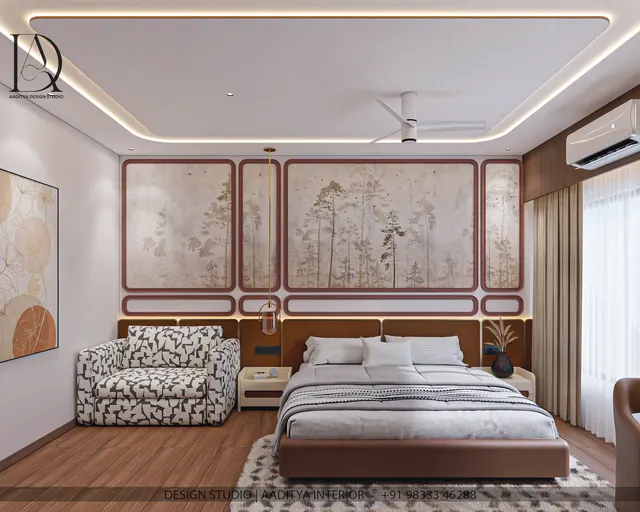
| Midscale | ₹1,400–2,200 | 250–320 sq ft | ≈ ₹3.5–7 lakh | Vinyl plank or carpet, veneer-look laminate or PU casegoods, glass shower, dimmable bedside lighting |
| Upscale | ₹2,200–3,500 | 320–420 sq ft | ≈ ₹7–15 lakh | Carpet or engineered wood, veneer casegoods, stone vanity, layered lighting, acoustic detailing |
| Luxury | ₹3,500–6,000+ | 450–650+ sq ft | ≈ ₹16–39 lakh+ | Stone bathroom, bespoke furniture, upholstered walls, lighting control, premium fittings |
| Boutique / heritage | Project-specific | Varies | Often midscale to upscale per key | Restoration costs depend on the building |
The per-key figures are simply the rate multiplied by the room size at each end of the range: an economy room of 180 sq ft at ₹900 is about ₹1.6 lakh; one of 240 sq ft at ₹1,400 is about ₹3.4 lakh. Real projects rarely sit at the extremes. A midscale room of 290 sq ft at ₹1,600–1,900 — where many select-service hotels land — comes to roughly ₹4.6–5.5 lakh per key. Suites cost more in total but are usually priced per key at about 1.5 to 2.5 times a standard room, depending on whether they add a separate living room, a second bathroom or a pantry.
Where the money goes inside a guest room
A room-by-room quotation is easier to compare when it is broken into elements. The pattern below is an indicative split for a midscale room where the interior contractor supplies the fit-out and FF&E together. It shifts with the concept: an economy room with a compact shower spends a smaller share on the bathroom and more on joinery; a luxury room with a stone bathroom and a freestanding tub can spend a third or more of its budget in the bathroom alone.
| Element | Indicative share of room interior | ≈ ₹ per key at midscale (₹4.6–5.5 lakh room) | What it covers |
|---|---|---|---|
| Bathroom fit-out | 24–30 % | ₹1.1–1.65 lakh | Waterproofing, wall and floor tiles or stone, sanitaryware, CP fittings, shower glass, vanity, mirror |
| Casegoods and built-in joinery | 18–24 % | ₹0.85–1.3 lakh | Wardrobe, headboard panel, desk, TV panel, minibar and luggage units |
| Flooring | 8–12 % | ₹0.4–0.65 lakh | Carpet with underlay, vinyl plank or engineered wood; bathroom floor counted above |
| Loose furniture | 8–12 % | ₹0.4–0.65 lakh | Bed base, lounge chair, desk chair, side tables, ottoman |
| Soft furnishings | 6–10 % | ₹0.3–0.55 lakh | Blackout and sheer curtains with tracks, bed throw, cushions, rug |
| Electrical and room controls | 6–9 % | ₹0.3–0.5 lakh | Wiring within the room, switches, sockets, key-card energy saver, data points |
| Lighting fixtures | 5–8 % | ₹0.25–0.45 lakh | Bedside readers, floor lamp, wardrobe and mirror lights, cove profiles |
| Ceiling and paint | 5–8 % | ₹0.25–0.45 lakh | Gypsum bulkhead at the entry, paint or wallcovering |
| Entry door and hardware | 3–6 % | ₹0.15–0.35 lakh | Fire-rated door set, lock, closer, viewer, seals |
| Art, mirrors, signage | 2–4 % | ₹0.1–0.2 lakh | Framed art, full-length mirror, room number sign |
The bathroom: the most expensive square metre in the hotel
Bathrooms cost the most per square foot because they concentrate waterproofing, tiling, plumbing, sanitaryware, glass and lighting into four or five square metres. They are also where hotels fail most visibly: a leaking shower tray, a blocked floor drain or mould on silicone joints shows in reviews long before a worn carpet does. Aaditya Interior's hospitality drawings detail the bathroom first — falls of about 1 in 60 to 1 in 100 to the drain, a waterproofing membrane turned up the walls (to full height in the shower), a raised threshold or a linear drain at the shower entry, and an exhaust that runs whenever the room is occupied — because a bathroom built right once is cheaper than one repaired three times. Where many identical rooms repeat, prefabricated bathroom pods can be considered; they suit large, repetitive projects with good crane access and need early coordination with the structure and shafts.
Casegoods: buy them as a product, not as site carpentry
Casegoods are the second-largest line and the one where per-key thinking pays off most. Built on site by carpenters, each wardrobe and headboard is a slightly different object; made in a factory to approved shop drawings, they are identical, better finished and quicker to install. A mock-up room — one complete room built and approved before mass production — is standard practice in branded hotels and is strongly recommended for independent ones too. Its cost, typically one room's worth of FF&E plus extra labour, is small against the cost of discovering a mistake repeated eighty times.
Public areas: how the lobby and corridors load each key
Guests judge a hotel by its lobby, but owners pay for it per key. The public areas — arrival, lobby, reception, lounge, all-day dining, meeting rooms, corridors, lift lobbies, public toilets — are fitted out at rates similar to or higher than the rooms, and their total cost is spread over the number of keys. A small hotel with a grand lobby has a high public-area load per key; a large hotel with a modest lobby has a low one. Banquet halls are usually budgeted separately using the banquet bands of about ₹1,500–2,200, ₹2,200–3,500 and ₹3,500–6,000 or more per sq ft, because they generate their own revenue.
| Segment | Typical interior public area per key (excl. banquet) | Public area rate (₹/sq ft) | Public area load per key | Complete interior per key (room + public) |
|---|---|---|---|---|
| Economy | ≈ 40–70 sq ft | ₹900–1,400 | ≈ ₹0.4–1 lakh | ≈ ₹2–4.5 lakh |
| Midscale | ≈ 70–120 sq ft | ₹1,400–2,200 | ≈ ₹1–2.6 lakh | ≈ ₹4.5–10 lakh |
| Upscale | ≈ 120–200 sq ft | ₹2,200–3,500 | ≈ ₹2.6–7 lakh | ≈ ₹10–22 lakh |
| Luxury | ≈ 200–350+ sq ft | ₹3,500–6,000+ | ≈ ₹7–21 lakh | ≈ ₹23–60 lakh+ |
The public-area-per-key figures are planning allowances, not standards: they include corridors and lift lobbies, which in a double-loaded hotel are a large share of the total, and they vary with the number of restaurants and meeting rooms. A resort with spread-out villas, long walkways and several outlets will sit well above these figures; a compact city economy hotel with a breakfast room instead of a restaurant will sit below them. The method is what matters: measure the public interior area from the plans, apply the right band, divide by the keys, and add it to the room figure.
What sits outside the interior figure
Owners are most often surprised not by the interior figure but by everything that comes after it. The items below are commonly excluded from interior quotations and should appear in the project budget from the first day. HVAC alone can be a large line: this site's banquet guide uses about ₹30,000–80,000 per TR for HVAC depending on the system, and the actual tonnage must be calculated by the HVAC consultant from the room sizes, glazing, orientation and climate.
| Budget line | Usually in the interior quote? | How it is priced | Note |
|---|---|---|---|
| Guest room fit-out and FF&E | Yes | Per sq ft or per key | Confirm whether loose furniture and lighting are included |
| Public area interiors | Yes, often as a separate package | Per sq ft | Lobby and restaurant often at a higher band than rooms |
| OS&E (linen, towels, crockery, amenities) | Rarely | Per key, from the operator's list | Roughly ₹0.4–0.8 lakh economy to ₹3–6 lakh luxury per key (indicative, verify) |
| Room AC units and central HVAC | No | Per TR, by HVAC consultant | About ₹30,000–80,000 per TR depending on system |
| Fire detection, sprinklers, smoke management | No | By fire consultant and contractor | Assembly and residential-hotel rules under NBC 2016 Part 4 |
| Electrical mains, DG set, transformers | No | By electrical consultant | Room wiring may sit in the interior scope |
| TV, minibar fridge, safe, kettle | Sometimes | Per key | Operators often buy these directly |
| Commercial kitchen and laundry equipment | No | By specialist | Driven by the food and beverage concept |
| Design and consultancy fees, GST | No | Per project | Add before comparing with revenue |
A worked budget: 80-key midscale business hotel
Consider an 80-key select-service hotel on a city ring road, with typical rooms of about 290 sq ft, a lobby and lounge of about 2,500 sq ft, an all-day dining restaurant of about 2,500 sq ft, and corridors, lift lobbies and public toilets totalling about 4,000 sq ft. The public interior area is therefore about 9,000 sq ft, or roughly 112 sq ft per key — within the midscale allowance. Using a room rate of ₹1,600–1,900 per sq ft and a public area rate of ₹1,600–2,200, the indicative interior budget is built below.
| Line | Quantity | Indicative rate | Indicative amount |
|---|---|---|---|
| Typical guest rooms (fit-out + FF&E) | 80 × 290 sq ft = 23,200 sq ft | ₹1,600–1,900 per sq ft | ≈ ₹3.7–4.4 crore |
| Public area interiors | ≈ 9,000 sq ft | ₹1,600–2,200 per sq ft | ≈ ₹1.45–2 crore |
| Complete interior | 80 keys | — | ≈ ₹5.15–6.4 crore, or ≈ ₹6.4–8 lakh per key |
| OS&E (operator list) | 80 keys | ≈ ₹0.8–1.5 lakh per key (verify) | ≈ ₹0.65–1.2 crore |
| Mock-up room (extra over a typical room) | 1 room | Lump sum | Allow one room's FF&E plus rework |
| Contingency on interiors | — | 5–10 % | ≈ ₹25–65 lakh |
The result, about ₹6.4–8 lakh per key for the complete interior, sits in the middle of the midscale band, as it should for a hotel with modest public areas. HVAC, fire systems, the building and the kitchen equipment are all in addition. If the owner later decides to add a 6,000 sq ft banquet hall at the mid-range banquet rate of ₹2,200–3,500 per sq ft, that is a further ₹1.3–2.1 crore — about ₹1.6–2.6 lakh per key — which is why banquet space is always budgeted and justified separately.
Refurbishment, value engineering and life cycle
A hotel room is not furnished once. Operators commonly plan a soft refurbishment — carpets, curtains, bedspreads, paint, some loose furniture and lamps — every several years, and a hard refurbishment — bathrooms, casegoods, flooring and lighting — at longer intervals, typically every decade or more depending on segment, wear and brand requirements. A design that lets the soft layer be changed without disturbing the hard layer is cheaper to own. Wall-hung headboard panels that unclip, carpet tiles rather than broadloom in corridors, and lighting on standard bases rather than integrated fittings all make the next refurbishment faster and cheaper.
| Refurbishment type | What changes | Typical interval (planning guide) | Indicative cost as share of a new room interior |
|---|---|---|---|
| Soft | Carpet, curtains, bedspreads, paint, cushions, some chairs and lamps | Every 5–7 years | ≈ 15–30 % |
| Hard (rooms) | Bathroom finishes and fittings, casegoods, flooring, lighting | Every 10–15 years | ≈ 60–90 % |
| Full repositioning | Layout, bathrooms, services and brand change | When the market or brand changes | Can exceed a new-build interior |
| Running repairs | Hinges, silicone, grout, touch-up paint, upholstery cleaning | Continuous | Operating budget, not capital |
Value engineering is best done on paper, before tenders, and it should target the elements that guests do not touch. Good savings include standardising room types so that casegoods repeat, using large-format porcelain instead of natural stone on bathroom walls, replacing some built-in joinery with good loose furniture, keeping the ceiling flat except at the entry bulkhead, and limiting decorative lighting to the bedside and the desk. Poor savings are the ones that come back as complaints: thinner acoustic separation between rooms, cheaper door seals, inferior shower mixers, flimsy wardrobe hardware or unrated carpets and upholstery.
Where per-key costs are heading
Three directions are clear. First, more of the room is being made off-site — casegoods, headboards, bathroom pods and pre-wired lighting panels — which raises the quality floor and shortens site time, at the cost of earlier design freeze. Second, energy and comfort controls are moving into every segment: key-card energy savers, occupancy sensing, efficient inverter or central systems and tunable lighting are now common in midscale rooms. Third, rooms are getting smarter rather than bigger; many new select-service brands offer compact rooms with excellent beds, showers and storage, and spend the savings on a lively ground floor. For owners, the per-key number will keep rising slowly with expectations, but disciplined room standards remain the best way to hold it.
Rules for budgeting hotel interiors per key
- Fix the room types, sizes and brand standards before asking for any per-key figure.
- State the scope of every per-key number: fit-out, FF&E, public areas, OS&E — and keep it identical across bids.
- Build the room budget from the gross room area at the right band, then add public areas divided by the keys.
- Budget banquet halls, spas and specialty restaurants separately; they have their own rates and revenue.
- Detail the bathroom first — falls, membrane, drain, exhaust — and never value-engineer waterproofing or acoustics.
- Approve a full mock-up room before ordering casegoods and FF&E for the whole hotel.
- Keep HVAC, fire systems, OS&E, equipment, fees and GST visible as separate lines from day one.
- Design for the soft refurbishment: changeable headboards, curtains, carpets and lamps on standard parts.
- Hold a 5–10 per cent interior contingency, and more for heritage conversions.
Frequently asked questions
What does cost per key mean in a hotel?
It is a cost divided by the number of lettable rooms or suites (keys). Development cost per key covers the whole hotel; interior cost per key covers the room fit-out and FF&E and, in this article's complete figure, the public area interiors divided across the rooms. Always ask which layers a quoted figure includes.
How much does it cost to furnish a hotel room in India?
Indicatively in October 2026, the complete room interior — finishes, bathroom, built-in joinery and FF&E — costs about ₹1.6–3.4 lakh for an economy room, ₹3.5–7 lakh for a midscale room, ₹7–15 lakh upscale and ₹16–39 lakh or more for a luxury room, excluding HVAC, OS&E and GST. Loose furniture and soft furnishings alone are usually about a fifth of that.
What is the difference between FF&E and OS&E?
FF&E — furniture, fixtures and equipment — is the furniture, lighting, curtains, carpets, mirrors, art and similar items that stay in the room for years. OS&E — operating supplies and equipment — is what the hotel uses and replaces in operation: linen, towels, amenities, crockery, cutlery, glassware and housekeeping equipment. OS&E is normally bought from the operator's list as part of the pre-opening budget.
How much does a 3-star hotel room interior cost per key?
A typical 3-star or midscale room of 250–320 sq ft at ₹1,400–2,200 per sq ft costs roughly ₹3.5–7 lakh per key for the room, and about ₹4.5–10 lakh per key including the public areas, indicatively in October 2026. Many select-service projects land around ₹6–8 lakh per key for the complete interior.
How often should hotel rooms be renovated?
As a planning guide, a soft refurbishment of carpets, curtains, paint and some furniture every five to seven years, and a hard refurbishment of bathrooms and casegoods every ten to fifteen years. The actual cycle depends on segment, occupancy, wear and brand requirements.
Sources & standards
- Ministry of Tourism, Government of India — guidelines for project approval and classification of hotels (star categories, room and bathroom requirements)
- Bureau of Indian Standards — National Building Code of India 2016, Part 3 (general building requirements), Part 4 (fire and life safety), Part 8 (building services) and Part 9 (plumbing services)
- Bureau of Energy Efficiency — Energy Conservation Building Code (ECBC) 2017 for commercial buildings, including hotels
- Time-Saver Standards for Building Types — hotels and motels: guest room and public area planning
- Neufert, Architects' Data — hotel guest rooms, bathrooms and circulation
- Hotel operators' and brands' published design-standard practice, described generically (mock-up rooms, FF&E and OS&E categories)
- Price ranges: indicative October 2026 estimates — confirm locally before budgeting