A jewellery showroom is a stage, and the jewellery is the only actor that matters. Everything the designer does — the ceiling, the counters, the colour of the walls, the seating — exists to make a small bright object look irresistible and to keep it safe. Two systems do most of this work and both are invisible to the customer until they go wrong: the lighting, which decides whether gold looks like warm treasure or cheap brass and whether a diamond throws fire or sits dull; and the security, which must protect very high value in a very small space without turning the shop into a vault that nobody wants to enter.
The common mistakes are predictable. Showrooms are lit with a single flood of cool white light, which flattens gold and makes it look grey; or with cheap fittings whose colour rendering is so poor that a yellow diamond and a white one look the same on the counter and different in daylight, and the customer feels cheated. On the security side, owners buy one expensive safe and think the job is done, leaving the approach, the shop floor, the billing counter and the back office unprotected, so the weak link is everything except the safe. Both failures are designed in, and both can be designed out.
This article treats the two systems together, because they share the same ceiling, the same counters and the same plan. It covers the lighting levels, colour temperatures and colour rendering that gold and diamonds need; the dimensions of display counters and cases that sell comfortably and display safely; the concentric layers of security from the shopfront to the strongroom; the customer journey that ties it together; and the indicative costs. Prices are indicative October 2026 ranges and vary widely with size, brand and specification, so they are a starting point for budgeting only.
The Indian jewellery showroom, briefly
The jewellery shop has a long history in India as a trusted, often family-run counter where gold was weighed, valued and kept. The traditional baithak-style shop — a cushioned floor seating, a modest counter, a heavy safe in the back — served a relationship business in which the jeweller knew the family. From the 1990s onward, organised chains and larger independent showrooms transformed the format: air-conditioned halls, glass display cases lit from within, branded sections for bridal, diamond and daily-wear jewellery, and a far more theatrical use of light. Alongside this came a steady rise in the standard of security, driven by the obvious concentration of value, so that the modern showroom is as much a lighting and security project as an interior one. The constant through all of it is the Indian customer's demand to see gold in a flattering light and to trust that what glows on the counter is what they take home.
Lighting: making gold glow and diamonds flash
Lighting a jewellery showroom is about three qualities, not just brightness. The first is the light level, measured in lux: the general hall sits comfortably around 300–500 lux, the display cases are lifted well above that to roughly 1,500–3,000 lux so the eye is drawn to them, and hero pieces or the diamond section can go higher still. The contrast between a moderately lit hall and brilliantly lit cases is what makes the jewellery jump forward. The second quality is colour temperature: warm light around 2,700–3,000 K flatters yellow gold and makes it look rich, while cooler light around 4,000 K and above makes white metals, platinum and especially diamonds sparkle and appear white rather than yellowish. Good showrooms mix the two — warm over the gold sections, cooler over the diamond and platinum sections.
The third quality, and the one cheap fittings fail, is colour rendering, measured by the colour rendering index (CRI). A high CRI, ideally above 90, means colours are shown truthfully, so a customer sees the real colour of a gemstone and the true tone of the gold. Low-CRI light distorts colour, which both makes the jewellery look worse and, more dangerously, undermines trust when the piece looks different in daylight. On top of these, accent lighting uses tightly focused beams — narrow-spot track heads and in-case spots — to throw a concentrated highlight that creates the sparkle, while heat and glare are controlled so the cases do not cook the staff or dazzle the customer. Low-voltage LED has largely replaced the old halogen for this, giving the sparkle without the heat.
| Zone / purpose | Target lux | Colour temperature | Minimum CRI | Typical fitting |
|---|---|---|---|---|
| General hall (ambient) | 300–500 lux | 3000–3500 K | 80+ | Recessed downlights, cove wash |
| Gold display cases | 1500–2500 lux | 2700–3000 K (warm) | 90+ | In-case LED strip and spots |
| Diamond / platinum cases | 2000–3000 lux | 4000–5000 K (cool) | 90+ | Narrow-beam LED spots |
| Hero / feature pieces | 3000 lux or more | Matched to the metal | 95+ | Tight accent spot on track |
| Billing and consultation | 500–750 lux | 3500–4000 K | 80+ | Comfortable task lighting |
| Shopfront and signage | Higher than interior | Brand-matched | 80+ | Facade and sign lighting |
Display counters and cases
The counter is where the sale happens, and its dimensions decide whether that happens comfortably. A standing display counter is usually about 900–1,000 mm high, deep enough to hold a glass case and leave a working ledge, with the glass top angled or flat so a standing customer looks down onto the jewellery. For higher-value and bridal selling, showrooms add seated consultation points — a lower table around 720–750 mm with chairs on both sides, where a customer can sit, try pieces at a mirror and take time over a large purchase. Behind the counter the staff need their own working space, storage drawers that lock, and a clear line of sight for supervision and cameras.
Inside the case, the jewellery must be close to its light and close to the glass so the customer sees it clearly without reflections. Glass should be low-iron for clarity and, in exposed positions, laminated or toughened for security; shelves are often glass with their own edge-lit or strip lighting so each layer glows. The classic error is a deep case with a single light at the top, which leaves the lower shelves in shadow — each shelf wants its own light. Mirrors at the back of a case double the apparent depth and the sparkle but must be positioned so staff can still supervise the contents.
| Element | Typical dimension | Why |
|---|---|---|
| Standing display counter height | 900–1000 mm | Comfortable to look down into the case |
| Counter depth | 550–650 mm | Holds the case and a working ledge |
| Seated consultation table | 720–750 mm | For bridal and high-value selling |
| Aisle between counter runs | 1200–1500 mm | Two customers pass; wheelchair access |
| Display case glass | Low-iron, toughened/laminated | Clarity plus security in exposed spots |
| Shelf lighting pitch | Every shelf lit | Avoids shadowed lower shelves |
| Mirror at case back | Full height of case | Doubles apparent depth and sparkle |
Security: concentric layers from street to strongroom
Security in a jewellery showroom is not one safe; it is a series of rings, each one slowing an intruder and raising the chance of detection. The outermost ring is the shopfront: tough, laminated glazing, shutters, good external lighting and cameras covering the approach. Inside the door, many showrooms use a controlled entry — a single, supervised entrance, sometimes with an interlock or mantrap arrangement for high-value premises, so that entry and exit are seen and can be stopped. The sales floor is the next ring, covered by overlapping cameras with no blind spots, panic buttons at the counters, and the stock itself locked in cases. The billing and cash point is its own ring, and the back office with the strongroom or vault is the innermost, strongest ring, reached only by authorised staff.
The electronic systems tie the rings together: a comprehensive CCTV system recording to a protected recorder with enough retention, intrusion alarms on doors, glass and the vault linked to a monitored response, access control on the back-office and strongroom doors, and panic alarms that staff can trigger discreetly. The vault or strongroom itself is built to a recognised burglary-resistance standard, with its own alarm and often time-lock and dual-control opening. Good practice keeps the recorder and the alarm panel in a protected location, not on the open sales floor where they can be smashed. None of this should feel oppressive to the customer; the art is to make the showroom feel open and welcoming while the layers do their work out of sight.
| Security layer | What it is | Key measures |
|---|---|---|
| Shopfront | The outer skin | Laminated glazing, shutters, external lights, cameras |
| Controlled entry | Supervised single entrance | Interlock or mantrap for high value; door camera |
| Sales floor | The public space | Overlapping CCTV, panic buttons, locked cases |
| Billing / cash point | Where money is handled | Separate zone, drop safe, camera overhead |
| Back office | Staff-only area | Access control, recorder and alarm panel protected |
| Strongroom / vault | The innermost ring | Rated vault, intrusion alarm, time-lock, dual control |
Layout and the customer journey
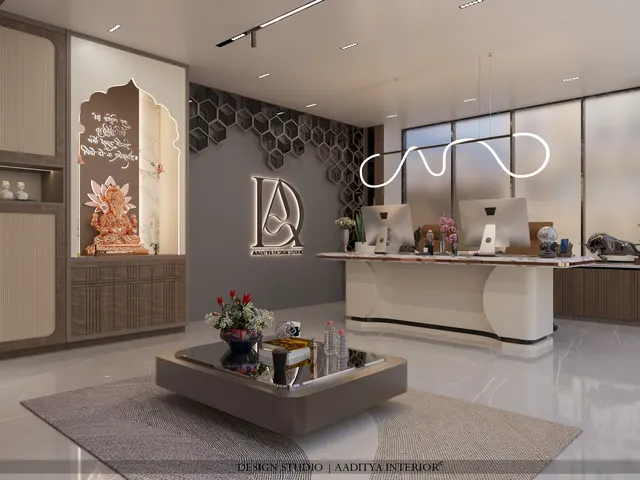
The plan should lead a customer naturally from the door through the sections in a sensible order while keeping every piece of stock under watch. A common arrangement places daily-wear and lighter gold near the entrance where footfall browses, the diamond and bridal sections deeper inside where customers take more time and sit down, and the billing and consultation near the back. Sight lines matter in two directions: staff must see the whole floor and every case, and customers must be drawn towards the brightest, most tempting displays. Seating, a water point, and a comfortable bridal room make high-value selling easier, while clear, generous aisles keep the showroom feeling calm rather than crowded. Aaditya Interior plans these journeys so that the lighting and the security layers reinforce the selling sequence rather than fighting it. A well-planned journey also keeps the queue at billing clear of the browsing counters, so a customer paying does not block another customer trying on a necklace at the mirror, and it gives the staff a single supervisory position from which the whole floor and every case stay in view.
What a jewellery showroom costs
Jewellery-showroom fit-out sits at the premium end of retail, because the finishes, the lighting and the security all cost more than an ordinary shop. The ranges below are indicative October 2026 figures for planning; a flagship with imported stone, designer lighting and a rated vault costs several times a modest neighbourhood showroom, so treat these as orientation and confirm with suppliers before budgeting. The lighting and the security are the two line items owners most often underestimate and most regret cutting.
| Item | Indicative Oct 2026 rate | Notes |
|---|---|---|
| Showroom interior fit-out | ₹3,000–8,000 per sq ft | Finishes, ceiling, flooring, counters |
| Display cases / counters | ₹25,000–1,50,000 each | Varies with size, glass and lighting |
| High-CRI accent and in-case lighting | ₹250–700 per sq ft of display | Over and above general lighting |
| CCTV system (cameras + recorder) | ₹1.5–6 lakh | Scales with camera count and retention |
| Intrusion alarm and access control | ₹1–4 lakh | Doors, glass, panic buttons, panel |
| Strongroom / rated vault | ₹3–15 lakh or more | Depends on rating and size |
| Air-conditioning | ₹120–200 per sq ft | Comfort and case-heat management |
Where jewellery showroom design is going
The showroom is being reshaped by technology and by the way customers now shop. Tunable LED lighting lets a single fitting shift from warm to cool at the touch of a controller, so the same case can flatter gold in the morning and diamonds in the evening, and smart controls can scene-set the whole floor. Security is becoming more intelligent, with analytics on the cameras that flag unusual behaviour and remote monitoring that lets a response be triggered from anywhere. At the same time, customers research online before they arrive, so the physical showroom increasingly plays the role of a trusted, experiential space — a place to see, touch and trust the jewellery — supported by appointment-based bridal rooms and digital displays. The constants remain: truthful, flattering light and layered, discreet security. A showroom built today should wire for tunable lighting, networked cameras and future expansion from the start.
Rules for a jewellery showroom
- Light the cases far brighter than the hall — the contrast is what pulls the eye to the jewellery.
- Use warm light (2700–3000 K) over gold and cooler light (4000 K+) over diamonds and platinum.
- Never go below a colour rendering index of 90 on display lighting — low CRI distorts colour and destroys trust.
- Light every shelf of a case, not just the top, and use a mirror back to double depth and sparkle.
- Set standing counters at about 950 mm and add lower seated consultation points for bridal and high-value selling.
- Build security as concentric rings — shopfront, controlled entry, camera-covered floor, cash point, strongroom.
- Cover the whole floor with overlapping cameras with no blind spots, and keep the recorder and alarm panel protected.
- Plan the customer journey so lighting and security reinforce the selling sequence instead of fighting it.
Frequently asked questions
These are the questions owners most often ask when planning a jewellery showroom, with short practical answers.
What colour temperature of light is best for a jewellery shop?
Use a mix. Warm light around 2,700–3,000 K flatters yellow gold and makes it look rich, while cooler light around 4,000 K and above makes diamonds and white metals sparkle and appear white. The best showrooms zone the lighting — warm over the gold sections and cooler over the diamond and platinum sections — or use tunable fittings that can shift between the two. Whatever the temperature, keep the colour rendering index at 90 or above so colours are shown truthfully.
How many lux should a jewellery display have?
The general hall sits around 300–500 lux, and the display cases are lifted to roughly 1,500–3,000 lux so they stand out, with hero pieces and diamond sections sometimes higher. The important thing is the contrast between the moderately lit room and the brilliantly lit cases, because that contrast is what draws the eye and makes the jewellery sparkle. Billing and consultation areas need a comfortable 500–750 lux for paperwork and close viewing.
What security does a jewellery showroom need?
Security should be layered rather than resting on a single safe: a tough shopfront with shutters and good lighting, a controlled and supervised entrance, overlapping CCTV with no blind spots on the sales floor, panic buttons at the counters, a separate secured cash point, access control on the back office, and a rated strongroom or vault with its own alarm as the innermost ring. The recorder and alarm panel should be kept in a protected location, and the alarms should be linked to a monitored response.
How high should a jewellery display counter be?
A standing display counter is usually about 900–1,000 mm high and 550–650 mm deep, which lets a standing customer look comfortably down into the glass case. For bridal and high-value selling, add lower seated consultation tables at about 720–750 mm with chairs and a mirror, so customers can sit, try pieces and take their time. Keep aisles between counter runs at 1,200–1,500 mm so two customers can pass and the space feels calm.
How much does a jewellery showroom interior cost?
Indicatively, in October 2026, a jewellery-showroom interior fit-out runs about ₹3,000–8,000 per square foot depending on finishes, with display cases from roughly ₹25,000 to ₹1,50,000 each, a CCTV system from about ₹1.5–6 lakh, and a rated vault from around ₹3–15 lakh or more. A flagship with imported stone, designer lighting and a high-rated vault costs several times a modest showroom, so these are orientation figures to confirm with suppliers before budgeting.
Sources & standards
- National Building Code of India 2016, Part 8 (Building Services) — lighting and electrical installations; Part 4 (Fire and Life Safety)
- Bureau of Indian Standards — IS 3646 (interior illumination) and related lighting recommendations; CIBSE / IES lux and colour-rendering guidance (described generically)
- Commission Internationale de l'Éclairage (CIE) — colour rendering index (CRI) definition
- European burglary-resistance standards for safes and strongrooms (EN 1143-1) and equivalent ratings, described generically
- Neufert, Architects' Data — retail and showroom planning, counters and circulation
- Bureau of Energy Efficiency (BEE) — efficient lighting practice for commercial interiors
- Price ranges: indicative October 2026 estimates — confirm locally before budgeting