Mid-century modern is one of the few interior styles that has never really gone away. The furniture designed in the two or three decades after the Second World War — moulded plywood chairs, low teak sideboards, sofas on slim tapered legs, globe lamps and abstract rugs — is still produced, copied and collected all over the world. In India it has a special resonance, because the same years produced Chandigarh, the furniture of Pierre Jeanneret, and the National Institute of Design in Ahmedabad. Many Indian families also grew up with grandparents' teak-and-cane furniture that is, in fact, mid-century in spirit.
The style is popular for good reasons: it is warm without being fussy, compact without feeling cheap, and easy to clean because almost everything stands on legs. But it is also easy to get wrong. A living room filled with catalogue copies, a mustard sofa, an orange wall and a starburst clock quickly becomes a theme set rather than a home. Sofas that are too low for elderly parents, sideboards too shallow for a set-top box and an amplifier, and light-coloured fabrics in a dusty city are common practical mistakes.
This article explains where mid-century modern came from and which features define it, then turns those features into dimensions, layouts, colour palettes, materials and indicative October 2026 costs for an Indian living room. It complements this site's guide to modern versus contemporary design, which places mid-century modern within the wider modern movement, and keeps its numbers.
Where mid-century modern came from
Mid-century modern is the domestic, post-war branch of the modern movement, usually dated from about 1945 to 1970. Early modernism of the 1920s and 1930s — the Bauhaus, tubular steel chairs, white walls — had been intellectual and often austere. After the war, designers in the United States and Scandinavia used new manufacturing methods, such as moulded plywood and fibreglass, and traditional materials, such as teak and walnut, to make modern furniture that was warmer, lighter and affordable for growing families moving into new houses.
A few pieces define the period in most people's minds. Charles and Ray Eames worked extensively with moulded plywood and released their lounge chair and ottoman in 1956. Hans Wegner's Wishbone chair appeared around 1950, and Arne Jacobsen designed the Egg chair in 1958 for a Copenhagen hotel. Eero Saarinen's pedestal Tulip chairs and tables came in the late 1950s. The phrase mid-century modern itself became widely used later, and is often credited to a 1984 book on 1950s furniture by the American writer Cara Greenberg; the revival of interest since then has kept the style alive.
India's own mid-century
India's mid-century was not a copy. In Chandigarh, planned in the 1950s by Le Corbusier with Pierre Jeanneret and a team of Indian architects, Jeanneret designed simple, robust furniture in teak and cane for government offices, colleges and housing — chairs with V-shaped or compass-shaped legs, woven cane seats and backs, and plain solid-wood frames. These pieces were made by local carpenters, used for decades, and are now among the most copied designs in Indian furniture shops. At the same time, Charles and Ray Eames visited India and wrote The India Report in 1958, which led to the founding of the National Institute of Design in Ahmedabad in 1961. India's mid-century look is therefore teak, cane, handloom, terrazzo and brass as much as walnut and fibreglass.
Seven features that make a room mid-century modern
A room does not need a single designer original to read as mid-century modern. It needs a handful of consistent features, repeated with discipline. The seven below are the ones Aaditya Interior uses as a checklist when a family asks for the style; a room with five of them reads clearly, a room with all seven can start to feel like a museum display, and a room with two or fewer usually reads simply as contemporary.
- Furniture on legs: sofas, chairs, sideboards and even beds stand on slim, often tapered legs about 150–200 mm high, so the floor runs underneath and the room feels larger.
- Low, long horizontal lines: a long sideboard, a low sofa back and a low coffee table keep the eye moving along the room rather than up.
- Warm wood: teak, walnut or a teak-look veneer on the sideboard, coffee table and chair frames, usually with a satin rather than high-gloss finish.
- Organic and geometric shapes together: a kidney or oval coffee table, a curved lounge chair, beside rectangular sideboards and simple grid shelving.
- A restrained palette with one or two warm accents: mustard, teal, olive or burnt orange against off-white walls and wood.
- Statement lighting: an arc floor lamp, a globe pendant, a cone-shaded table lamp or a multi-arm brass fitting, usually only one or two of them.
- Connection to outside: large windows, plants and, where possible, a view or balcony treated as part of the room.
It helps to see these features against the living room that most Indian flats end up with by default. The comparison below is not a judgement — the typical contemporary room has its own strengths, especially storage — but it shows exactly which decisions turn one into the other. Most families do not need to change everything; swapping the TV unit for a sideboard, lifting the sofa on legs and warming the palette already moves a room most of the way.
| Element | Typical Indian contemporary living room | Mid-century modern version | Effect of the change |
|---|---|---|---|
| TV wall | Full-height unit with back panel, niches and cove light | Low sideboard on legs; TV wall-mounted or on the sideboard | Wall becomes calmer; less storage |
| Sofa | Deep L-shaped sofa on a plinth or hidden legs | Three-seater on tapered legs plus two chairs | Floor visible; more flexible seating |
| Coffee table | Large rectangular, glass or high-gloss top | Oval, round or kidney shape in wood | Softer circulation, fewer bruised shins |
| Ceiling | Layered gypsum ceiling with many downlights | Plain or simple cove; one statement pendant or arc lamp | Lower cost; light where it is needed |
| Palette | Grey, white and high-gloss surfaces | Warm white, wood, one saturated accent | Warmer, more relaxed mood |
| Floor | Large glossy vitrified tiles | Matte warm tiles, terrazzo or a wool or cotton rug | Less glare, more texture |
Furniture dimensions for an Indian mid-century living room
Original mid-century furniture was designed for Western bodies and Western houses, and some reissues and copies are too low or too deep for Indian families, especially for older members who need to get up easily. The table below gives practical ranges. They follow the figures in this site's guide to modern and contemporary design: seat heights of about 400–450 mm, seat depths of about 480–550 mm, and legs of about 150–200 mm.
| Piece | Typical mid-century dimension (mm) | Indian family adjustment | Why |
|---|---|---|---|
| Three-seater sofa | L 1950–2200 · D 800–900 · seat H 400–430 · back H 750–800 | Seat 420–450 if elders use it; firm cushions | Low seats are stylish but hard to rise from |
| Lounge chair | W 750–850 · D 800–850 · seat H 380–420 | Choose one with arms; seat ≥ 400 | Arms help when getting up |
| Accent chair (cane or wood) | W 550–650 · D 600–700 · seat H 420–450 | Cane seat with a removable cushion | Breathable in Indian summers |
| Coffee table | L 1000–1300 · W 500–700 · H 350–420 | Keep 400–450 mm clear from the sofa | Reach for tea cups without leaning |
| Sideboard / credenza | L 1500–2400 · D 400–450 · H 600–750 | Depth 450 for set-top box and soundbar cabling | Doubles as the TV unit |
| Side table | Dia 400–500 · H 500–550 | Match arm height of the sofa ± 50 | Lamp and cup within reach |
| Arc floor lamp | Reach 1500–2000 · H 1800–2100 | Weighted base; route cable along the wall | Lights the coffee table without a ceiling point |
| Rug | 1600 × 2300 or 2000 × 3000 | Front legs of sofa and chairs on the rug | Ties the group together; easier to clean than wall-to-wall |
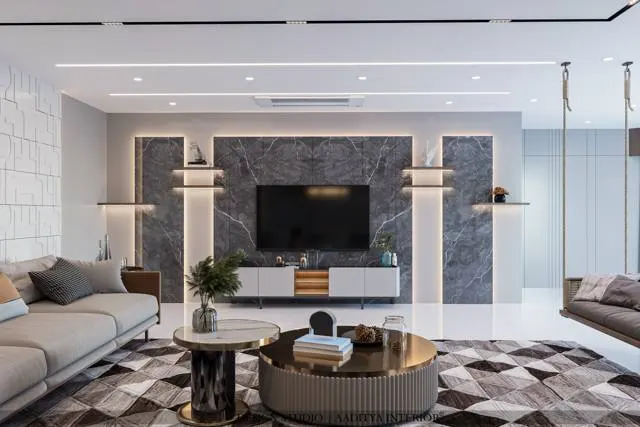
The sideboard is the piece that most clearly separates a mid-century living room from a typical Indian one. Instead of a floor-to-ceiling TV unit with a back panel, open shelves and a lit niche, the mid-century room uses a long, low cabinet on legs with sliding or flap shutters, and the television either hangs on the wall above it or sits on it. This frees the wall for art, a single shelf or simply a good paint colour, and it makes the room feel calmer. The practical cost is storage: a 1800 mm sideboard holds far less than a full-height unit, so the household's books, files and display items need another home — usually a bookshelf or a built-in cabinet elsewhere.
Layout: a 3600 × 4800 mm living room
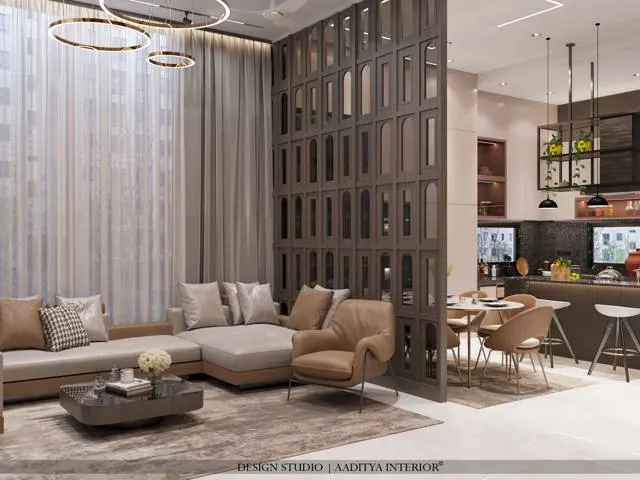
Most Indian flats offer a living room somewhere between 3350 × 4250 mm and 3650 × 4900 mm, often combined with the dining area. Fig. 3 shows a mid-century layout for a 3600 × 4800 mm room. The sofa sits against the longer solid wall, two chairs face it across a rug and an oval coffee table, and the sideboard with the television sits on the short wall, so that the TV is viewed from the side of the conversation group rather than dominating it. Walkways stay at about 900 mm, and the floor remains visible under every piece.
The same principles adapt to other room shapes. In a long, narrow living-dining room, the sofa and sideboard face each other across the short dimension, and the dining table sits beyond with a pendant over it, so the two zones read as one long, low composition. In a square room, two lounge chairs and a sofa around a round coffee table make a compact, sociable group. In every case, the test is whether the floor stays visible: if more than about half of the floor is covered by furniture and rugs, the room will feel heavy, which is the opposite of what the style intends.
Colour palettes that work in Indian light
Mid-century colour is often remembered as bright — orange, avocado, turquoise — but the best rooms used those colours in small doses against generous neutrals and warm wood. Indian light, which is stronger and warmer than northern European light for much of the year, makes saturated colours look even brighter, so restraint matters. A simple rule works well: about 60 per cent neutral (walls, ceiling, large rug), about 30 per cent wood and secondary colour (furniture, sideboard, one wall or the sofa), and about 10 per cent accent (cushions, a chair, a lamp, art).
| Palette | Walls (≈ 60 %) | Wood and secondary (≈ 30 %) | Accent (≈ 10 %) | Best for |
|---|---|---|---|---|
| Teak and mustard | Off-white or warm white | Teak sideboard and chair frames, tan leather | Mustard cushions or one mustard chair | East- or north-facing rooms that need warmth |
| Walnut and teal | Warm white | Walnut or dark teak veneer, grey sofa | Teal velvet chair or cushions | West-facing rooms with strong afternoon sun |
| Olive and rust | Ivory | Olive sofa, light teak | Rust and terracotta cushions, clay pots | Homes with plants and balconies |
| Greige and brass | Light greige | Dark wood, cane, stone | Brass lamps and frames | Families who want the style quietly |
| Indian handloom twist | White or lime-washed | Teak and cane | Ikat, kalamkari or block-printed cushions | Bringing Indian craft into a global style |
Materials: teak, cane, terrazzo and brass
The materials of a mid-century room are as important as its shapes. Solid teak and walnut were the original woods; in Indian interiors, natural teak veneer on plywood or MDF is the practical equivalent for built-in sideboards and wall panels, while solid wood is used for chair frames and table legs. Cane, which Jeanneret used throughout Chandigarh, gives chairs and shutters lightness and air. Terrazzo — familiar to many Indian families as the mosaic floors of the 1960s and 1970s — is the natural mid-century floor, and modern terrazzo tiles bring the look back without the dust of on-site grinding. Brass, in lamps, handles and frames, adds the warm metallic note.
| Material | Where in the room | Indicative cost (October 2026) | Care in Indian conditions |
|---|---|---|---|
| Natural teak veneer, PU lacquered | Sideboard, wall panels, built-in shelving | ₹600–1,100 per sq ft of finished shutter | Matte or satin lacquer; keep out of direct sun to limit fading |
| Solid teak or sheesham | Chair frames, coffee table, legs | Wide range; get item quotes from the maker | Oil or polish periodically; check moisture content before making |
| Cane webbing | Chair seats and backs, sideboard shutters | Usually priced per item or per panel; confirm locally | Keep dry; tighten or replace sagging seats every few years |
| Terrazzo or mosaic tiles | Floor, or a band under the sofa group | Confirm per tile and laying rate locally | Seal against oil and turmeric stains; matte finish reduces slipping |
| Vitrified tiles in a warm matte finish | Whole floor where terrazzo is not possible | ₹60–120+ material plus ₹25–40 laying per sq ft | Low maintenance; choose warm beige rather than cool grey |
| Upholstery — linen blend, wool blend, velvet | Sofa and chairs | Wide range by fabric; armchair about ₹15,000–60,000 | Mid-tone colours hide dust better than pale linen |
| Brass and powder-coated metal | Lamps, handles, frames, table bases | Lighting from about ₹2,000–15,000 per designer piece | Lacquered brass stays bright; raw brass darkens naturally |
Two practical cautions apply in Indian cities. First, dust: the open undersides that make mid-century furniture look light also collect dust, so plan for robot vacuums or easy mopping under every piece — legs of at least 100–150 mm make this possible. Second, humidity: in coastal cities such as Surat and Mumbai, cane, solid wood and natural fibres need air circulation and should not sit against damp external walls. A 20–30 mm gap behind a sideboard on an outside wall helps.
Lighting the mid-century living room
Mid-century rooms rely on lamps rather than rows of ceiling downlights. A typical scheme combines one statement fitting — an arc floor lamp over the coffee table or a globe pendant — with two or three table or floor lamps at seated eye level and soft general light. In an Indian flat with a false ceiling, a small number of warm-white (2700–3000 K) downlights or a perimeter cove can provide the general layer, but they should be dimmable, so that the lamps carry the room in the evening. Plan sockets at both ends of the sofa and beside the sideboard during electrical work; trailing extension cables across the floor spoil the clean lines that the style depends on.
Making it current, not retro
A mid-century living room in 2026 should feel lived-in, not like a period film set. The simplest way is to mix eras: a mid-century sideboard and lounge chair with a contemporary sofa, a handloom rug and contemporary art. Indian craft fits naturally — block-printed cushions, a dhurrie, terracotta pots, a brass lamp from a local workshop — because the style already valued honest materials and handwork. Avoid the theme-park signals: starburst clocks, boomerang-pattern wallpaper on every wall, and full sets of matching reproduction furniture.
Looking ahead, the style is moving in three directions that suit India well. Sustainability is pushing designers towards reclaimed teak, certified wood and repairable furniture, which matches mid-century values of durability. Comfort is pushing seat heights and cushion firmness up, which suits families with elderly members. And the renewed interest in Indian modernism — Jeanneret's chairs, Indian terrazzo, Chandigarh's concrete and cane — means that an Indian mid-century room can draw on its own history rather than importing someone else's.
Eight rules for a mid-century modern living room
- Lift everything on legs of about 150–200 mm; avoid skirted sofas and plinth-based TV units.
- Use a long, low sideboard (600–750 mm high, 400–450 mm deep) instead of a full-height TV unit.
- Keep sofa seats at 420–450 mm and choose chairs with arms if elderly family members will use them.
- Follow 60–30–10: light walls, wood and one secondary colour, and a single accent colour.
- Use one or two statement lights at most; add warm-white, dimmable general light.
- Mix one or two original or high-quality pieces with simpler furniture rather than buying a full matching set.
- Bring in Indian materials — cane, teak, terrazzo, brass, handloom — to keep the room rooted.
- Leave at least half of the floor visible and keep walkways at about 900 mm.
Frequently asked questions
What is the difference between mid-century modern and modern?
Modern design is the broader movement, roughly from the 1920s to the 1970s. Mid-century modern is its post-war domestic branch, roughly 1945–1970, warmer and more relaxed than early modernism, with teak and walnut, moulded plywood, tapered legs and gentle curves.
Does mid-century modern work in a small Indian flat?
Yes, often better than bulky styles. Furniture on legs, low sideboards and compact lounge chairs keep the floor visible and the room feeling larger. Choose a 1950–2100 mm sofa, one or two chairs and a sideboard of 1500–1800 mm in a typical 3350 × 4250 mm room.
What colours are used in a mid-century modern living room?
Warm neutrals for walls, wood tones for furniture, and one or two accents such as mustard, teal, olive green, burnt orange or rust. In India's strong light, keep accents to about 10 per cent of the room.
Is mid-century modern furniture comfortable?
Good pieces are comfortable, but some reissues and copies have low seats of about 380 mm and deep, soft cushions. For Indian families, especially with elderly members, look for seat heights of 420–450 mm, firm cushions and arms on at least some chairs.
Can a mid-century living room have a pooja unit or traditional elements?
Yes. A wall-mounted mandir in teak veneer with a cane or jaali shutter sits naturally in a mid-century room, as do brass lamps, handloom textiles and terracotta. The style's honest materials blend well with Indian craft.
Sources & standards
- Cara Greenberg, Mid-Century Modern: Furniture of the 1950s (1984)
- Charles and Ray Eames, The India Report (1958), and the National Institute of Design, Ahmedabad (founded 1961)
- UNESCO World Heritage Centre — The Architectural Work of Le Corbusier, including the Capitol Complex, Chandigarh
- Neufert, Architects' Data — seating heights, furniture dimensions and living room clearances
- Time-Saver Standards for Interior Design and Space Planning — residential furniture and circulation clearances
- Bureau of Indian Standards — IS 1659 (block boards) and IS 303 (plywood for general purposes) for built-in joinery
- Price ranges: indicative October 2026 estimates — confirm locally before budgeting