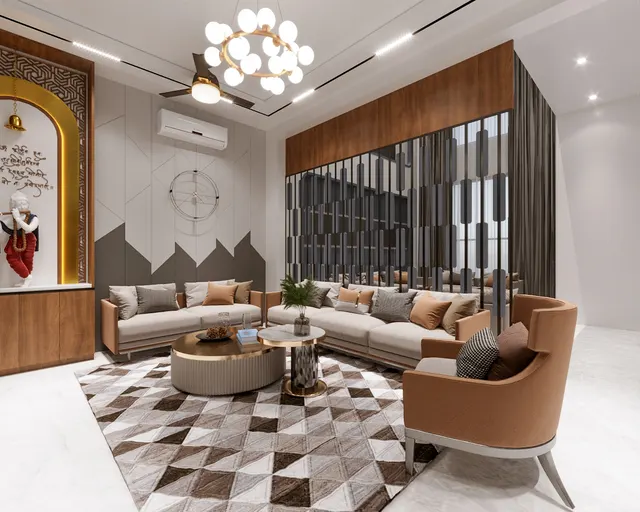
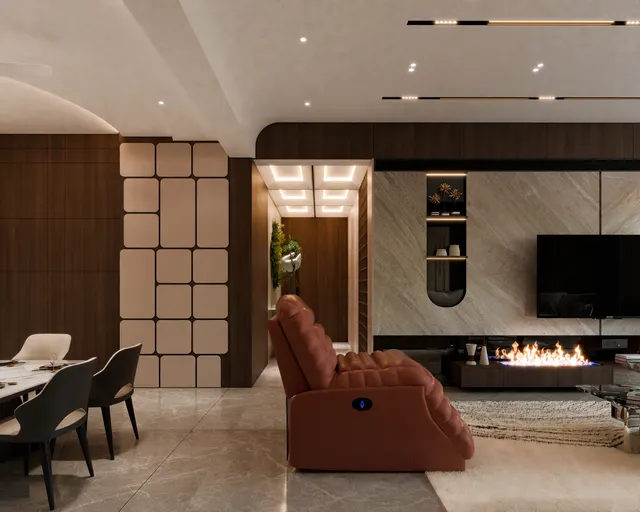
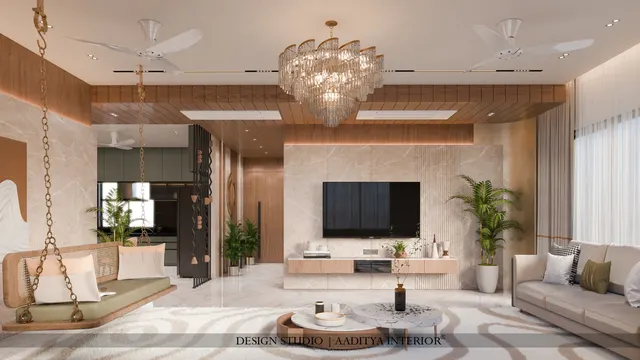
In almost every first meeting with a client, two words come up as if they mean the same thing: modern and contemporary. A homeowner says they want a modern living room and shows a photograph of a curved boucle sofa, fluted panels and a cove-lit ceiling. Another says contemporary and shows a teak sideboard on tapered legs and a cane chair. Both are reasonable pictures — but the first is contemporary and the second is modern, and the difference decides almost everything that follows: the furniture profiles, the colour palette, the ceiling design, even the joinery details and the budget.
The confusion is understandable. In everyday English, modern simply means new, and furniture shops in India use both words loosely to mean not traditional. But in design, modern refers to a specific movement with a beginning and, broadly, an end, while contemporary refers to whatever is current — and therefore keeps moving. A home designed in a contemporary style in 2010 already looks a little dated; a well-designed modern interior from 1960 can still look fresh. Understanding that difference helps a homeowner choose what they actually like, brief a designer clearly, and avoid spending on finishes that will feel stale in five years.
This article explains where each style came from, how to recognise them by line, form, colour, material and furniture dimensions, how each translates into an Indian flat, what they cost to execute, and how to combine them sensibly — because most good Indian homes today are, in practice, a considered mix of the two.
The short answer: a fixed style versus a moving target
Modern interior design is a historical style. It grew out of the modernist movement in architecture and design in the early twentieth century, and it is usually dated from about the 1920s to the 1970s, with its most popular domestic expression — mid-century modern — flourishing from roughly the end of the Second World War to around 1970. Its principles are stable and well documented: function first, form follows purpose, no ornament for its own sake, honest use of materials, open plans, and furniture that is light, raised and clearly structured.
Contemporary interior design is not a fixed style at all. It is the design of the present moment, which borrows freely from modernism, minimalism, regional craft, and new materials and technology. That means contemporary in 1995 (glossy surfaces, chrome, bright accent colours) looks very different from contemporary in 2026 (warm neutrals, matte finishes, curves, textured walls, hidden lighting). A useful way to remember it: modern is a closed chapter you can study; contemporary is the page being written now.
Where modern design came from
Modernism began as a reaction against the heavy ornament of the nineteenth century and a response to industrial production. Its most famous school, the Bauhaus, was founded in Germany in 1919 by Walter Gropius and closed in 1933. Bauhaus teachers and students argued that everyday objects — chairs, lamps, kitchens, houses — should be designed for industrial manufacture, with forms derived from their purpose and materials rather than from historical decoration. Architects such as Le Corbusier and Ludwig Mies van der Rohe carried similar ideas into buildings: open plans, large windows, flat roofs, structural frames that freed walls from carrying loads, and a strong preference for simple geometry.
After the Second World War, these ideas reached ordinary homes as mid-century modern. Designers in the United States and Scandinavia produced furniture that was warmer and more domestic than the austere early modernism: moulded plywood, teak and walnut, tapered legs, low sideboards, organic but disciplined curves, and bright accents against neutral backgrounds. Many of these designs are still in production and are widely copied. When an Indian furniture shop sells a teak-finish sideboard on splayed legs or a slim armchair with a shaped plywood shell, it is selling mid-century modern.
Indian modernism
India has its own modern tradition, and it is one of the richest in the world. Chandigarh, planned in the 1950s by Le Corbusier with Pierre Jeanneret and an Indian team, gave the country a new civic architecture of exposed concrete, deep sunshades and bold forms. Jeanneret's furniture for the city — simple teak frames with woven cane seats and backs — is a textbook example of modern design adapted to a hot climate: the cane breathes, the timber is local, the construction is honest and repairable. In Ahmedabad, architects including B. V. Doshi and Charles Correa built a modern architecture of brick, concrete, shade and courtyards, and Louis Kahn's brick campus for the Indian Institute of Management became a landmark. For Indian homeowners, Indian modernism is a reminder that modern does not have to mean cold or Western; it can mean local timber, cane, brick, Kota stone and terrazzo, used with discipline.
| Principle of modern design | What it looks like in a room | Indian example or material |
|---|---|---|
| Function first | Every piece has a clear job; nothing is purely decorative | Built-in storage benches, simple study tables |
| Truth to materials | Timber looks like timber, concrete like concrete; no fake finishes | Teak and cane, exposed brick, Kota stone, terrazzo |
| Clean geometry | Straight lines, right angles, simple circles | Flat shutters with slim handles, rectangular coffee tables |
| Raised, light furniture | Pieces stand on legs; floor visible underneath | Jeanneret-style chairs, sideboards on 150–200 mm legs |
| Open plan | Living, dining and sometimes kitchen flow together | Living–dining cores of Indian flats |
| Limited palette | Neutral base, natural wood, a few strong accent colours | White or off-white walls with mustard, teal or rust accents |
| Light and view | Large windows, minimal curtains, sun control by design | Deep sunshades and jaali in Indian modern buildings |
What contemporary design means in India today
Contemporary design in 2026 is easiest to describe by what designers and clients are currently choosing. In Indian flats, the contemporary look tends to combine five things. A warm, quiet palette: off-whites, greige, beige, taupe, clay and muted greens rather than stark white and grey. Softer forms: rounded sofa arms, curved corners on coffee tables, arched openings and pill-shaped mirrors. Texture as decoration: fluted or ribbed panels, textured paint, limewash-effect finishes, boucle, linen and stone with visible veining. Integrated lighting: cove lights, profile lights recessed into joinery, LED strips under floating units, warm colour temperatures. And handle-less or minimal joinery: matte laminate, PU or acrylic shutters with gola profiles or push-to-open fittings.
Contemporary design also borrows heavily. Japandi blends Japanese restraint with Scandinavian warmth; quiet luxury emphasises tactile materials over logos and shine; biophilic design brings in plants, natural light and natural textures; and Indian contemporary brings handloom textiles, cane, brass and local stone into a modern frame. Because contemporary design keeps absorbing new influences, a contemporary interior has a shorter shelf life than a modern one — unless it is designed with restraint. The trick is to use the passing trends in things that are cheap to change, such as cushions, rugs, lamps and paint, and to keep the expensive, permanent elements — joinery, flooring, ceilings — calm and simple.
How to tell them apart: line, form, colour and material
In a showroom or on a mood board, a few clear signals separate the two styles. The table below is the most useful single reference in this article: run any room photograph through it, and the dominant style becomes obvious. Most real rooms will score a mix, which is normal and often desirable.
| Aspect | Modern | Contemporary (India, 2026) |
|---|---|---|
| Definition | A historical style, roughly 1920s–1970s | The design of the present; keeps changing |
| Lines | Strictly straight, horizontal emphasis | Straight lines softened by curves and radii |
| Furniture base | Raised on visible legs, often tapered | Plinth-based, floating or low to the floor |
| Colour | Neutral base with strong primary or earthy accents (mustard, teal, orange) | Warm neutrals — greige, beige, taupe, clay, sage — with tonal layering |
| Wood | Visible, warm timbers (teak, walnut) and plywood | Lighter oaks, ash, smoked or fluted veneers, often mixed with stone |
| Metal | Chrome, brushed steel, black tube frames | Brushed brass, champagne, matte black, PVD finishes |
| Texture | Smooth surfaces; texture comes from wood grain and textiles | Texture as decoration — fluting, boucle, limewash, stone veining |
| Lighting | Statement pendants, arc lamps, table lamps | Concealed cove and profile lights plus a sculptural pendant |
| Ornament | Almost none; the object itself is the decoration | Little, but sculptural shapes and textured walls are welcome |
| Shelf life | Long — already a classic | Shorter — depends on how much of the room chases trends |
Two signals are especially reliable in Indian flats. The first is the furniture base. Modern furniture stands on legs, often 150–250 millimetres tall, so the floor runs visibly underneath; that makes small rooms look larger and makes cleaning easier. Contemporary joinery, by contrast, is often wall-hung (floating) with a strip of LED light underneath, or sits on a recessed plinth that hides the floor junction. The second is how the room is lit. A modern room is lit by objects — a pendant, an arc lamp, a reading lamp. A contemporary room is lit by the architecture itself — cove lights, profile lights in the ceiling, strips inside niches and under units — with a single sculptural fitting as the focal point.
Dimensions matter more than the label
The furniture dimensions in Figure 3 are where the style choice becomes a comfort choice. Mid-century sofas and lounge chairs generally have seat heights around 400–450 millimetres and seat depths of 480–550 millimetres, with slim arms and visible legs. Many contemporary sofas are lower — 380–420 millimetres — and deeper, at 550–650 millimetres, with wide rounded arms and solid bases. They look generous and suit lounging, but in Indian homes with grandparents, a deep, low seat can be genuinely difficult to get out of. A designer working in a contemporary style for a multi-generation family will often keep the contemporary look — rounded arms, textured fabric, plinth base — while holding the seat at 420–450 millimetres and the depth near 550 millimetres, and adding firm cushions.
Ceilings and lighting: where the styles diverge most
Indian apartments almost always get a false ceiling, and the ceiling is where the two styles separate most clearly. A modern interior, true to its roots, prefers a flat, uninterrupted ceiling: either the bare slab painted white, or a single-level gypsum ceiling with a few recessed downlights, and the mood created by pendants and lamps. A contemporary interior usually layers the ceiling: a perimeter drop with a cove, a recessed profile light running in a line, or a floating raft with indirect light around it. Both can be done well. The modern approach preserves height and costs less; the contemporary approach gives more control over atmosphere but eats headroom and budget.
What each style costs in an Indian flat
Neither style is inherently more expensive; what moves the budget is the finish and the amount of built-in work. A modern interior tends to spend on a few good pieces of furniture and natural materials — veneer, solid wood edges, cane — while keeping the ceiling simple. A contemporary interior tends to spend on joinery finishes, wall textures and integrated lighting. The table below compares typical choices for a 2BHK living–dining area using indicative October 2026 rates already used across this blog; furniture prices vary too widely by brand to quote meaningfully and are left out.
| Element | Modern choice | Indicative cost | Contemporary choice | Indicative cost |
|---|---|---|---|---|
| Shutter finish (TV unit, crockery) | Natural veneer with polish | ₹600–1,100 per sq ft of shutter | Matte PU or acrylic, handle-less | ₹1,000–1,800 (PU) / ₹900–1,500 (acrylic) |
| Cabinetry (carcass + finish) | Mid-range joinery on legs | ₹1,200–2,200 per sq ft of elevation | Mid-range floating joinery with LED | ₹1,200–2,200 + LED ₹150–300 per running ft |
| Ceiling | Single-level gypsum, few downlights | ₹60–80 per sq ft | Cove and profile-light ceiling | ₹80–180 per sq ft |
| Wall finish | Premium emulsion, one colour | ₹20–30 per sq ft | Texture or limewash-effect feature wall | ₹40–150+ per sq ft |
| Feature panel | Veneer or solid wood batten wall | Veneer ₹600–1,100 per sq ft | Fluted MDF panel, PU painted | Priced like PU shutters, ₹1,000–1,800 |
| Lighting | Statement pendant + lamps | Pendants ₹2,000–15,000 each | Cove, profile, panels + one pendant | Panels ₹400–1,200 each; cove per running ft |
| Floor | Vitrified or Kota/terrazzo accent | Vitrified ₹60–120 + ₹25–40 laying | Large-format matte vitrified | ₹60–120+ + ₹25–40 laying |
For a typical mid-range Indian home, the full interior lands around ₹1,400–1,800 per sq ft of carpet area regardless of which style is chosen. Contemporary schemes drift to the upper end when they use PU finishes, extensive cove lighting and textured walls everywhere; modern schemes drift up when they use solid timber furniture and premium veneers. The cheapest way to make either look expensive is the same: reduce the number of materials, keep the joinery lines aligned, and light the room in layers.
Related styles that cause confusion
Several other style labels sit close to modern and contemporary and are often mixed up with them. Knowing them helps when collecting images on Pinterest or Instagram and explaining a preference to a designer.
| Style | Relationship | How to spot it | Works in Indian flats? |
|---|---|---|---|
| Mid-century modern | The domestic, post-war branch of modern | Teak, tapered legs, low sideboards, shaped plywood chairs | Very well — warm, compact, easy to clean under |
| Minimalism | A strict offshoot shared by both styles | Very few objects, hidden storage, monochrome palette | Yes, if storage is generous; hard with large families |
| Scandinavian | Modern roots, contemporary popularity | Light woods, white walls, cosy textiles, simple forms | Yes, with warmer tones for Indian light |
| Japandi | A contemporary blend of Japanese and Scandinavian | Low furniture, natural fibres, muted earthy palette | Yes; keep seat heights practical |
| Industrial | Uses modern materials in a raw way | Exposed brick, metal, concrete, Edison bulbs | In accents; full industrial can feel hot and dark |
| Transitional | A bridge between traditional and contemporary | Classic shapes with simplified detailing, neutral palette | Common in Indian homes that want some tradition |
| Indian contemporary | Contemporary design with Indian craft and materials | Cane, handloom, brass, jaali, terrazzo in a clean frame | Ideal — climate- and culture-appropriate |
How to mix modern and contemporary without confusion
Most well-designed Indian homes are, in practice, contemporary interiors with modern furniture or modern interiors with contemporary lighting. The mix works because both styles share the same underlying discipline: uncluttered surfaces, limited palettes and a dislike of fake ornament. Problems arise only when the mix has no rule — when every room uses a different wood, every wall has a different texture, and furniture of three eras competes for attention. A simple method is to choose one style for the fixed shell (joinery, ceiling, flooring, walls) and allow the other style into the movable layer (furniture, lamps, rugs, art). A calm contemporary shell with handle-less matte joinery and warm cove lighting looks excellent with a teak-and-cane armchair and a mid-century sideboard; a modern shell with veneer joinery and a flat ceiling looks excellent with a curved contemporary sofa.
A second method is to choose one shared material that appears in both styles and repeat it. Natural wood is the easiest bridge: a walnut or teak tone on the modern sideboard repeated on the contemporary fluted panel and on the dining chairs ties the room together. Black metal is another bridge: slim black handles, a black lamp base and black window frames link a modern chair with a contemporary kitchen. Aaditya Interior often limits a living–dining space to three main materials plus one accent, which keeps a mixed-style room from looking like a showroom.
Which style lasts longer?
Modern, almost always. Because it is already a closed chapter, the forms have been tested by decades of use and repeated in museums, shops and homes; they read as classic rather than fashionable. Contemporary design is by definition tied to the present, and the most trend-specific elements — a particular colour, an extreme curve, a fashionable panel pattern — will date. That is not a reason to avoid contemporary design; it is a reason to put the trend in the cushions, the paint and the light fittings, and to keep the joinery, the flooring and the ceiling restrained.
Where both styles are heading
The two styles are converging. Contemporary design in India is moving away from the high-gloss, grey-and-white interiors of the 2010s towards warmer, more tactile, more natural interiors — which is to say, back towards the values of mid-century and Indian modernism: real materials, comfortable proportions, visible craft and a connection to climate. At the same time, the modern furniture classics are being reissued in contemporary colours and fabrics. Over the next few years, the most durable Indian interiors are likely to be those that combine a modern discipline in planning and joinery with contemporary comfort in lighting, acoustics and textiles, and with Indian materials — cane, stone, terrazzo, handloom — in place of imported clichés.
Eight rules for choosing between modern and contemporary
- Name the style by its features, not the label: legs or plinth, straight or curved, object lighting or built-in lighting.
- Choose one style for the fixed shell — joinery, ceiling, flooring — and let the other appear only in loose furniture and décor.
- Keep sofa seat height at 420–450 mm and depth near 500–550 mm if elderly family members will use it, whatever the style.
- Raise storage on 150–250 mm legs or float it 300–450 mm above the floor in small rooms; a visible floor makes the room feel larger.
- Limit false-ceiling drops to 100–300 mm so clear height stays at or above 2700 mm.
- Limit a living–dining space to three main materials plus one accent.
- Put trends where they are cheap to change: cushions, rugs, lamps, paint — not joinery or flooring.
- Light every room in at least two layers; use 2700–3000 K warm white in living spaces for either style.
Frequently asked questions
Is contemporary the same as modern?
No. Modern refers to a specific design movement of the twentieth century with fixed principles, while contemporary refers to the design of the present moment, which changes over time. Contemporary interiors often borrow modern ideas, which is why the two are confused.
Which is better for a small Indian flat — modern or contemporary?
Both can work. Modern furniture on legs keeps the floor visible and makes small rooms feel larger; contemporary floating joinery with under-lighting does the same. The more important choices are a limited palette, aligned joinery and ceiling drops kept shallow.
Is mid-century modern still in style in 2026?
Yes. Mid-century modern furniture — teak or walnut, tapered legs, simple forms — continues to be produced and copied, and it sits comfortably in contemporary Indian interiors, especially alongside cane, handloom fabrics and warm lighting.
What colours are used in contemporary interior design?
In Indian homes in 2026, contemporary palettes are dominated by warm neutrals — off-white, greige, beige, taupe, sand and clay — with muted greens, terracotta, or deep blues as accents, and natural wood and stone as the main texture.
Can traditional Indian elements be used in a modern or contemporary home?
Yes, and they often improve it. A jaali screen, a cane chair, a brass lamp, a terrazzo or Kota stone floor or a handloom throw all fit within modern and contemporary frameworks, provided they are used sparingly and in clean, simplified forms.
Sources & standards
- Bauhaus-Archiv / Museum für Gestaltung, Berlin — history of the Bauhaus (1919–1933)
- UNESCO World Heritage Centre — The Architectural Work of Le Corbusier, including the Capitol Complex, Chandigarh (2016)
- Neufert, Architects' Data — seating heights, depths and living-room furniture dimensions
- Time-Saver Standards for Interior Design and Space Planning — upholstered seating dimensions
- Bureau of Indian Standards — National Building Code of India 2016, Part 3 (room heights); IS 3646-1 (interior illumination)
- Bureau of Indian Standards — IS 303 (plywood for general purposes), IS 2095 (gypsum plaster boards)
- Price ranges: indicative October 2026 estimates — confirm locally before budgeting