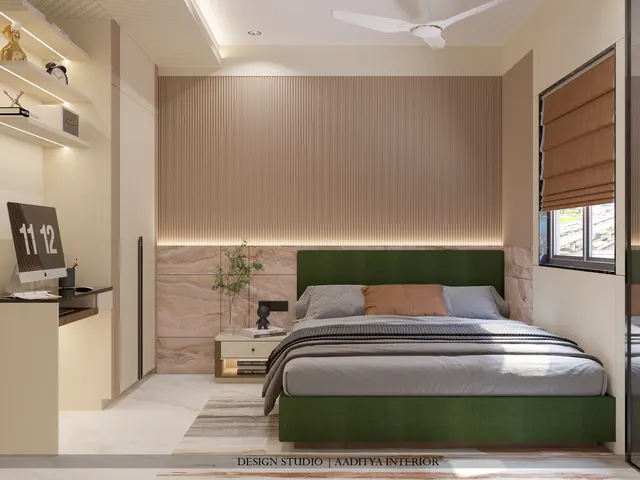
A Murphy wall bed is the oldest honest answer to the smallest Indian flat. In a 1BHK or a studio of 350 to 500 square feet, a fixed double bed eats the one room that must serve as bedroom, living room and guest room in turn. A wall bed folds that bed away in under a minute and gives the floor back, so the same room works through the day. It is not a compromise bed for occasional guests. Fitted properly, with the right mattress and a good mechanism, it is a full everyday bed that simply stands upright when it is not needed.
The mistakes are almost always made before the bed is ordered. Families buy the mechanism first and measure the room later, or they order a cabinet that is too shallow for their mattress, or they fix a heavy bed to a hollow brick wall that cannot hold it. The result is a bed that is hard to fold, a cabinet that rocks, or a mattress that must be removed every night — which defeats the whole purpose. This article sets out the dimensions, clearances, mechanisms and costs that decide whether a Murphy bed works in an Indian home, in the order a homeowner should decide them.
The guidance here follows Indian practice: plywood carcasses in 18 mm board, standard mattress sizes of 1830 by 1370 mm for a double and 1980 by 1520 mm for a queen, floor-to-ceiling heights of 2700 to 3000 mm in most flats, and the brick and concrete walls found in Indian apartment construction. Where a number is a range, the range is the safe one to design to, and the article says so. Aaditya Interior has fitted wall beds in compact Surat flats where the same 10 by 12 feet room must serve three uses a day, and the dimensions below are the ones that survived daily use.
From fold-down beds to the modern Murphy bed
The fold-down bed is more than a century old. William Murphy, a young man living in a one-room apartment in San Francisco, patented a bed that folded into a closet so that his small room could serve as a parlour by day. The idea spread quickly through American cities, where small apartments were common, and the name Murphy bed became the generic term for any bed that folds up into a wall cabinet. Early versions used counterbalanced springs and heavy timber frames, and they were built into the fabric of the room rather than bought as furniture.
Indian homes arrived at the same idea by a different route. The charpai, the takht and the diwan were all low platforms that served as seating by day and sleeping by night, and the sofa-cum-bed became the standard answer for the small flat from the later decades of the twentieth century onwards. What the Murphy bed adds to that tradition is a proper mattress at proper sleeping height, with the bed stored vertically rather than folded in half. The sleeping surface is flat, full-length and uncreased, which is why a wall bed suits nightly use in a way a folding sofa bed rarely does.
The modern change is the mechanism. Gas pistons, borrowed from car boots and office chairs, now carry most of the bed weight, so a bed that weighs 60 to 80 kg with its mattress can be folded by one person with one hand. Soft-close dampers stop the bed slamming shut, and locking legs fold out automatically as the bed comes down. At the same time, modular furniture makers in India began offering wall beds as standard catalogue items with desks, sofas and wardrobes built into the same cabinet. The bed stopped being a carpenter's one-off and became a product with a price list, a warranty and a known set of sizes.
How a Murphy bed works: the parts that matter
A Murphy bed has four working parts, and each one must be right. The cabinet is a box fixed to the wall, usually 400 to 450 mm deep, that holds the bed upright. The bed frame pivots on a pair of heavy brackets low on the cabinet, about 250 to 300 mm above the floor. The mechanism — pistons or springs — connects the frame to the cabinet and carries most of the weight as the bed swings down. And the legs, usually a folding pair at the foot end, swing out as the bed reaches horizontal and carry the far end. When the bed is up, the underside of the frame becomes the visible front of the cabinet.
There are two orientations. A vertical Murphy bed folds down from a tall cabinet, with the head of the bed at the wall and the foot swinging out into the room; it needs about 2000 mm of clear floor in front of the cabinet. A horizontal Murphy bed folds down sideways from a long, low cabinet, with the long side of the bed against the wall; it needs only about 1000 to 1200 mm of floor in front but needs 2000 mm or more of wall length. Vertical beds suit narrow rooms and single beds; horizontal beds suit wide, low rooms, rooms under windows, and homes where a tall cabinet would block light or look heavy.
The mattress is part of the mechanism, not an afterthought. Most pistons are rated for a mattress of 150 to 200 mm thickness and a defined weight, and a mattress that is too thick or too heavy will not stay up, or will not stay down. The mattress is held to the frame by straps or a retaining bar, and the pillow usually stays on the bed when it folds up. Bedding is folded flat against the mattress or removed. Designers recommend choosing the mattress first, confirming its thickness and weight with the mechanism supplier, and only then finalising the cabinet depth, because a 25 mm error in depth is the difference between a cabinet that closes and one that does not.
Standard sizes: cabinet, mattress and bed dimensions
The table below gives the working sizes for the three bed sizes most Indian homes buy. Cabinet width is the mattress width plus about 100 to 150 mm for the frame and side panels; cabinet height is the mattress length plus about 150 to 250 mm for the pivot, the top pelmet and clearance; cabinet depth is the folded thickness of frame plus mattress plus bedding, usually 400 to 450 mm. A queen bed in a vertical cabinet is 2100 to 2200 mm tall overall, which fits comfortably under a 2700 mm ceiling with a pelmet or a storage loft above, but it is worth measuring the ceiling before ordering, because older homes and mezzanine flats can have ceilings as low as 2400 mm.
| Bed size | Mattress (mm) | Cabinet W × H (mm) | Cabinet depth (mm) | Best for |
|---|---|---|---|---|
| Single | 1830 × 915 | 1000 × 2050 | 400–450 | Kids room, guest room, studio |
| Double | 1830 × 1370 | 1500 × 2050 | 400–450 | Couple in a 1BHK, guest room |
| Double (long) | 1980 × 1370 | 1500 × 2200 | 400–450 | Taller sleepers, master bedroom |
| Queen | 1980 × 1520 | 1650 × 2200 | 400–450 | Master bedroom, daily use |
| Horizontal double | 1830 × 1370 | 2050 × 1500 | 400–450 | Wide room, under a window |
| Horizontal queen | 1980 × 1520 | 2200 × 1650 | 400–450 | Wide room, low ceiling |
Two dimensions deserve special attention. The first is the folded depth: 400 mm is enough for a 150 mm mattress with thin bedding, but a 200 mm mattress with a thick quilt needs 450 mm, and the cabinet front will not sit flush if the depth is short. The second is the pivot height: the bed frame pivots about 250 to 300 mm above the floor, which sets the sleeping height at 450 to 550 mm from the floor to the top of the mattress — the same as a normal bed. A pivot set too high makes the bed hard to climb into; a pivot set too low leaves the folded bed scraping the floor. Both numbers are set by the mechanism manufacturer and should not be improvised on site.
The cabinet front is the face the room sees all day, so it deserves the same thought as a wardrobe shutter. Plain laminate fronts are cheapest and most durable; fluted or panelled fronts suit traditional interiors; a mirror front makes a small room feel larger but adds weight and cost; and a fold-down desk or a sofa built into the front turns the cabinet into two pieces of furniture. Whatever the front, it should have a proper handle or a recessed pull at a comfortable height — about 900 to 1000 mm from the floor — because the front is also what the user pulls to bring the bed down.
Room sizes and clearances: the plan that actually works
A Murphy bed needs floor in front of it, not just wall behind it. When the bed is down, it occupies its full length — 2000 mm for a queen — plus the cabinet depth, so the room must be at least 2500 mm deep in the direction the bed opens, and 3000 mm is comfortable. At the foot of the bed, 900 mm of clear space lets a person walk past and make the bed; 600 mm is the absolute minimum and feels cramped. On at least one long side, 600 mm of clear space lets a person get in and out without climbing over a partner. A room of 3000 by 3600 mm takes a queen wall bed comfortably with a wardrobe on one wall and a small desk on the other.
| Bed size | Minimum room (mm) | Comfortable room (mm) | Clear at foot | Clear at one side |
|---|---|---|---|---|
| Single vertical | 2400 × 2700 | 2700 × 3000 | 750 mm | 600 mm |
| Double vertical | 2700 × 3000 | 3000 × 3600 | 900 mm | 600 mm |
| Queen vertical | 3000 × 3000 | 3000 × 3600 | 900 mm | 600 mm |
| Double horizontal | 3600 × 2400 | 4200 × 2700 | 750 mm | 600 mm |
| Queen horizontal | 4200 × 2400 | 4500 × 2700 | 900 mm | 600 mm |
| Murphy + sofa front | 3000 × 3600 | 3600 × 4200 | 900 mm | 750 mm |
The room plan should be drawn with the bed down, not with the bed up. Furniture that looks fine when the bed is folded — a coffee table, a floor lamp, a child's toy box — becomes an obstacle when the bed comes down at night. Designers mark the bed footprint on the floor with tape during the site visit and ask the family to live with the taped outline for a few days before ordering. Doors need the same check: a bedroom door that swings into the bed footprint will hit the bed, so the door should swing the other way or be replaced with a sliding door. Ceiling fans need clearance above the folded bed, and a fan directly over the bed should be checked against the upright cabinet, which can reach 2100 mm.
Light and air decide whether the room feels like a bedroom or a store room. A wall bed against the window wall blocks daylight when it is up, so the cabinet usually goes on a solid wall, with the window free. A reading light on the cabinet front or on the wall beside the bed is more useful than a ceiling light, and a small shelf or a charging point near the head of the bed makes the bed usable at night. In Surat's warm climate, the bed should not sit against a west-facing wall that stays hot into the night; a wall that gets the morning sun is better, and a ceiling fan above the bed matters more than it does over a fixed bed, because the room is used through the day.
Mechanisms, frames and materials
The mechanism is the part that fails first, so it is the part to spend on. Gas-piston mechanisms are the current standard: two pistons, one on each side, rated for the weight of the frame plus mattress, with a smooth action and a soft close. Spring mechanisms are older, cheaper and noisier, and they need periodic adjustment as the springs stretch. Manual mechanisms with no assistance exist for light single beds but are not recommended for a double, because the full weight must be lifted by hand. A good piston mechanism is rated for 10,000 or more open-close cycles, which is about 27 years at once-daily use, and the supplier should state the rating in writing.
| Mechanism | Lift effort | Noise | Life (cycles) | Indicative cost |
|---|---|---|---|---|
| Gas piston (pair) | One hand, light | Quiet, soft close | 10,000+ | ₹18,000–₹35,000 |
| Spring counterbalance | Two hands, firm | Some creak | 5,000–8,000 | ₹10,000–₹18,000 |
| Manual, no assist | Full weight by hand | Quiet | Frame life only | ₹4,000–₹8,000 |
| Piston + sofa front | One hand, light | Quiet, soft close | 10,000+ | ₹30,000–₹55,000 |
| Piston + desk front | One hand, light | Quiet, soft close | 10,000+ | ₹35,000–₹60,000 |
The frame is usually mild-steel tube or heavy plywood. A steel frame is lighter, stronger and straighter, and it suits a bed that will be folded every day; a plywood frame is quieter and cheaper but heavier, and it needs good bracing to stay square. The cabinet carcass is best in 18 mm plywood — marine ply (IS 710) where the wall is damp — with a laminate or veneer finish; MDF (IS 12406) is acceptable for the front panels but not for the load-bearing sides, and particle board (IS 3087) should not be used for a wall bed at all, because the screws that hold the pivot brackets will pull out of it over time. All pivot brackets should be fixed with through-bolts or long coach screws into the wall, never with ordinary wall plugs alone.
| Material | Where used | Strength | Moisture behaviour | Cost note |
|---|---|---|---|---|
| 18 mm plywood (IS 303) | Cabinet carcass, sides | High | Good if sealed | Standard, recommended |
| 18 mm marine ply (IS 710) | Carcass near damp walls | High | Best | ₹15–25% more than ply |
| MDF (IS 12406) | Front panels only | Medium | Swells if wet | Cheaper, smooth finish |
| Mild-steel tube frame | Bed frame | Very high | Needs paint | Light and strong |
| Particle board (IS 3087) | Not recommended | Low | Poor | Avoid for wall beds |
The wall itself is a structural decision. A Murphy bed in daily use pulls on its fixings every time it is folded, so it must be anchored to a solid brick wall of at least 200 mm thickness, or to a concrete wall, with the load spread across four to six anchor points. A 100 mm partition wall, a hollow block wall or a gypsum partition cannot carry a double wall bed safely, and a bed fixed to such a wall will work loose within months. Where the only available wall is a partition, the answer is a floor-standing frame that is bolted to the floor as well as the wall, or a freestanding cabinet that is fixed to the floor slab. The National Building Code of India 2016, Part 3, sets the general requirements for such fixings, and a structural engineer should be consulted where the wall construction is in doubt.
Costs in India: what a Murphy bed costs in October 2026
A Murphy bed is bought in three parts — mechanism, cabinet and mattress — and the total depends on how much of each is standard and how much is custom. A basic single wall bed with a spring mechanism, a laminate cabinet and a standard mattress can be fitted for about ₹45,000 to ₹70,000. A double with a piston mechanism, a plywood cabinet and a good mattress costs about ₹75,000 to ₹1,20,000. A queen with a piston mechanism, a desk or sofa front, a premium laminate or veneer finish and a quality mattress costs about ₹1,20,000 to ₹2,00,000. These are indicative October 2026 estimates for a metro or tier-2 city, and they exclude civil work such as moving a door or adding a socket.
| Item | Basic range | Mid range | Premium range | Notes |
|---|---|---|---|---|
| Piston mechanism (pair) | ₹18,000–₹25,000 | ₹25,000–₹35,000 | ₹35,000–₹55,000 | Imported pistons cost more |
| Cabinet, single (ply + laminate) | ₹25,000–₹40,000 | ₹40,000–₹60,000 | ₹60,000–₹90,000 | Veneer adds ₹15,000+ |
| Cabinet, queen (ply + laminate) | ₹40,000–₹65,000 | ₹65,000–₹95,000 | ₹95,000–₹1,40,000 | Desk/sofa front adds more |
| Mattress, double 150 mm | ₹8,000–₹15,000 | ₹15,000–₹25,000 | ₹25,000–₹45,000 | 150–200 mm thickness |
| Installation + wall fixing | ₹5,000–₹8,000 | ₹8,000–₹12,000 | ₹12,000–₹18,000 | Includes anchors, levelling |
| Complete double, all-in | ₹75,000–₹1,00,000 | ₹1,00,000–₹1,50,000 | ₹1,50,000–₹2,00,000 | Mechanism + cabinet + mattress |
Two cost traps are common. The first is the cheap mechanism: a piston set that costs half the standard price usually has no stated cycle rating, no spare parts and no warranty, and replacing it later means dismantling the cabinet. The second is the forgotten extra: delivery and installation, wall strengthening, a new socket near the bed, and the cost of moving or changing a door that swings into the bed. A written quotation should list the mechanism brand and rating, the board specification, the finish, the mattress size and thickness, and the installation scope separately, so that a cheaper quote can be compared honestly with a dearer one. Aaditya Interior recommends getting two quotations on the same written specification before ordering.
Installation, safety and building rules
Installation takes a day for a standard bed and two days where the wall needs strengthening or the cabinet is custom. The sequence matters: the wall is checked and marked first, the cabinet is levelled and fixed, the mechanism is fitted and the piston rating is checked against the actual mattress weight, and only then is the mattress strapped on and the bed tested through twenty or more open-close cycles. The installer should demonstrate the fold to the family, show the lock that holds the bed up, and leave the fixing positions marked on the wall for future reference. A bed that is not level will drift open or shut on its own, so levelling is not cosmetic — it is the safety check.
Safety rules are simple and non-negotiable. The bed must lock positively in the upright position, so that a child cannot pull it down. The folding legs must lock open before anyone lies on the bed. Nothing heavier than the rated mattress weight should be stored on the bed when it is folded up, and the area in front of the cabinet must be kept clear when the bed is being lowered. Children should be taught that the bed is not a climbing frame, and the piston covers should be kept in place so that fingers cannot reach the moving parts. Where the bed is in a rented flat, the landlord's written permission should be taken before drilling into the wall, and the fixing holes should be made good when the bed is removed.
Building rules rarely forbid a wall bed, but they do govern the room it sits in. The National Building Code of India 2016, Part 3, sets minimum room sizes and ventilation requirements, and a room that becomes a bedroom at night must have the window area and ventilation of a bedroom, not of a store. In apartments, the society may have rules about drilling into structural walls or about work hours, and these should be checked before the installation day. Fire safety is straightforward: the bed must not block the door or the escape route when it is down, and the room must still have a clear path to the door at night.
Living with a Murphy bed: daily use, maintenance and mistakes
Daily use settles into a routine within a week. The bed comes down at night and goes up in the morning, the bedding is smoothed flat before folding, and the floor in front of the cabinet is kept clear of bags and shoes. A thin mattress topper, if used, should be strapped to the mattress so that it does not slip when the bed is upright. Pillows stay on the bed, held by the retaining strap, and the quilt is folded to the thickness the cabinet allows — a thick winter quilt may need to be stored separately. Families who fold the bed every day report that the habit becomes automatic, like making the bed; families who leave it down for weeks lose the benefit and should ask whether a fixed bed would have served them better.
Maintenance is light but regular. The pivots and the leg hinges should be oiled twice a year, the piston rods wiped clean so that dust does not score them, and the wall fixings checked once a year by pulling firmly on the cabinet — any movement means the anchors need attention. The retaining straps should be checked for fraying, and the mattress should be rotated every few months, which is easy because it lifts off the frame. Laminate fronts are wiped with a damp cloth; veneer fronts need a dry cloth and occasional polish. The most common failure is a piston that loses pressure after years of use; it is replaced as a pair, in an hour, by the supplier, and the bed should not be used with one weak piston, because the load then falls unevenly on the frame.
The mistakes that ruin a wall bed are worth listing plainly. Ordering the cabinet before measuring the ceiling height and the door swing. Choosing a mattress thicker than the mechanism rating. Fixing the cabinet to a partition wall. Putting the bed on the window wall and losing the daylight. Filling the freed floor with furniture so the bed cannot come down. And buying the cheapest mechanism to save money on the one part that does all the work. Each of these is avoidable at the planning stage and expensive to fix afterwards, which is why the measurements in this article come before the shopping.
What comes next: smarter fold-down beds
The next generation of wall beds is already visible in Indian showrooms. Electric mechanisms that lower and raise the bed at the touch of a button are available for queen beds, with a battery backup for power cuts; they cost more and need a socket, but they suit older users and anyone who struggles with the manual fold. Cabinets with a fold-down desk on the front are now standard, so the room is a study by day and a bedroom by night without moving furniture. Lighting is being built into the cabinet — a reading light that switches on when the bed comes down, and a strip light under the pelmet for the daytime room.
The longer trend is towards lighter frames and better pistons, which will bring the price of a good piston mechanism down and make wall beds viable in smaller budgets. Modular makers are also standardising sizes, so that a replacement piston or a replacement leg can be bought off the shelf rather than ordered from the original maker. For Indian homes, the most useful development may be the simplest: cabinets designed for Indian mattress sizes and Indian wall construction, rather than imported kits adapted on site. A wall bed that is designed for a 3000 mm ceiling, a 200 mm brick wall and a 200 mm mattress will always fit better than one designed for another country's standards.
- Measure the room with the bed DOWN: mark the 2000 mm footprint on the floor with tape before ordering
- Choose the mattress first, then match the piston rating to its thickness and weight
- Fix only to a 200 mm brick wall or a concrete wall; never to a 100 mm partition or gypsum wall
- Keep 900 mm clear at the foot of the bed and 600 mm on at least one side, every night
- Insist on a written cycle rating (10,000+) and warranty for the piston mechanism
- Use 18 mm plywood for the carcass; keep MDF to the front panels and avoid particle board
- Check the door swing, the ceiling fan and the window before fixing the cabinet position
- Test the bed through 20 open-close cycles on installation day and check the upright lock
Frequently asked questions
How much wall space does a Murphy bed need?
A vertical double needs about 1500 mm of wall width and 2100 mm of height, plus a little room on each side for the cabinet to be fixed and levelled. A horizontal double needs about 2050 mm of wall length but only 1500 mm of height. The wall must be flat and plumb; a wall that bows by more than 10 mm will show as a gap behind the cabinet and should be levelled with packing or a back panel.
Can a Murphy bed be used every night?
Yes, provided the mechanism is a gas-piston type rated for daily use and the mattress is a proper 150–200 mm mattress rather than a thin folding pad. A good piston mechanism is rated for 10,000 or more cycles, which is about 27 years at once-daily use. Spring mechanisms and manual frames are better suited to occasional guest use.
What mattress thickness fits in a Murphy bed?
Most mechanisms accept a mattress of 150 to 200 mm thickness, and the cabinet depth must match: 400 mm for a 150 mm mattress with thin bedding, 450 mm for a 200 mm mattress with a quilt. A mattress thicker than the rating will stop the bed closing, and a mattress heavier than the rating will stop it staying up. Always confirm the rating with the mechanism supplier before buying the mattress.
Is a Murphy bed safe with children in the house?
A wall bed with a positive upright lock, covered pistons and locking legs is safe when the rules are followed: the bed is locked upright when not in use, children are not allowed to climb on the folded bed, and the area in front is kept clear while the bed is lowered. The lock should be checked every few months, and the bed should never be used with a weak or leaking piston.
How much does a Murphy bed cost in India?
A basic single costs about ₹45,000–₹70,000 all-in, a good double with a piston mechanism costs about ₹75,000–₹1,20,000, and a queen with a desk or sofa front costs about ₹1,20,000–₹2,00,000. These are indicative October 2026 estimates. The mechanism is the part worth spending on, because it is the part that does all the work and is the hardest to replace.
Sources & standards
- National Building Code of India 2016, Part 3 (Development Control Rules and General Building Requirements) and Part 8 (Building Services, Section 1: Lighting and Natural Ventilation) — Bureau of Indian Standards
- Bureau of Indian Standards — IS 303 (plywood for general purposes), IS 710 (marine plywood), IS 12406 (medium density fibreboard)
- Neufert, Ernst — Architects' Data, 4th edition: residential furniture, bed and clearance dimensions
- Ramsey, Sleeper and Hoke — Architectural Graphic Standards / Time-Saver Standards for Residential Development and Housing: bedroom and living-room clearances
- Bureau of Indian Standards — IS 3087 (particle board) for panel materials used in furniture carcasses
- Price ranges: indicative October 2026 estimates — confirm locally before budgeting