Most interior trends chase the new, the flawless and the shiny: the seamless laminate, the high-gloss acrylic, the perfectly matched set bought in one afternoon. Wabi-sabi moves in the opposite direction. It is a Japanese aesthetic that finds beauty in exactly the things a glossy interior tries to hide — the mark of the hand, the unevenness of a natural material, the patina of age, the quiet of an empty corner. In a country like India, where handmade things and weathered surfaces are everywhere and were long taken for granted, wabi-sabi is less an import than a reminder of a sensibility that was always here.
The style is widely misunderstood, which leads to two common mistakes. The first is to treat wabi-sabi as an excuse for an unfinished or careless room, when in fact it is a highly disciplined aesthetic that requires restraint, editing and a good eye for proportion. The second is to try to buy it ready-made, filling a room with distressed-looking factory furniture and calling it wabi-sabi, which misses the point entirely: the style is about authenticity, so a genuinely old or handmade object belongs in it and a mass-produced imitation of age does not. Wabi-sabi is earned through choices, not purchased as a look.
This article explains what wabi-sabi actually is, where it comes from, and how to bring it into an Indian home without it becoming either precious or shabby. It covers the philosophy in plain terms, the natural materials and muted palette the style rests on, how to handle light, emptiness and the arrangement of objects, the finishes that suit Indian conditions and their indicative October 2026 costs, and the things to avoid. The aim is a home that feels calm, grounded, personal and quietly beautiful, rather than a showroom that could belong to anyone.
What wabi-sabi actually means
Wabi-sabi is a way of seeing that grew out of Japanese culture, with deep roots in Zen Buddhism and the spareness of the traditional tea ceremony. The two words carry two linked ideas. Wabi points to a rustic, understated simplicity, a contentment with little and a preference for the humble and the quiet over the grand and the ornate. Sabi points to the beauty that comes with age and use — the patina, the weathering, the serenity of things that have lived a while. Put together, wabi-sabi is the appreciation of beauty that is imperfect, impermanent and incomplete, and it treats these not as flaws to be corrected but as the very source of an object's character and depth.
Translated into an interior, this becomes a set of attitudes rather than a checklist of products. A wabi-sabi room values the natural over the synthetic, the handmade over the machine-perfect, the aged over the brand-new, and the simple over the busy. It is comfortable with asymmetry and with empty space, and it prefers a few meaningful things to many clever ones. Crucially, it is warm rather than cold: where strict minimalism can feel clinical, wabi-sabi is soft, textured and human, full of the irregularities that make a space feel lived-in and loved. It is the difference between a room that impresses and a room that soothes.
| Quality | Wabi-sabi | Minimalism | Industrial |
|---|---|---|---|
| Surfaces | Natural, textured, aged | Flawless, hard, pristine | Raw, utilitarian, metal |
| Palette | Muted, earthy, warm | Mostly white and neutral | Grey, black, rust |
| Feeling | Calm, soft, human | Clean, cool, ordered | Edgy, exposed, tough |
| Imperfection | Celebrated as character | Removed entirely | Accepted as rawness |
| Objects | Few, handmade, personal | Few, perfect, hidden | Functional, mechanical |
An aesthetic India already half knew
Although the vocabulary is Japanese, much of what wabi-sabi admires was ordinary in the Indian home until recently. The hand-thrown terracotta pot, the khadi and handloom textile with its slubs and small irregularities, the lime-plastered wall that softened with age, the worn stone threshold, the brass vessel dulled by use, the low wooden stool darkened by generations of hands — all of these are wabi-sabi objects in everything but name. India has an unbroken tradition of making things by hand, in which small variations were not defects but the signature of the maker, and in which objects were kept, repaired and allowed to age rather than replaced at the first sign of wear.
What interrupted this was the same wave of glossy modernity that displaced brass in the kitchen: the arrival of the flawless, the matched and the machine-made as the markers of a modern home, and the quiet retirement of the handmade to the village or the museum. Seen this way, bringing wabi-sabi into an Indian interior is not about adopting a foreign style but about rediscovering and valuing the handmade heritage that was always close at hand. The jute, the terracotta, the handloom, the lime plaster and the reclaimed timber that the style calls for are, happily, exactly the materials that India still makes superbly.
Natural materials: the foundation
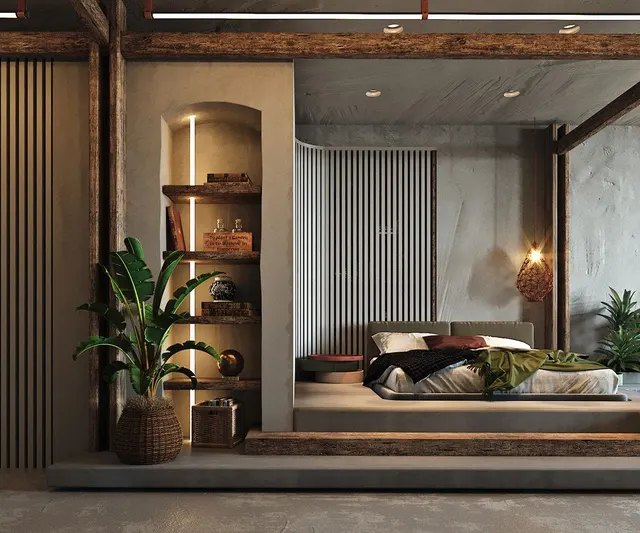
Wabi-sabi is built on natural materials that age gracefully and show their origin. The surfaces do the work, so they are chosen for texture and honesty rather than for a flawless face. On walls, lime plaster and microcement give a soft, slightly uneven, hand-applied finish that catches light and deepens with age, far more alive than flat emulsion paint. On floors, natural stone such as kota or a matt terracotta, left honed rather than mirror-polished, grounds the room. For furniture and joinery, solid and reclaimed timber with a visible grain and an oiled rather than high-gloss finish is central, as is cane, rattan and bamboo. Textiles are the handmade fibres India does so well: khadi, handloom cotton, raw linen, jute and wool, in their natural, undyed or earth-dyed states.
The rule that ties these together is that the material should look like what it is. Timber should read as timber, with its knots and grain; stone should show its natural variation; plaster should carry the gentle marks of the trowel; textile should have the slub and irregularity of the loom. Shiny, seamless and synthetic surfaces — high-gloss laminate, mirror acrylic, printed finishes imitating other materials — are the opposite of wabi-sabi, because they deny their own nature and refuse to age. The handmade ceramic, the rough-cast metal, the unpolished stone and the naturally finished wood are the vocabulary; the factory-perfect and the plastic are not.
| Element | Wabi-sabi material | Avoid | Why |
|---|---|---|---|
| Walls | Lime plaster, microcement, limewash | High-gloss paint, printed wallpaper | Soft, hand-applied texture that ages |
| Floors | Honed kota, matt terracotta, aged wood | Mirror-polished vitrified, glossy marble | Grounded, natural, non-reflective |
| Furniture | Solid and reclaimed timber, cane, rattan | High-gloss laminate, mirror acrylic | Shows grain, make and age |
| Textiles | Khadi, handloom cotton, linen, jute, wool | Shiny synthetics, printed imitations | Natural fibre with honest irregularity |
| Objects | Hand-thrown ceramic, rough metal, stone | Machine-perfect matched sets | Each piece carries the maker's hand |
The muted, earthy palette
Colour in wabi-sabi is quiet. The palette is drawn from nature and from the materials themselves: the off-whites and greys of lime plaster and stone, the warm browns and tans of timber and jute, the soft terracotta and clay tones, muted greens and the deep near-blacks of charred wood or oxidised metal. These are not the clean, bright whites and primaries of a contemporary scheme but complex, slightly muddied, earthy tones with warmth in them. The palette is deliberately low in contrast and saturation, so that the eye is soothed rather than stimulated, and so that attention falls on texture and form rather than on colour.
Because the colours are close in tone, texture becomes the main source of variety and interest, which is why the materials matter so much. A room that is almost monochrome in colour can be rich and absorbing if it layers a rough plaster wall against a smooth stone floor, a nubbly jute rug, a grainy timber table and a soft wool throw. The small amounts of darker tone — a charred-wood shelf, a black metal frame, a dark ceramic bowl — are used sparingly to anchor the scheme and give the eye somewhere to rest. Bright, pure colour is used almost never, and when a touch of life is wanted it comes from a single natural thing: a branch, a bowl of fruit, a flower.
Emptiness, light and the art of arrangement
If materials and colour are the body of wabi-sabi, space and light are its breath. The style depends on emptiness — the deliberate leaving of clear surfaces, bare walls and open floor — so that the few things present can be seen and felt. This is the hardest discipline for most homes, because the instinct is to fill, but in wabi-sabi the empty space is not wasted; it is the quiet that lets the objects speak, the pause that makes the room feel calm. A single beautiful bowl on a long bare table says far more than a table covered in clever accessories. Editing out is as important a skill as choosing well.
Light should be soft, warm and natural wherever possible. Harsh, bright, cool-white lighting flattens texture and kills the mood; wabi-sabi wants low, warm pools of light that model the surfaces, throw gentle shadows and let the plaster, timber and stone show their grain. Daylight, filtered through a simple curtain or a screen, is ideal, and artificial light is best kept warm in colour, layered at low level, and dimmable. Shadow is welcomed rather than banished, because it gives depth and quiet. Paired with soft light, the arrangement of objects follows the principle of relaxed asymmetry: things are grouped in odd numbers, off-centre, at varying heights, so that the balance feels natural and human rather than rigid and matched.
Making it work in Indian conditions
Wabi-sabi suits Indian homes well, but a few practical adjustments help it survive the climate and the way Indian homes are used. Lime plaster and limewash, which are central to the look, are also genuinely well-suited to the Indian climate, being breathable and naturally resistant to mould, though they need a skilled applicator and a sealing or waxing where water is a risk. In wet zones such as the kitchen and bathroom, microcement gives a similar hand-finished, seamless, muted surface while being waterproof when properly sealed. Natural stone floors cope easily with Indian cleaning routines. Reclaimed and solid timber must be treated against borer and termite before use, as with any wood here.
The soft, tactile textiles of the style — khadi, handloom, linen, jute — are readily available across India and are often cheaper and more authentic here than the imported versions sold elsewhere, which is a real advantage. The main caution is dust: the muted, matt, textured surfaces of wabi-sabi can hold dust in a way that glossy ones do not, so the style rewards a home that is kept lightly but regularly cleaned, and favours washable natural textiles and wipeable sealed finishes in the hardest-working rooms. Approached sensibly, none of these points is an obstacle; they simply mean choosing the right natural finish for each zone rather than applying one everywhere.
| Finish | Indicative cost (per sq ft) | Where it suits | Note |
|---|---|---|---|
| Lime plaster / limewash wall | ₹120–350 | Living, bedroom, feature walls | Breathable; needs a skilled hand |
| Microcement (walls or floors) | ₹250–600 | Kitchen, bath, seamless surfaces | Waterproof when sealed well |
| Honed kota / natural stone floor | ₹90–180 installed | Whole-home grounding floor | Matt, not mirror-polished |
| Oiled solid / reclaimed timber | Confirm locally by piece | Furniture, shelving, joinery | Treat against borer first |
| Handloom / jute textiles | By piece; widely available | Rugs, cushions, throws, curtains | Natural fibre with honest texture |
The mistakes that spoil it
Wabi-sabi goes wrong in predictable ways, and knowing them is half the battle. The commonest failure is confusing it with mess or neglect: a careless, cluttered or unfinished room is not wabi-sabi, which is a highly edited and intentional aesthetic that only looks effortless. The second is buying distressed-looking mass-produced furniture, which substitutes a fake, uniform imitation of age for the genuine article and feels hollow, because the whole point is authenticity. The third is overdoing the rustic until the room feels like a themed cafe rather than a home, with every surface shouting its roughness; real wabi-sabi is quiet and often includes smooth and refined elements alongside the rough, for contrast.
Other traps are easy to avoid once named. Bright, cool lighting undoes the mood instantly, so warmth and dimness matter. Too much contrast or any pure, saturated colour pulls the scheme out of its calm register. Filling every surface defeats the emptiness the style depends on. And treating wabi-sabi as a shopping list to be bought in one go contradicts its grain entirely, since the style is meant to accumulate slowly, with pieces that are collected, inherited, found and lived with over time. The best wabi-sabi homes are never finished and never try to be; they simply deepen.
| Do | Don't |
|---|---|
| Edit to a few genuine, natural pieces | Fill every surface with clutter |
| Use real handmade and aged objects | Buy factory imitations of age |
| Keep light soft, warm and low | Light it bright and cool-white |
| Let texture carry a muted palette | Add pure, saturated colour |
| Balance rough with refined | Overdo the rustic into a theme |
| Let the home accumulate slowly | Buy a complete look in one go |
Where the style is heading
Wabi-sabi is riding a broad shift in how people want to live, which suggests it is more than a passing trend. As life speeds up and screens dominate, there is a growing hunger for interiors that slow the nervous system down, and the calm, tactile, natural quality of wabi-sabi answers that directly. At the same time the turn against disposable, mass-produced goods towards durable, repairable, handmade and sustainable things aligns exactly with the style's respect for authenticity, age and the maker's hand. The revival of craft in India — handloom, pottery, lime, natural dye — gives the style a deep and local supply of exactly the right materials.
The likely direction is that wabi-sabi settles from a named trend into a quieter, permanent sensibility — a preference for the natural, the handmade and the imperfect that simply becomes part of how thoughtful Indian homes are built, whether or not the Japanese label is used. It will blend with India's own traditions of the handmade and the aged until the two are hard to tell apart, which is as it should be. What endures is the core insight, as true in a Surat flat as in a Kyoto teahouse: that a home filled with a few genuine, natural, well-worn things, calmly arranged with space to breathe, is more beautiful and more restful than any showroom of flawless newness.
Rules for a wabi-sabi home
- Edit ruthlessly: keep a few meaningful things and leave real empty space around them.
- Choose natural, honest materials — lime plaster, stone, solid and reclaimed timber, khadi, jute, linen — that age well.
- Work in a muted, low-contrast, earthy palette and let texture, not colour, carry the room.
- Use genuine handmade or aged pieces; never substitute factory-made imitations of age.
- Keep light soft, warm and low, welcome shadow, and avoid bright cool-white lighting.
- Arrange objects in relaxed asymmetry — odd numbers, varying heights, off-centre.
- Balance the rough with the refined so the room reads as calm, not as a rustic theme.
- Let the home accumulate slowly over time rather than buying a complete look in one go.
Frequently asked questions
Is wabi-sabi the same as minimalism?
They overlap but differ in feeling. Both value simplicity and empty space, but minimalism tends towards cool, flawless, hard-edged surfaces and perfect order, while wabi-sabi is warm, textured, imperfect and human. A minimalist room can feel clinical; a wabi-sabi room feels soft and lived-in. In short, wabi-sabi is simplicity with warmth, patina and the mark of the hand, rather than simplicity as pure, pristine reduction.
Does a wabi-sabi home look unfinished or shabby?
It should not. Wabi-sabi is a disciplined, carefully edited aesthetic that only looks effortless; a careless, cluttered or genuinely shabby room is a failure of the style, not an example of it. The imperfection it values is the honest texture of natural materials and the patina of real age, not neglect. A good wabi-sabi room is calm, intentional and quietly refined, with every element chosen and plenty of clear space.
Which Indian materials work for wabi-sabi?
Many of India's traditional handmade materials are ideal: lime plaster and limewash on walls, honed kota and terracotta on floors, solid and reclaimed timber, cane and rattan for furniture, and khadi, handloom cotton, linen and jute for textiles. Hand-thrown terracotta and ceramic, rough-cast and aged brass, and natural stone objects complete the palette. These are widely available in India and often more authentic and affordable here than imported alternatives.
How do I keep a wabi-sabi home clean given the dust?
Favour sealed, wipeable versions of the natural finishes in hard-working rooms — microcement in kitchens and baths, sealed lime plaster, washable natural textiles — and keep the home lightly but regularly dusted, since matt textured surfaces hold dust more than glossy ones. The muted palette is forgiving of small marks, and natural stone floors take Indian cleaning routines easily, so the upkeep is steady rather than heavy.
Can I create wabi-sabi on a modest budget?
Yes, and it suits a modest budget well, because the style values the found, the inherited and the handmade over the expensive and the new. Limewash is inexpensive, handloom and jute textiles are affordable in India, and the key cost is often just the skilled application of a plaster finish. The real investment is time and a good eye for editing, not money, since wabi-sabi is meant to accumulate slowly from pieces collected and lived with.
Sources & standards
- General references on Japanese aesthetics and the wabi-sabi tradition, rooted in Zen Buddhism and the tea ceremony (descriptive, not attributed to invented authors)
- Indian Green Building Council (IGBC) and GRIHA — regional, natural and low-impact material guidance relevant to natural finishes
- Bureau of Indian Standards — IS 712 (building limes) and IS 401 (preservation of timber) for lime finishes and timber treatment
- Neufert, Architects' Data — lighting, proportion and the arrangement of interior space
- Time-Saver Standards for Interior Design and Space Planning — natural materials, finishes and composition
- Price ranges: indicative October 2026 estimates — confirm locally before budgeting