After two decades of sharp corners — flat-pack boxes, square handles, rectilinear false ceilings, glossy straight-edged kitchens — Indian interiors have begun to soften. Arched doorways, rounded sofas, round dining tables, pill-shaped mirrors, curved bar counters and wardrobes with rounded ends now appear in apartments, bungalows, cafés and salons alike. Clients ask for "the curved look" by showing a photograph; the challenge for designers is that a curve is far less forgiving than a straight line. A badly proportioned arch, a curved sofa that blocks the walkway or a wobbly gypsum radius looks worse than no curve at all.
Curves are not new. Indian architecture has used arches for many centuries, from Mughal and Sultanate gateways to the verandahs of colonial bungalows, and the round forms of the stepwell, the stupa and the dome are part of the country's visual memory. What has changed is how curves are made inside homes: today they are cut by CNC from MDF, formed in gypsum on curved channels, bent in flexible ply, moulded in solid surface or cast in glass-fibre reinforced gypsum. Each method has a minimum radius, a joint pattern and a cost, and the design must respect them.
This article explains why curves feel good, where they came from and where they work, and then gives the practical numbers: arch proportions for Indian ceiling heights, curved sofa sizes and clearances, edge radii for joinery and counters, how curved walls and ceilings are built, and indicative October 2026 costs consistent with the organic modern, Mediterranean and sofa guides on this site.
Why curves feel good
The appeal of curves is partly cultural and partly perceptual. Psychology researchers have repeatedly found that, when people are shown pairs of otherwise similar objects, many prefer the version with curved contours to the version with sharp angles; one widely cited study by Moshe Bar and Maital Neta, published in 2006, linked sharp angles with a sense of threat. Later work by Oshin Vartanian and colleagues, published in 2013, found that participants tended to judge images of curvilinear rooms as more beautiful than rectilinear ones. These are laboratory studies with photographs, not proof that every curved room is better, but they match what designers observe: rounded forms read as softer, more welcoming and more relaxed.
There are practical reasons too. A rounded table corner does not catch a hip or a child's head. A curved end on a kitchen island guides people around it. A rounded sofa invites conversation because people sitting on it face one another. An arch frames a view and marks a threshold without the heaviness of a full door. And a few curves in a room of straight lines make the straight lines look intentional, the way a single round mirror lifts a rectangular bathroom.
A short history of the curve indoors
The semicircular arch was developed into a systematic structural element by Roman builders, who used it for aqueducts, bridges and vaults; the pointed arch spread through Islamic architecture and later Gothic Europe; and in India the true arch became widespread with the Delhi Sultanate and reached great refinement under the Mughals. These were structural curves: the arch carried load by compression. Interior curves as pure comfort and style came later. Art Nouveau, roughly 1890 to 1910, drew whiplash lines from plants; the Streamline Moderne of the 1930s rounded corners on buildings, radios and furniture to suggest speed; mid-century designers of the 1950s, such as Eero Saarinen with his pedestal Tulip chair, used moulded plastics and plywood to make fluid single forms; and the 1960s and 1970s brought low, rounded, modular seating.
The present wave of curves, visible in Indian design from the late 2010s onwards, borrows from all of these. It is quieter than Art Nouveau and less futuristic than the Space Age: soft arches in limewash or plaster, rounded sofas in bouclé or textured fabric, pill and arch mirrors, round tables and fluted, rounded cabinet ends. It sits comfortably beside Japandi, organic modern and Mediterranean styles, which is one reason it has spread so quickly.
Arches: types, proportions and heights
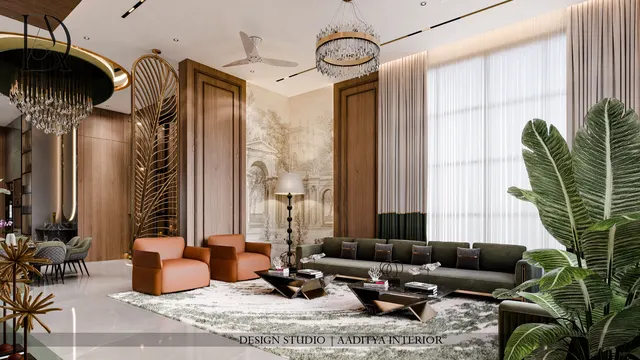
The arch is the signature of curved interiors, and it is where proportion matters most. Inside a modern Indian home, an arch is almost always a lining: the structural opening is rectangular, framed by an RCC lintel or beam, and the arch shape is formed inside it in gypsum, plaster, MDF or GRG. This means the arch shape can be chosen freely — but it must fit under the lintel and the ceiling. In a flat with a 2850–3000 mm floor-to-slab height, a 2700 mm false ceiling and a lintel at 2100 mm, there is often less vertical room than the photograph from a 3.5 m-high villa suggests.
Fig. 2 shows why proportion has to be checked rather than copied. A semicircular arch rises half its span, so a 1000 mm arch sprung at 2100 mm reaches 2600 mm — only 100 mm below a 2700 mm false ceiling, which looks cramped. A pointed arch rises even more. Under typical Indian flat ceilings, the comfortable choices are a segmental arch (a flatter part of a larger circle), an elliptical or three-centred arch, or a semicircular arch with a lower spring point of about 1900–2000 mm. The structural opening must also be tall enough: with a spring at 2000–2100 mm and a rise of 250–300 mm, the lintel or beam soffit needs to sit at about 2400 mm or higher, so arches are best planned before construction, and any change to a lintel needs a structural engineer. The organic modern guide on this site recommends a 900–1200 mm arch sprung at 2000–2100 mm; the Mediterranean guide suggests about 1000 mm semicircular or 1500 mm segmental under a 3000 mm ceiling, with 150–300 mm reveals. Both are consistent with the geometry here.
| Arch type | Rise (height above spring) | Good span range | Ceiling height it suits | Character |
|---|---|---|---|---|
| Semicircular (round) | ½ × span (1000 span → 500) | 700–1100 mm | ≥ 2850–3000 mm, or spring lowered to 1900–2000 mm | Classic, soft, Roman and Mediterranean |
| Segmental | About ¼–⅙ × span | 1200–2400 mm | 2700 mm and above | Calm, wide, works over living–dining openings |
| Elliptical / three-centred | About ¼–⅓ × span | 1000–2400 mm | 2700 mm and above | Elegant, slightly formal, good for wide openings |
| Pointed (two-centred) | ≈ 0.6–0.9 × span | 600–1000 mm | ≥ 3000 mm or niches | Vertical, Islamic or Gothic in feeling |
| Horseshoe | More than ½ × span | 700–1000 mm | ≥ 2850 mm | Moroccan, Moorish; use once, as a feature |
| Arch-top niche (not a door) | ½ × width | 300–900 mm wide | Any | Display niches, pooja units, mirrors |
Arch details that make the difference
Three details decide whether a lining arch looks crafted or cheap. The reveal — the depth of the arch soffit, seen from below — should be at least about 150 mm and ideally 200–300 mm; a thin 75 mm reveal reads as a cut-out rather than an opening. The spring point should align with something: the top of an adjacent door, the height of a wardrobe, a skirting-to-dado line. And the curve itself must be true: set out with a trammel or a CNC-cut template, not freehand, and finished with a rounded corner bead or a smooth plaster return so the edge does not chip.
Rounded sofas and curved seating
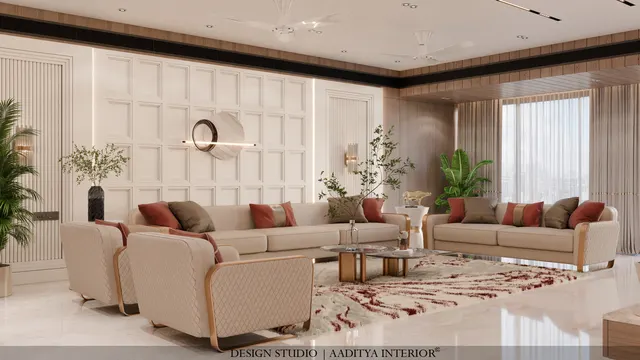
The curved sofa is the second icon of the style, and it is the one most likely to go wrong in an Indian living room. A straight three-seater sits against a wall and occupies a predictable rectangle. A curved sofa is usually wider and deeper, and it is designed to float — it looks its best with space behind it. In a typical 2BHK living room of about 3300 × 4200 mm, a full curved sofa often blocks the walkway; in a 3600 × 4800 mm room or larger, with the sofa facing the TV wall or a window, it can be the most beautiful piece in the home. The organic modern guide on this site uses about 3600 mm as the minimum room width for a curved sofa.
| Seating piece | Typical size (mm) | Room it suits | Indicative October 2026 cost |
|---|---|---|---|
| Ready-made 3-seater, straight (reference) | 2000–2200 × 850–950 | Any living room | ≈ ₹25,000–80,000 |
| Custom 3-seater, straight (reference) | To measure | Any living room | ≈ ₹60,000–1.5 lakh |
| Custom curved sofa, 3–4 seats | 2400–3600 across × 900–1100 deep | Rooms ≥ 3600 mm wide, floating layout | ≈ ₹75,000–2 lakh (about 20–40 % over straight custom) |
| Rounded-arm or rounded-back straight sofa | 2000–2300 × 900–1000 | Most living rooms | Close to straight custom rates |
| Curved 2-seater or loveseat | 1600–2000 across | Bedrooms, small living rooms, lounges | ≈ ₹45,000–1.2 lakh |
| Round or barrel armchair | 750–900 diameter | Reading corners, bedrooms | ≈ ₹15,000–60,000 |
| Round coffee table | Ø 800–1000, 400–450 high | With straight or curved sofas | Varies widely by material |
Curved sofas cost more for honest reasons: the frame needs more joints or a laminated curved rail, the foam must be cut to a taper, the upholstery must be pleated or panelled around the curve, and fewer standard sizes are made. Before ordering, it is worth taping the outline on the floor at full size and walking around it for a day. Check that the sofa passes through the door and the lift — a one-piece curved frame cannot be tilted the way a straight frame can — and ask whether it can be made in two or three sections that join on site.
Soft edges: radii for furniture, joinery and counters
The quietest part of the curved look is the softened edge: a table whose corners are rounded, a wardrobe whose end panel curves into the side, a counter with a gentle bullnose, a mirror with radius corners. These are inexpensive and they improve safety, especially in homes with children and elders. The trick is consistency — choose two or three radii for the whole home and repeat them, instead of a different curve on every piece.
| Element | Recommended radius | Material notes | Why |
|---|---|---|---|
| Counter and table edges (section) | R 3–5 pencil; R 10–20 for soft look | Quartz and granite take any profile; laminate needs post-formed or solid edge | Prevents chipping; comfortable to lean on |
| Table and desk corners (plan) | R 25–75 | Any material | Safety for children; softer appearance |
| Kitchen island or bar end | R 250–600, or a full half-round | Solid surface, quartz with joints, PU-painted MDF | Guides movement around the island |
| Wardrobe or TV unit end panel | R 300–600 curved end | Bending ply or kerfed MDF with PU finish | Softens a long run of joinery |
| Mirror corners | R 50–150, or arch-top and pill shapes | Mirror cut by machine; edges polished | Echoes arches cheaply |
| Wall corners (external) | R 10–25 rounded corner bead | Plaster or gypsum with plastic or metal bead | Stops chipping on busy corners |
| Door and window linings | R 3–5 on edges | Solid wood or MDF with paint or veneer | Smoother, safer, paints better |
How curves are built: walls, ceilings and joinery
Every material bends only so far, and the minimum radius decides the method. Gypsum board can be bent dry to large radii and wetted or scored for tighter ones; curved metal channels form the frame. Flexible or bending plywood bends to small radii and is usually laminated in two or more layers to build thickness. MDF can be kerfed — sawn part-way through on the back at close intervals — to curve it, or the curve can be built from stacked CNC-cut layers. Solid surface materials can be heat-formed. Glass can be curved, but it is made to order, costs several times flat glass and takes weeks. The table below summarises the options designers use in Indian projects.
| Method | Typical minimum radius | Best for | Watch out for | Indicative October 2026 cost |
|---|---|---|---|---|
| Gypsum board on curved metal frame | ≈ 600–1000 mm dry; tighter with thinner board, wetting or scoring | Arches, curved walls, curved ceiling coves | Cracks at joints if the frame is weak | Arched opening ≈ ₹15,000–60,000 each; plain gypsum ceiling ₹60–80 per sq ft |
| Bending ply (2–3 layers) with laminate or veneer | ≈ 150–300 mm | Curved wardrobe ends, reception desks, bar fronts | Laminate needs a flexible grade on tight radii | Joinery rates plus about 15–30 % for curves |
| Kerfed or stacked CNC MDF, PU painted | ≈ 100–300 mm (stacked: any) | Rounded cabinet ends, arch surrounds, fluted curves | Kerf lines can telegraph through thin paint | ≈ ₹1,000–1,800 per sq ft (PU finish band) |
| Solid surface, heat-formed | ≈ 75–150 mm (varies by grade) | Island ends, vanity tops, curved counters | Specialist fabricator; joints must be seamless | Fabricator quotation |
| GRG / GFRC moulded panels | Any shape from the mould | Domes, deep curved ceilings, arches in hotels | Mould cost suits repeated shapes | Quotation-based; suits large projects |
| Lime or cement plaster over curved masonry | Any, set out by templates | Built-in seating, niches, Mediterranean arches | Skilled masons; crack control | Plaster rates plus labour for templates |
| Curved toughened glass | Made to order | Shower screens, shopfronts, balustrades | Long lead time; several times flat glass cost | Verify locally |
Where curves work best — room by room
The most successful curved interiors concentrate curves where they do something, and keep the rest calm. In the living room, the main curve is usually the sofa, an arch between living and dining, or a round coffee table; the TV wall stays rectilinear. In the dining area a round or oval table is the natural choice — a round table of about Ø 1050–1200 mm seats four comfortably, and an oval of about 1800–2100 × 1000 mm seats six. In bedrooms, a curved or channel-tufted headboard, a rounded bedside table and an arch-top mirror are enough. Kitchens take curves at the island end, in open shelving with rounded ends and in arched range hoods. Bathrooms take an arch or pill mirror, a rounded vanity and an arched niche in the shower.
| Room | Best curved element | Keep straight | Typical dimension |
|---|---|---|---|
| Foyer | Arched opening or arch-top mirror over a console | Shoe storage, door | Mirror about 600–900 × 1500–1800 mm |
| Living | Curved sofa or rounded-arm sofa; round coffee table | TV wall, windows, ceiling | Sofa across 2400–3600 mm; table Ø 800–1000 mm |
| Dining | Round or oval table; arched opening to kitchen | Crockery unit | Ø 1050–1200 mm for four |
| Bedroom | Curved headboard, rounded side tables, arched niche | Wardrobe shutters | Headboard 1200–1400 mm high for a king bed |
| Kitchen | Rounded island end, curved open shelf, arched hood | Base and wall units | Island end R 250–600 |
| Bathroom | Arch or pill mirror, rounded vanity, arched shower niche | Shower glass, tiles | Niche 300–600 mm wide (arch top) |
| Commercial (café, salon, clinic) | Curved counter, booth seating, arched mirrors | Back-of-house | Counter front R 600 or more |
Curves and Vastu-minded clients
Some families ask whether arches or round furniture conflict with Vastu. Traditional texts are mainly concerned with orientation, the open centre and the placement of rooms and heavy items; they do not forbid curved furniture or arched openings, and many temples and traditional houses use arches and round forms. In practice, a designer can satisfy most Vastu preferences — heavier seating on the south or west, an open centre, a clear north-east — with curved pieces as easily as with straight ones.
Colour, material and light for curved rooms
Curves look best in materials that show them. A matt or textured finish — limewash, lime plaster, microcement, clay-look paint — catches light along a curve and makes it visible; a high-gloss finish turns every ripple in a gypsum curve into a highlight. Warm, light colours (sand, cream, clay, soft terracotta, sage) suit the style, and the organic modern guide on this site prices limewash and lime-based finishes at about ₹40–150+ per sq ft of paintable area. Upholstery in bouclé, textured weaves or performance velvet emphasises soft forms; in hot and humid Indian cities, a breathable textured cotton or linen blend is often more comfortable than heavy bouclé.
Lighting can make or break a curve. A cove light at 2700–3000 K washing up a curved ceiling makes the curve glow; a wall washer or a linear LED hidden in the soffit of an arch draws its outline at night. Grazing light — a fitting very close to the wall — reveals texture but also every imperfection, so curved gypsum walls lit this way must be finished to a high standard. Cove LED is priced on this site at about ₹150–300 per running ft installed.
Where the curved look is going — and how to keep it from dating
Any strong trend risks dating, and curves are no exception: by the late 2020s, some of today's more extreme looks — every opening arched, every piece bouclé, every mirror a pill — will feel of their moment, as this site's article on dated interior trends notes for decorative arches. The way to avoid that is the way designers have always handled curves: use them where they have a reason, at good proportions, in durable materials. A segmental arch that frames the dining area, a round table, softened edges on joinery and one beautiful curved sofa will still look right in fifteen years. Looking ahead, the strongest directions are curves made with craft — lime plaster, terracotta, carved wood — and curves that serve comfort and accessibility, such as rounded corners in homes for children and elders.
Rules for designing with curves
- Use one family of arches per home, proportioned to the ceiling — check the crown height before choosing the shape.
- Under a 2700 mm ceiling prefer segmental or elliptical arches, or a semicircular arch sprung at 1900–2000 mm.
- Give arches a reveal of at least 150 mm, ideally 200–300 mm, and align the spring with nearby door heads.
- Use one curved hero piece per room — a sofa, a table or an arch — and keep the rest rectilinear.
- Choose a curved sofa only for rooms about 3600 mm wide or more, with space to float it; check door and lift access.
- Repeat a small family of radii: about R 3–5 on edges, R 50 on table corners, R 250–600 on joinery ends.
- Match the method to the radius: gypsum for large curves, bending ply or kerfed MDF for tight ones.
- Finish curves in matt or textured materials and light them with soft cove or wash light.
- Never cut lintels or beams for arch height; consult a structural engineer before altering openings.
Frequently asked questions
Are arches in interiors still in style?
Yes, when they are well proportioned and used with restraint. A single family of arches that frames real openings or niches is timeless; decorative arches added everywhere for effect are the part of the trend most likely to date.
What is the standard size of an arch doorway?
For homes, a clear width of about 900–1200 mm is common, with the arch springing at about 2000–2100 mm. Under a 2700 mm ceiling, a segmental or elliptical arch with a rise of about 250–300 mm fits comfortably; a semicircular arch needs a higher ceiling or a lower spring point.
Is a curved sofa practical for a small living room?
Usually not as a full curve. In rooms narrower than about 3600 mm, choose a straight sofa with rounded arms or back, a curved two-seater, or a round armchair, and keep at least 900 mm for walkways.
How much does an arch cost in India?
Indicatively in October 2026, an arched opening lined in gypsum, POP or GRC costs about ₹15,000–60,000 per opening depending on size, material and detailing, excluding any structural changes to the wall.
How do you make curved furniture and cabinets?
With bending ply laminated in layers, kerfed or stacked CNC-cut MDF finished in PU paint, heat-formed solid surface, or moulded GRG and GFRC for larger pieces. Each method has a minimum radius, so the design must be detailed with the fabricator.
Sources & standards
- M. Bar and M. Neta, Humans Prefer Curved Visual Objects, Psychological Science (2006)
- O. Vartanian and colleagues, Impact of Contour on Aesthetic Judgments and Approach-Avoidance Decisions in Architecture, Proceedings of the National Academy of Sciences (2013)
- Bureau of Indian Standards — IS 2095 (gypsum plaster boards), IS 12406 (medium density fibreboard), IS 303 (plywood for general purposes); National Building Code of India 2016, Part 6 (Structural Design)
- Neufert, Architects' Data — furniture dimensions and living room clearances
- Gypsum board manufacturers' installation guides — curved partition and ceiling systems (generic)
- Price ranges: indicative October 2026 estimates, consistent with this site's organic modern, Mediterranean and sofa guides — confirm locally before budgeting