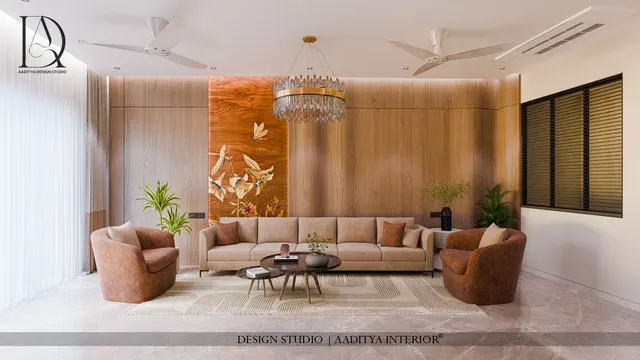
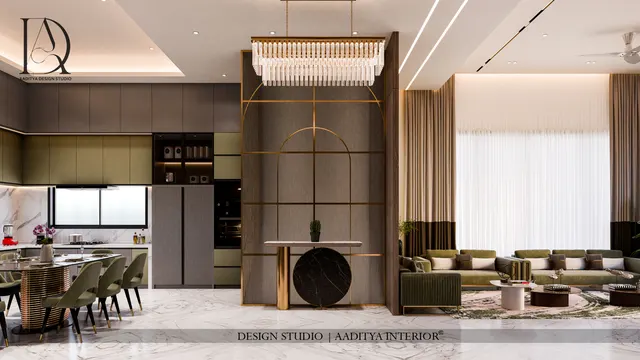
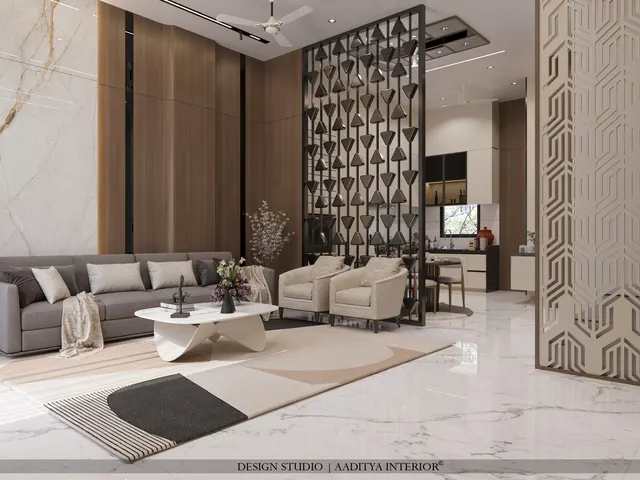
Most families begin choosing an interior style the same way: by saving photographs. Over a few weeks the phone fills with images from Instagram and Pinterest — a white Scandinavian living room, a dark luxurious bar, a Japandi bedroom, a Rajasthani dining room with arches and brass. When the designer asks which style they want, the honest answer is all of them. That is not a failure of taste. It is a sign that photographs show finished rooms in perfect light, not the life that has to happen inside them.
In Indian homes the gap between the picture and the life is large. The photographed room has no school bags, no dust from a construction site next door, no monsoon damp, no grandparents who need firm seating, no domestic help cleaning the floor every morning and no cylinder, water purifier or washing machine looking for a place. A style that ignores these will look tired within two years. A style chosen with them in mind can look better every year, because the home is working with its occupants rather than against them.
This article gives a practical method for choosing an interior design style: a short history of where today's styles come from, a comparison of the main styles in Indian terms, the questions about lifestyle, light, climate and maintenance that should decide the choice, how architecture and room sizes narrow the options, what different styles cost, and how to combine styles without creating confusion. It is the starting point for the individual style guides elsewhere on this site.
Where interior design styles come from
An interior style is a set of choices that repeat: a family of shapes, colours, materials and furniture that belong together because they were developed by people solving similar problems at a similar time. Almost every style named today descends from one of four roots. The first is the classical and historic tradition — Greek and Roman proportions, revived again and again in Renaissance, Georgian, Neoclassical and Victorian interiors, and today in transitional and neoclassical styles. The second is the modern movement of the early twentieth century, which stripped away ornament in favour of function, light, new materials and open plans; mid-century modern, minimalism, Scandinavian and Japandi all descend from it. The third is craft and regional traditions — Indian, Japanese, Moroccan, Mediterranean, rustic and farmhouse styles — which grew out of local climate, materials and making. The fourth is industrial and adaptive reuse, which turned factories and warehouses into homes and celebrated exposed brick, steel and concrete.
Contemporary design, the style most new Indian apartments are actually delivered in, is not a fixed style at all. It means design of the present moment and borrows freely from all four roots. That is why the same flat can be called contemporary whether it has fluted panels and brass, or white lacquer and black profiles. Understanding the roots is useful because styles from the same root mix easily, while styles from opposite roots need more care.
The main styles, compared in Indian terms
The table below compares fourteen styles that Indian families most often ask for. It is deliberately practical: alongside the look, it records what each style asks of the household in cleaning and care, and where it tends to work best. Each style has its own detailed guide on this site; the purpose here is to see them side by side before choosing.
| Style | Key traits | Typical colours | Signature materials | Upkeep in Indian homes | Works best in |
|---|---|---|---|---|---|
| Modern / contemporary | Clean lines, functional, current finishes | Neutrals with one or two accents | Laminate, lacquer, glass, metal profiles | Low to medium | Most apartments; families wanting a safe, flexible base |
| Minimalist | Few objects, hidden storage, calm surfaces | White, greige, pale wood | Handleless joinery, plain plaster, light wood | Medium — clutter shows at once | Disciplined households with ample closed storage |
| Scandinavian | Light, warm, cosy, practical | White, pale grey, soft pastels, light oak | Light wood, wool, linen, white walls | Medium — light floors and fabrics show dust | Bright flats; north light; smaller rooms |
| Japandi | Japanese calm plus Scandinavian warmth | Warm neutrals, muted earth tones, black accents | Oak or ash veneer, linen, paper, stone | Low to medium | Compact flats, bedrooms, people who dislike clutter |
| Modern Indian | Modern base with Indian craft accents | Warm neutrals with indigo, rust, mustard | Teak, cane, brass, Kota, handloom | Medium | Families wanting cultural warmth without heaviness |
| Traditional Indian regional | Kerala, Chettinad, Rajasthani or Gujarati character | Rich reds, ochres, deep wood | Teak, carved wood, tiles, mirror work, lime | Medium to high | Bungalows, farmhouses, larger rooms |
| Transitional | Classic shapes simplified | Soft neutrals, greys, muted blues | Mouldings, upholstery, stone, brushed metal | Medium | Families split between classic and modern taste |
| Neoclassical / Victorian-inspired | Mouldings, symmetry, marble, rich wood | Ivory, deep green, burgundy, gold | Marble, POP mouldings, veneer, brass | Medium to high | High ceilings, larger living and dining rooms |
| Art Deco | Geometry, glamour, brass and lacquer | Black, emerald, navy, gold, blush | Brass inlay, fluted glass, velvet, lacquer | Medium to high | Living rooms, bars, powder rooms |
| Industrial | Exposed brick, metal and concrete | Grey, charcoal, rust, warm wood | Brick cladding, microcement, black steel | Medium — dust settles on open services | Studios, offices, young households |
| Tropical modern | Shade, air, natural materials | Whites, greens, wood, terracotta | Kota, lime, teak, cane, louvres | Low to medium | Hot and humid cities, bungalows, holiday homes |
| Bohemian / eclectic | Collected, layered, personal | Many, held together by one palette | Textiles, cane, vintage, plants | High — many objects | Creative households who enjoy collecting |
| Organic modern / earthy | Curves, natural textures, warm calm | Sand, clay, terracotta, olive | Limewash, wood, stone, linen | Medium | Living rooms and bedrooms seeking warmth |
| Quiet luxury | Understated quality, few strong pieces | Taupe, stone, cream, camel | Natural stone, fine veneer, wool, leather | Medium; higher material cost | Premium flats and villas |
Start with life, not with pictures: the seven questions
Before saving a single image, a family should answer seven questions honestly. Each answer removes some styles and strengthens others. Interior designers ask these in the first meeting because they predict, far better than a mood board, whether a style will still be loved after the first monsoon and the first Diwali clean-up.
1. Who lives here, and how?
A couple who travel often, a family with two small children, a joint family with elders and a work-from-home professional need different homes. Small children and pets argue for washable finishes, rounded edges, closed lower storage and durable fabrics — a strong point for modern, Japandi, modern Indian and tropical styles, and a caution for white minimalist interiors, glass-heavy Art Deco and delicate antiques. Elders need firm seating at about 450 mm height, good lighting and slip-resistant floors, which suits almost any style if it is detailed well. Frequent entertaining favours styles with generous seating and a strong dining room, such as transitional, modern Indian and neoclassical.
2. How much clutter does the household really have?
Minimalism and Japandi look beautiful only when everything has a closed place. If the family owns many books, utensils, clothes, festival items and gifts — as most Indian families do — a minimalist style needs a large amount of hidden storage, often 1.8–2.4 m of full-height wardrobe per adult and closed units in every room. If that storage cannot be provided, a warmer style that tolerates visible objects, such as modern Indian, eclectic or Scandinavian, will look better in real life.
3. How much cleaning and care can the home receive?
Indian cities are dusty, and many homes are cleaned daily with water. Glossy black, high-gloss lacquer, pale fabrics, open shelving and textured surfaces all show dust and marks faster. Styles that rely on these — Art Deco, Hollywood Regency, bohemian layering, white Scandinavian — demand more care. Matte finishes, mid-tone woods, patterned or textured fabrics in medium colours and closed storage forgive more.
4. What is the climate and the light?
A west-facing flat in Surat or Mumbai with strong afternoon sun suits light, breathable, matte materials and shaded windows — the logic of tropical modern. A north-facing flat in a dense block with little direct sun benefits from Scandinavian lightness. Heavy velvets, deep-pile rugs and dark walls are easier in air-conditioned rooms than in naturally ventilated ones. Humidity rules out MDF and wallpaper near wet areas whatever the style.
5. What does the architecture already say?
A bungalow with high ceilings, arches and a courtyard can carry a traditional Indian or Mediterranean style naturally; a standard apartment with 2.75–2.85 m ceilings, beams and a builder's vitrified floor leans towards modern, Japandi, transitional or modern Indian. Fighting the architecture is expensive: deep cornices in a low flat, or a rustic beamed ceiling under a slab, quickly look forced.
6. How long will the family stay?
A home for twenty years deserves a timeless shell and durable materials; a home for four years before an upgrade, or a rental, should keep fixed work neutral and put the style into furniture, fabric, lighting and art that can move to the next home.
7. What is the budget, and where is it best spent?
Some styles move money rather than adding it. Minimalism spends on storage and hardware instead of decoration; neoclassical and Art Deco spend on mouldings, stone and metal detailing; quiet luxury spends on fewer but finer materials. Knowing the budget early prevents choosing a style that the budget can only imitate.
| Household situation | Styles that suit | Styles that need care | Design moves that help any style |
|---|---|---|---|
| Young children | Modern Indian, Japandi, tropical modern, modern | White minimal, glass-heavy Art Deco, delicate antiques | Washable paint, rounded edges, closed low storage, durable fabrics |
| Joint family with elders | Transitional, modern Indian, traditional regional | Very low seating, slippery glossy floors | 450 mm seat height, good lighting, matte floors, grab points |
| Pets | Modern, industrial, earthy | Light linen sofas, deep-pile rugs | Performance fabrics, scratch-resistant floors, removable covers |
| Work from home | Japandi, Scandinavian, modern | Dim, heavily decorated rooms | A defined desk zone, 500 lux task light, acoustic softness |
| Frequent entertaining | Transitional, neoclassical, Art Deco, modern Indian | Very sparse minimal living rooms | Generous seating, a strong dining area, layered lighting |
| Rental or short stay | Scandinavian, bohemian, modern | Styles that depend on fixed mouldings or stone | Neutral fixed work; style in loose furniture and textiles |
| Collector of books and art | Eclectic, mid-century, transitional | Strict minimalism | Built-in shelving, picture rails, good wall lighting |
How room sizes and architecture narrow the choice
Style is often discussed as if it were only colour and decoration, but it is equally about proportion. Some styles need space and height to work. A neoclassical living room depends on symmetry, mouldings and a central chandelier; it reads best in rooms of at least about 4200 × 5400 mm with ceilings of 3000 mm or more. An Art Deco bar needs a wall long enough for its geometry. Rustic and farmhouse styles need visible structure, which a flat cannot provide honestly. Minimal, Japandi and Scandinavian styles, by contrast, actually help small rooms by reducing visual noise.
The drawing below shows the same 3600 × 4800 mm living room — a common size in Indian 2BHK and 3BHK flats — with the TV wall designed in three styles. The dimensions that matter for comfort do not change: the television centre at about 1050–1200 mm from the floor, a low unit of about 400–450 mm, and clear walkways. What changes is the treatment, and with it the cost and the cleaning.
| Home type and size | Natural fits | Possible with care | Usually forced |
|---|---|---|---|
| 1BHK or compact 2BHK, 2.75 m ceiling | Minimalist, Japandi, Scandinavian, modern | Modern Indian, mid-century | Neoclassical with deep mouldings, rustic beams |
| Standard 3BHK flat, 2.75–2.85 m | Modern, modern Indian, transitional, Japandi | Art Deco accents, industrial accents | Full Victorian, heavy Rajasthani carving everywhere |
| Premium flat, 3.0 m or more | Quiet luxury, transitional, neoclassical, Art Deco | Mediterranean arches, organic modern | Rustic farmhouse |
| Row house or duplex | Modern Indian, tropical modern, transitional | Industrial in the double height, Mediterranean | Very sparse minimal in a large family home |
| Bungalow with courtyard | Traditional regional, tropical modern, Mediterranean | Neoclassical, colonial | Glass-box minimalism without shade |
| Farmhouse or holiday home | Farmhouse, rustic, tropical, earthy | Wabi-sabi, Mediterranean | High-gloss luxury that needs constant care |
Shell and layers: where the style should live
A useful way to protect a style choice is to think of the home in three layers. The shell is the permanent work: flooring, ceilings, built-in wardrobes and kitchen, bathroom tiles and fittings, doors and windows. It is expensive and disruptive to change and should last ten to twenty years or more. The furniture layer — sofa, dining set, beds, rugs — lasts perhaps eight to fifteen years and can move between homes. The decorative layer — paint colours, curtains, cushions, art, plants and accessories — can change every few years at modest cost.
The rule that follows is simple. Keep the shell in a calm, durable version of the chosen style — neutral floors, simple joinery profiles, timeless tiles — and let the stronger statements live in furniture and decoration. A family that later tires of a bold Art Deco look can repaint and re-upholster; a family that has put it into brass-inlaid marble floors and lacquered wardrobes must break and rebuild. This is also why Aaditya Interior usually suggests choosing one base style for the shell of the whole home, even when individual rooms carry different personalities.
What style does to the budget
For a complete home interior in October 2026, this site's cost guides use indicative bands of about ₹800–1,200 per sq ft of carpet area for a basic fit-out, ₹1,200–2,000 for a complete mid-range interior and ₹2,000–3,500 or more for premium work, with most complete homes landing around ₹1,400–1,800. Style does not change these bands as much as people expect; specification and scope matter more. But each style pulls money towards different items, and some styles are hard to do convincingly at the lower end.
| Style | Where the money goes | Where it saves | Hard to do well below |
|---|---|---|---|
| Minimalist / Japandi | Full-height storage, handleless hardware, precise joinery | Decorative ceilings, mouldings, accessories | Mid-range — cheap joinery shows at once |
| Scandinavian / modern | Good lighting, light wood-look finishes, upholstery | Ornament and stone | Basic band works well |
| Modern Indian | One or two crafted pieces, cane, brass, handloom | Large stone areas, heavy carving | Basic to mid-range |
| Transitional | Mouldings (POP ≈ ₹70–100 per sq ft), upholstery, lighting | Statement metals and lacquer | Mid-range |
| Neoclassical / Art Deco | Stone, brass inlay, lacquer or PU (≈ ₹1,000–1,800 per sq ft of shutter), chandeliers | Little — detail is the style | Upper mid-range to premium |
| Industrial | Brick or concrete-look finishes, metal, track lighting | False ceilings (often left open) | Basic to mid-range |
| Tropical modern / earthy | Kota (≈ ₹70–150 per sq ft), lime or limewash (≈ ₹40–150+), teak, cane | Glossy finishes, wallpaper | Basic to mid-range |
| Quiet luxury | Natural stone, fine veneer (≈ ₹600–1,100 per sq ft of shutter), wool, leather | Number of pieces and decoration | Premium |
Two warnings apply. First, a style chosen for its look but built at a budget that cannot support it becomes an imitation — printed marble instead of stone, printed charcoal louvres instead of real fluting, gold-coloured plating instead of PVD — and imitations tend to age badly. In that situation, a simpler style executed well is the better choice. Second, the most expensive part of any style is changing it. Getting the decision right before the shell is built saves far more money than any material substitution.
Mixing styles without confusion
Very few good homes follow a single style strictly. Most successful interiors combine a main style with one secondary influence. The method that works most reliably is a rough proportion of about 70 per cent main style and 30 per cent secondary style, held together by a shared colour palette and a shared material. A Japandi home with modern Indian accents, for example, keeps pale oak, linen and plaster as the base and adds cane, brass and one handloom textile; a transitional home with Art Deco touches keeps soft neutrals and simplified mouldings and adds fluted glass, brass and one geometric rug.
Three things make a mix look confused: too many wood tones, too many metal finishes and too many strong patterns. Limit wood to two tones (one dominant, one accent), metal to one main finish plus at most one accent, and strong patterns to one per room with smaller supporting patterns. Repeat each chosen colour and material at least three times across the home so it reads as intention rather than accident.
Where interior styles are heading
Interior styles in India are moving in three directions at once. The first is towards warmth and nature: after a decade of grey, high-gloss and heavy profile-light ceilings, families are choosing wood, cane, lime, clay, linen and plants, which is why earthy, organic modern, Japandi and tropical styles have grown. The second is towards identity: modern Indian, regional crafts and handmade materials are increasingly used not as theme decoration but as a way to make a home feel rooted in its place. The third is towards durability and repairability — fewer, better pieces, finishes that age gracefully and materials that can be refinished rather than replaced.
Technology is changing how styles are chosen as well. Photorealistic 3D renders, virtual walk-throughs and AI-generated mood boards let families see a room in several styles before anything is built, which reduces expensive mistakes. The risk is the same as with photographs: a render shows a perfect, empty, evenly lit room. The questions in this article — how the family lives, the climate and light, the upkeep and the budget — remain the test every render should pass.
Rules for choosing a style that lasts
- Answer the seven questions — people, clutter, care, climate, architecture, length of stay, budget — before saving any images.
- Choose one lead style for the shell of the whole home, and keep floors, ceilings and built-ins in its calmest version.
- Put bold statements in furniture, fabric, paint and art, which are cheap to change.
- Match the style to the architecture: deep mouldings need height, rustic needs real structure, minimal needs storage.
- Mix at roughly 70:30, with two wood tones, one main metal and one strong pattern per room at most.
- In humid cities, prefer matte, breathable, moisture-resistant materials whatever the style.
- If the budget cannot support a style honestly, choose a simpler style done well rather than an imitation.
- Test the choice with a sample board of real materials seen in the home's own daylight and night lighting.
Frequently asked questions
Which interior design style is best for Indian homes?
There is no single best style, but styles that combine a calm modern base with natural, durable materials — modern, modern Indian, Japandi, transitional and tropical modern — suit the widest range of Indian families, climates and apartment sizes. They tolerate dust and daily cleaning, work at standard ceiling heights and can carry Indian objects and festivals without looking out of place.
How do I find out my interior design style?
Collect twenty to thirty images of rooms you like, then look for what repeats: the colours, the materials, the amount of decoration and the shapes of the furniture. Ignore the styling and the light. Then test the result against how your family actually lives using the seven questions in this article. A designer can translate the pattern into a named style and a material palette.
Can different rooms have different styles?
Yes, within limits. Bedrooms, a study or a puja room can carry their own character, but the shared spaces — entrance, living, dining and corridors — should follow one lead style, and the whole home should share a floor finish or a consistent family of floors, a door style and a colour palette. Otherwise the home feels like a series of unrelated showrooms.
Is it expensive to change an interior style later?
It depends on where the style was placed. Changing paint, curtains, cushions, rugs and accessories costs relatively little. Changing furniture costs more. Changing floors, false ceilings, wardrobes, kitchen shutters and bathroom tiles is the most expensive and disruptive work. Keeping the permanent shell calm and neutral makes future changes affordable.
What is the difference between modern and contemporary style?
Modern refers to a specific historical movement of roughly the 1920s to the 1960s, with clean lines, honest materials and little ornament. Contemporary means the design of today, which changes over time and borrows from many styles. Many Indian apartments described as modern are in fact contemporary; this site has a separate guide on the difference.
Sources & standards
- Francis D. K. Ching and Corky Binggeli — Interior Design Illustrated (space, proportion and design principles)
- Joseph De Chiara, Julius Panero and Martin Zelnik — Time-Saver Standards for Interior Design and Space Planning
- Ernst and Peter Neufert — Architects' Data (furniture dimensions and room planning)
- Victoria and Albert Museum and Design Museum, London — collections and notes on the history of modern and historic interior styles
- Bureau of Indian Standards — National Building Code of India 2016, Part 3 (room sizes and heights) and IS 3646 (interior illumination)
- Companion guides on this site: Modern vs Contemporary Interior Design; Japandi; Modern Indian Interior Design; Transitional; Tropical Modern; Eclectic Interior Design
- Price ranges: indicative October 2026 estimates — confirm locally before budgeting