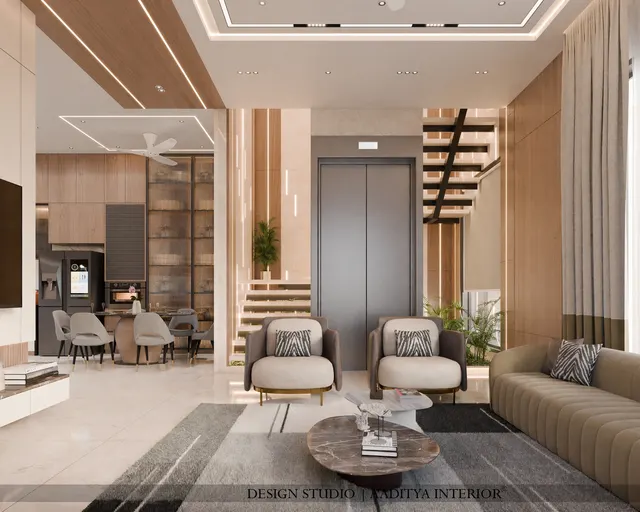
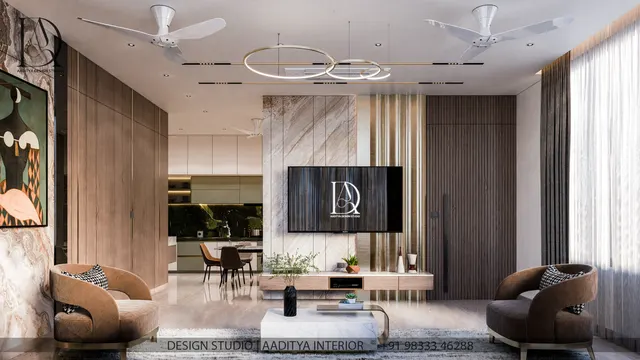
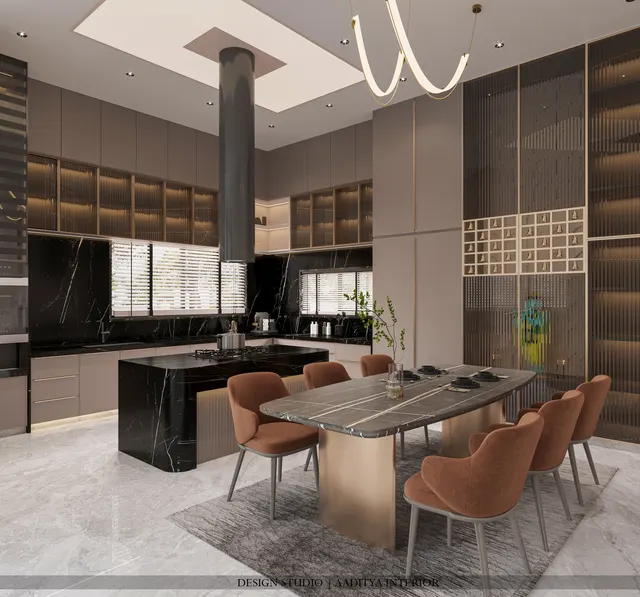
Few details have spread through Indian interiors as quickly as the flute. In five years it has moved from the occasional hotel lobby to almost every new flat: a fluted TV wall, a ribbed kitchen island, reeded glass on the crockery unit, a fluted bed back, a sideboard with a rippled front, even fluted handles and lamp bases. The appeal is easy to understand. A plain surface becomes a play of light and shadow; a flat shutter gains depth without colour; a cheap board looks crafted. Under a single cove light the same wall changes character from morning to night.
The problems are just as easy to see once a project is lived in. A pitch chosen for a sample looks busy on a full wall. Flutes copied from a magazine are cut so deep that 18 mm shutters bow. Reeded glass is installed with its ribs on the wrong side, so the kitchen shutters can never be wiped clean. A home ends up with five different fluted surfaces in five different rhythms, none of them lining up. And in dusty Indian cities every groove becomes a dust line within a week if the profile is wrong.
This article treats fluting and ribbing as a design language rather than a product. It explains where the idea came from, the difference between fluted, reeded and ribbed profiles, how to size the rhythm for the distance it will be seen from, and how the language changes across three families — wall panels, glass, and furniture. Detailed material specifications for fluted wall panels are covered in this blog's guide to fluted panels in MDF, WPC and stone; here the focus is on design decisions that make the whole home read as one.
A short history of the flute
Fluting is one of the oldest decorative ideas in architecture. The stone columns of ancient Greek temples were cut with shallow vertical grooves running the full height of the shaft: Doric columns typically carry twenty flutes meeting in sharp edges, while Ionic and Corinthian columns typically carry twenty-four, separated by narrow flat strips called fillets. The grooves made a heavy cylinder look slender and caught raking Mediterranean sunlight so that the column read as a set of vertical lines rather than a mass. Roman, Renaissance and neo-classical builders copied the system, and it arrived in India with colonial public buildings, where fluted pilasters and columns still frame the facades of many railway stations, courts and banks.
The convex cousin of the flute — the reed — came into its own in furniture. Late eighteenth- and early nineteenth-century European cabinetmakers turned and carved table and chair legs with clusters of parallel convex beads, a detail usually called reeding. In the 1920s and 1930s, Art Deco designers took both profiles into new materials: reeded glass in doors and lamps, fluted plaster and chrome on cinema and hotel interiors, ribbed metal on radios and furniture. Mumbai's Art Deco buildings along Marine Drive and the Oval Maidan, part of the Victorian Gothic and Art Deco Ensembles inscribed by UNESCO in 2018, are a reminder that this language has a long Indian history too.
The present revival began in international furniture and hospitality design in the late 2010s and reached Indian homes quickly, helped by two production changes: CNC routers that cut accurate flutes in MDF at low cost, and ready-made extruded WPC and PVC louver panels that can be clipped to a wall in a day. Fluted and reeded glass, once a niche patterned glass, became a standard option from glass processors as kitchen and wardrobe glass shutters grew popular.
Fluted, reeded, ribbed or slatted: what the words mean
In Indian showrooms the words are used loosely, and that causes real mistakes when a drawing says "fluted" and the carpenter makes "ribbed". The distinction is about the cross-section. A fluted surface has concave grooves cut into it — the surface is the high point and the flutes are the hollows. A reeded surface has convex half-round ribs standing proud — the ribs are the high points. A ribbed surface, in common use, has square or rectangular ribs with flat tops and flat-bottomed gaps; it reads crisper and more architectural. A slatted surface is made of separate battens with open gaps, so it can be see-through and casts much deeper shadows.
The profile changes three practical things. The first is shadow: a fluted concave groove gives a soft gradient, a square rib gives a hard shadow line, and a reed gives a rounded highlight on every rib. The second is cleaning: concave and square profiles collect dust in the bottom of the groove; reeds shed it more easily because there is no internal corner. The third is strength: grooves remove material from a board, so a deeply fluted 18 mm shutter is weaker than a reeded one of the same thickness where the ribs are added on top or left proud.
| Profile | Cross-section | Look under grazing light | Cleaning | Typical uses |
|---|---|---|---|---|
| Fluted | Concave grooves cut into a solid face | Soft gradient shadows; classical feel | Dust settles in hollows; brush or vacuum | TV walls, columns, island fronts, stone cladding |
| Reeded | Convex half-round ribs standing proud | Rounded highlights; Art Deco and mid-century | Easiest; no internal corners | Glass, sideboards, bed backs, furniture legs |
| Ribbed (square) | Rectangular ribs with flat gaps | Hard, crisp lines; contemporary | Moderate; corners hold dust | Reception desks, wall panels, ceramic tiles |
| Slatted | Separate battens with open gaps | Deep shadow; can be see-through | Every batten face collects dust | Screens, ceilings, partitions, bed backs |
| Louver panel (market term) | Extruded WPC or PVC panel with a ribbed face | Uniform, slightly rounded | Wipeable and water-tolerant | Budget feature walls, semi-wet areas |
Rhythm and scale: sizing the flute for the viewing distance
The most common design error with fluting is a rhythm that is the wrong size for where it is seen from. Up close, fine flutes read as a rich texture; from across a room the same flutes blur into a grey tone and the effect disappears. Wide flutes seen up close look clumsy, like corrugated sheet. A useful way to remember the practical ranges is that the pitch should be roughly one-hundredth of the usual viewing distance: about 12–20 mm for a shutter or a sideboard seen from arm's length, 20–40 mm for a wall seen from a sofa 2–4 m away, and 40–80 mm or more for a column or lobby wall seen from further back. This is a memory aid that matches the ranges designers use, not a rule from any code.
Depth matters as much as pitch. Shallow flutes of 3–4 mm give a gentle texture that suits small furniture and keeps an 18 mm board strong; 5–6 mm suits walls; 8 mm and deeper starts to look heavy and is best kept for stone, GFRC or thicker boards. As a working limit, the groove depth in a painted MDF or HDHMR shutter should stay at about a third of the board thickness or less, so an 18 mm shutter should not be fluted deeper than about 6 mm, and much less if the shutter is tall.
| Element | Usual viewing distance | Pitch (mm) | Depth (mm) | Notes |
|---|---|---|---|---|
| Handles, lamp bases, small boxes | 0.3–0.6 m | 6–12 | 2–3 | Very fine; reeding feels better in the hand |
| Shutters, drawer fronts, bedside tables | 0.6–1.5 m | 12–20 | 3–4 | Keep depth low; check shutter flatness |
| Sideboards, islands, bar fronts | 1–2.5 m | 20–30 | 4–6 | Takes knocks — round the ridges slightly |
| TV walls, bed backs, dining walls | 2–4 m | 25–40 | 5–6 | Most common residential range |
| Columns, lift lobbies, double-height walls | 4–8 m | 40–80 | 6–12 | Scale up or it reads as a flat tone |
| Facades and compound walls | 8 m and more | 50–150 | 10–25 | Stone, GFRC or aluminium only |
When more than one fluted surface appears in the same room, give them a family relationship. The simplest is to use one pitch throughout — say 30 mm — and vary only the material. The next is to use simple multiples: 15 mm flutes on the shutters, 30 mm on the wall behind them, 60 mm on the column. What looks unplanned is three unrelated rhythms of 18, 25 and 42 mm side by side. Line the flutes up where surfaces meet, and stop them at a clean border rather than letting a half-groove run into a corner.
Fluted and ribbed wall panels
Walls are where most homes start with fluting, and the choice of material sets both the cost and the look. Painted CNC-routed MDF or HDHMR gives the crispest, most custom profile in any colour, but must stay dry. Laminate-faced or membrane-pressed fluted MDF is cheaper and quicker. Veneered battens or veneered fluted board bring real wood grain. Extruded WPC louver panels are the budget, moisture-tolerant option and go up in a day. Fluted porcelain tiles and stone suit bathrooms, lobbies and anywhere water or heavy wear is expected.
| Wall panel material | Look | Moisture tolerance | Indicative installed cost (₹/sq ft, Oct 2026) | Best for |
|---|---|---|---|---|
| MDF or HDHMR, CNC-routed, PU painted | Crisp, seamless, any colour | Dry rooms (HDHMR: humid, not wet) | ₹1,000–1,800 | Feature TV walls, bed backs, lobbies |
| Fluted MDF, laminate or membrane faced | Uniform; good woodgrain and solid prints | Dry rooms | ₹350–850 | Most budgets; quick installation |
| Veneered battens or veneered fluted board | Warm natural grain | Dry rooms; seal well | ₹600–1,100 | Living rooms, bedrooms, offices |
| WPC louver panels, pre-finished film | Uniform, slightly rounded ribs | Water-tolerant | ₹250–500 | Budget walls, balconies under cover, utility areas |
| Fluted porcelain or ceramic tile | Ribbed, glazed or matt | Wet areas OK | ₹250–600 (tile + fixing) | Bathrooms, kitchens, café counters |
| Fluted sandstone or limestone | Natural, matt, deep shadows | Any; seal porous stone | ≈ ₹700–1,600 | Lobbies, facades, statement walls |
| Fluted marble | Luxurious, polished or honed | Any; avoid acid cleaners | ≈ ₹1,500–4,000+ | Hotel lobbies, premium homes |
Three details separate a good fluted wall from a tired one. First, the edges: a fluted panel should end against a solid border, a metal trim or a return, never with a half-flute cut by the end of the sheet. Second, the joints: panels from 2440 × 1220 mm sheets have vertical joints every 1220 mm at most, and those joints should fall at the bottom of a groove where they disappear. Third, the light: fluting only shows when light grazes it. A cove or a linear LED in an aluminium profile set 50–100 mm in front of the wall at the top or bottom makes the rhythm visible; a downlight pointing straight at it flattens it. Cove and strip lighting at about ₹150–300 per running ft (indicative October 2026) usually costs less than upgrading the panel material, and does more for the result.
Fluted and reeded glass
Fluted glass — also called reeded or ribbed glass in the trade — is a patterned glass whose surface has been rolled with parallel ribs while it is still hot. Light passes through, but the ribs bend it so that objects behind are blurred into vertical stripes. That makes it ideal where light is wanted but a clear view is not: kitchen wall cabinets that hide clutter, wardrobe shutters, bathroom partitions, office cabins and doors between a foyer and a living room. Patterned glass is supplied in several thicknesses, of which about 4–5 mm is common for cabinet shutters and 8–10 mm or more, toughened, for partitions and shower screens. Patterned glass of the usual thicknesses can be toughened by processors, and it should always be toughened (or laminated) wherever it is in a door, a partition, a shower or within reach of people.
How much the glass hides depends on two distances: the pitch of the ribs and how far the object is behind the glass. An object touching the glass is quite visible; the same object 300 mm behind is a soft blur. This is why fluted glass works so well on deep wardrobe and crockery cabinets, and why it gives less privacy than expected on a shower screen where a person stands close to it. The orientation matters too. Fit the textured face towards the side that stays dry and is cleaned least often — for a shower, the textured face outside and the smooth face towards the water, so limescale can be wiped off; for a kitchen wall cabinet, the textured face inside, so the outside face can be wiped of grease.
| Use | Typical glass | Frame or fixing | Privacy | Indicative cost (Oct 2026) |
|---|---|---|---|---|
| Kitchen and crockery wall cabinets | 4–5 mm fluted, toughened | 19–22 mm aluminium profile shutter | Good for contents set back from the glass | Glass shutters ≈ ₹700–1,400 per sq ft |
| Wardrobe shutters | 4–5 mm fluted or tinted fluted, toughened | Aluminium profile; soft-close hinges | Good; clothes are set back | ≈ ₹700–1,400 per sq ft |
| Room partition, slim frame | 8–10 mm fluted, toughened | Slim powder-coated aluminium or MS frame | Diffused by day; silhouettes at night | ≈ ₹700–1,400 per sq ft |
| Shower partition | 8–10 mm fluted, toughened | Channel or clamps with sealed base | Moderate — people stand close | Priced like other shower glass; confirm locally |
| Main or cabin door vision panel | Fluted toughened or laminated | Glazing bead in door shutter | Good | Per door, by size |
| Feature lighting (backlit panel) | Fluted glass over LED box | Removable bead for LED service | Not applicable | Glass plus lighting |
Fluted and ribbed furniture
In furniture, fluting turns a plain box into a designed object, and because furniture is seen close up the rhythm is usually finer. The best-known pieces are the fluted kitchen island or bar front, the reeded sideboard or crockery unit, fluted bedside tables, upholstered bed backs with fluted side panels, and round dining or coffee tables with a fluted pedestal base. Fluted legs, handles and lamp bases bring the same language in small doses. In each case the furniture must still work at standard heights and depths — a fluted island is first an island.
| Furniture piece | Typical size (mm) | Fluted element | Pitch (mm) | Indicative cost (Oct 2026) |
|---|---|---|---|---|
| Kitchen island | 1500–2400 × 900–1000, 900–915 high | Seating-side front and ends | 25–30 | Fluted face priced like PU panels, ₹1,000–1,800 per sq ft |
| Sideboard / crockery unit | 1500–2100 wide × 450–500 deep × 750–850 high | Shutter fronts or reeded glass doors | 12–20 | Shutters by finish; glass ₹700–1,400 per sq ft |
| Bedside table | 450–550 wide × 400–450 deep × 500–600 high | Drawer fronts or curved body | 12–15 | By finish and hardware |
| Bed back panel | Bed width + 300–600 each side, 1050–1200 high | Side panels or full back | 25–40 | Panel rates ₹350–1,800 per sq ft by material |
| Reception or study desk front | 1200–2400 wide × 750 high | Modesty or front panel | 20–40 | Add ₹600–1,500 per sq ft of front |
| Round dining table base | Top 1050–1200 dia; pedestal 400–500 dia | Fluted pedestal (MDF or stone) | 15–25 | By material; stone bases cost much more |
Furniture brings its own constraints. Fluted shutters should be made from stable boards — HDHMR or good MDF rather than plywood, whose grain and voids show through a painted groove — and tall fluted shutters need balanced finishes on both faces to stay flat. Hinges, push latches and handles have to be planned before the flutes are cut, because a hinge cup in the middle of a groove looks careless. Where a fluted front meets a drawer, the flutes should line up across the gap. On upholstered bed backs, fluted channels in fabric (often called channel tufting) bring the same rhythm in a soft material and suit bedrooms better than hard grooves where heads rest.
Using fluting across a whole home without overdoing it
Fluting is a strong accent. Used everywhere, it becomes visual noise and dates quickly; used with restraint, it gives a home a recognisable signature. A practical limit Aaditya Interior uses is one dominant fluted surface per room — the TV wall, the island, or the bed back — plus at most one quieter echo, such as reeded glass on a cabinet or fluted handles. The rest of the surfaces stay plain so the rhythm has something to stand against.
| Room | Dominant fluted surface | Quiet echo | Keep plain |
|---|---|---|---|
| Living room | TV wall or a full-height feature wall | Reeded glass on the display unit | Ceiling, other walls, sofa back wall |
| Kitchen and dining | Island front or bar counter | Fluted glass wall cabinets | Base shutters, backsplash, tall units |
| Master bedroom | Bed back panel | Fluted bedside drawers | Wardrobe shutters, ceiling |
| Foyer | Fluted glass screen or shoe-cabinet front | Fluted mirror frame | Main-door wall, ceiling |
| Bathroom | Fluted porcelain feature wall behind the vanity | Reeded shower glass | Floor and remaining walls |
| Office reception | Reception desk front | Fluted glass cabin partitions | Back wall behind the logo |
Colour choices change how fluting reads. Light colours — off-white, greige, pale wood — show the rhythm through soft shadows and suit small rooms. Dark colours — charcoal, deep green, walnut — read as a texture more than a pattern and need stronger grazing light. Two-tone fluting, with the grooves painted darker than the ridges, is effective in small doses but doubles painting labour and shows every chip. In Surat's dusty, humid climate, satin and matt finishes on the ridges hide dust and fingerprints better than gloss.
Cost: what fluting adds to a project
Fluting is priced by surface. For wall panels, the material sets the rate, from about ₹250–500 per sq ft for WPC louvers through ₹350–850 for laminate or membrane fluted MDF and ₹600–1,100 for veneer, to ₹1,000–1,800 for PU-painted CNC MDF. Fluted glass shutters and slim framed fluted partitions sit at about ₹700–1,400 per sq ft. Fluted porcelain tiles cost about ₹250–600 per sq ft with fixing; fluted stone from about ₹700–1,600 for sandstone or limestone to ₹1,500–4,000 or more for marble. These are indicative October 2026 ranges, consistent with this blog's panel, glass and partition guides; they vary by city, pitch, quantity and finish.
A worked example shows the balance. A 3BHK with a 10 × 9 ft PU-painted fluted TV wall (about 90 sq ft at ₹1,000–1,800, roughly ₹90,000–1,62,000), 30 sq ft of fluted glass shutters on the crockery unit (about ₹21,000–42,000) and a fluted island front of about 25 sq ft (₹25,000–45,000) spends roughly ₹1.4–2.5 lakh on fluting. The same home with a laminate fluted TV wall at ₹350–850 would save about ₹58,000–85,000 on that wall alone. Where the budget is tight, put the premium finish on the one surface people see most, and use laminate or WPC elsewhere.
Where fluted and ribbed design is going
Trends move fast, but three directions are already visible. First, fluting is moving from walls into objects: lamps, mirrors, vases, door pulls and furniture legs, where it adds craft without covering large areas. Second, materials are diversifying — fluted terrazzo, ribbed GFRC, fluted solid-surface counters and textured ceramic — so the language reaches kitchens, bathrooms and facades where wood cannot go. Third, integrated light: LED strips built into the base of a fluted wall or behind fluted glass make the rhythm glow at night, and slim LED channels are now made in profiles that sit inside a groove. The likely future of the flute is not as a wall finish everywhere, but as a quieter, more precise detail in a few well-chosen places — the way classical architects used it.
Eight rules for fluted and ribbed design
- Specify the profile on the drawing — fluted, reeded, ribbed or slatted — with pitch, groove width and depth in mm.
- Size the pitch for the viewing distance: about 12–20 mm on furniture, 20–40 mm on room walls, 40 mm and more on columns and lobbies.
- Keep groove depth to about one-third of board thickness or less, and finish both faces of fluted shutters to keep them flat.
- Use one dominant fluted surface per room and at most one quieter echo; keep the rest plain.
- Relate rhythms: one pitch throughout, or simple multiples such as 15, 30 and 60 mm.
- End fluting at solid borders and hide sheet joints in the bottom of a groove.
- Light fluting with grazing light — a cove or linear LED along the top or bottom — not a downlight pointing straight at it.
- Choose materials by moisture: MDF and veneer only in dry rooms; HDHMR, WPC, porcelain, stone or glass near water.
Frequently asked questions
What is the difference between fluted and reeded?
Fluted surfaces have concave grooves cut into them; reeded surfaces have convex, rounded ribs standing proud. Fluting gives softer shadows in the hollows and holds dust in the grooves; reeding gives rounded highlights and is easier to wipe clean. In glass, the trade uses fluted, reeded and ribbed almost interchangeably for patterned glass with parallel ribs.
Is fluted design going out of style?
Overuse ages quickly, but fluting itself has been in use for more than two thousand years and keeps returning. A single well-proportioned fluted surface in a durable material, combined with plain surfaces around it, is unlikely to look dated. Covering every wall, shutter and ceiling in the same flute is what tends to date.
Does fluted glass give full privacy in a bathroom?
No. Fluted glass blurs objects that are set back from it, but a person standing close to a shower screen remains a recognisable silhouette, especially when the bathroom is brightly lit. For a WC or a shower visible from a bedroom, add a frosted film band, choose a deeper pattern, or use frosted glass for the lower part.
How do you clean fluted panels and fluted glass?
Use a soft brush or a vacuum brush attachment along the flutes weekly, and wipe with a slightly damp microfibre cloth. Avoid soaking MDF or veneer. For fluted glass, clean along the ribs with a soft brush and a mild glass cleaner; fit the textured face on the side that stays dry or is cleaned least, so the smooth face takes the grease or limescale.
Which is cheaper — WPC louvers or fluted MDF?
WPC louver panels are usually cheaper, at about ₹250–500 per sq ft installed, and tolerate moisture. Laminate or membrane fluted MDF costs about ₹350–850, and PU-painted CNC MDF about ₹1,000–1,800 per sq ft (indicative October 2026). The painted MDF gives the crispest, most custom result in any colour; WPC is quicker and more forgiving in humid areas.
Sources & standards
- Vitruvius, The Ten Books on Architecture — classical orders and column proportions (standard translations)
- UNESCO World Heritage Centre — Victorian Gothic and Art Deco Ensembles of Mumbai (inscribed 2018): official description
- Neufert, Architects' Data — kitchen, furniture and counter dimensions
- Bureau of Indian Standards — IS 12406 (medium density fibreboard), IS 2553 (safety glass), IS 16231 (use of glass in buildings)
- National Building Code of India 2016, Part 4 (fire and life safety) and Part 8 (building services — lighting)
- Glass processors' and panel manufacturers' published standard ranges for patterned glass and fluted boards (described generically)
- Price ranges: indicative October 2026 estimates — confirm locally before budgeting