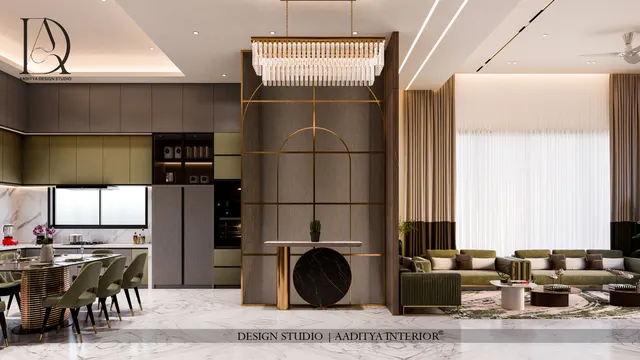
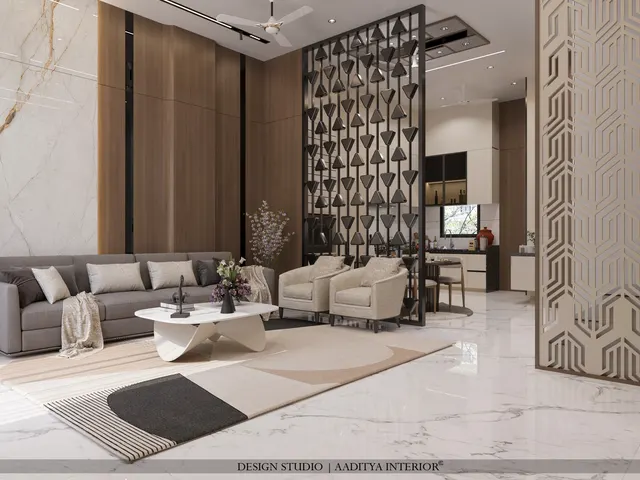
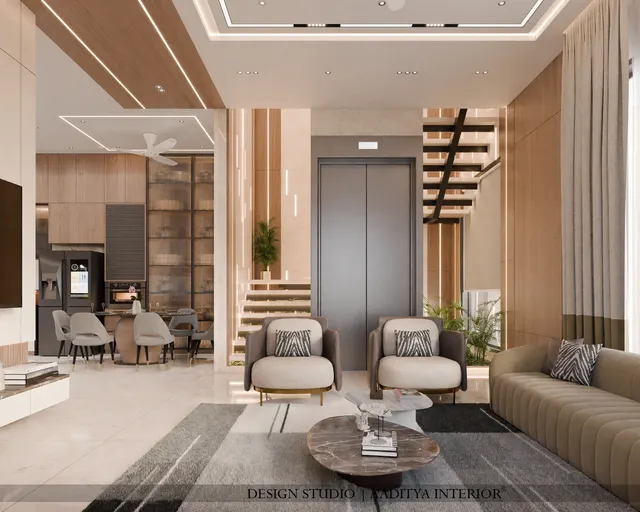
In an Avenue 203 flat, the dining table sits at the open end of the living room: a marble-topped rectangle under a cluster of glass globes, close enough to the sofa that the two zones share one walkway. It is a good reminder that a dining table is rarely a standalone object in an Indian home — it anchors an open plan, sits beside the kitchen, often shares a wall with the mandir, and gets used three times a day. The ideas below come from real studio projects and focus on the decisions that actually change how a table looks and lasts: the top material, the shape, the chairs and the space around it.
1. The marble-top rectangle that anchors an open plan
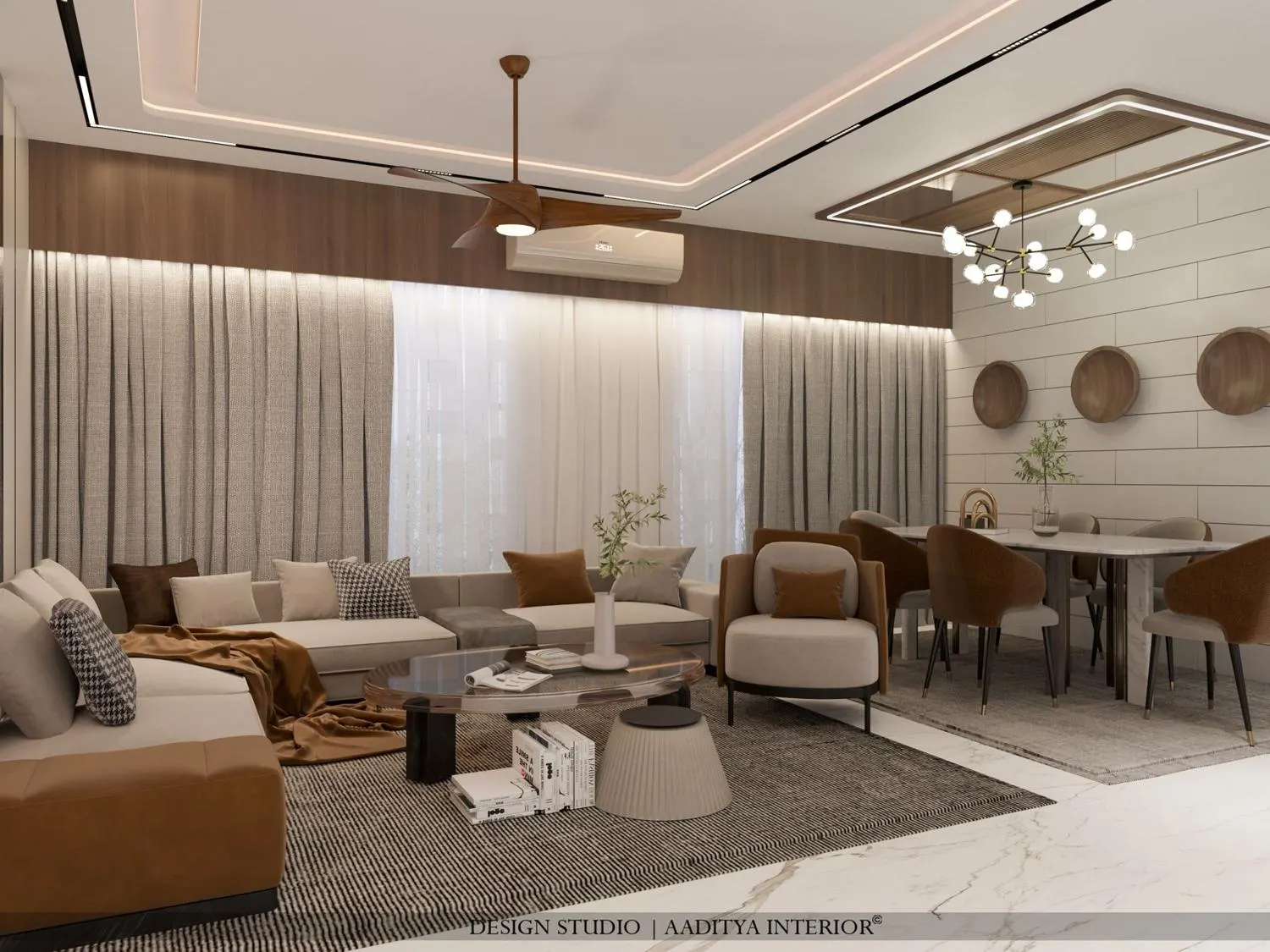
A light stone top is the workhorse of the modern Indian dining room: it wipes clean, shrugs off hot vessels better than a polished wood top, and bounces light around an open living-dining space. Here the rectangle seats six comfortably, the metal legs keep the base visually light so the room does not feel crowded, and the chair fabric is pulled straight from the sofa so the two zones read as one. For a top this exposed to daily use, sealed natural marble or — more forgiving — engineered quartz or a sintered-stone surface is the sensible choice.
2. A stone top with a sculptural pendant overhead
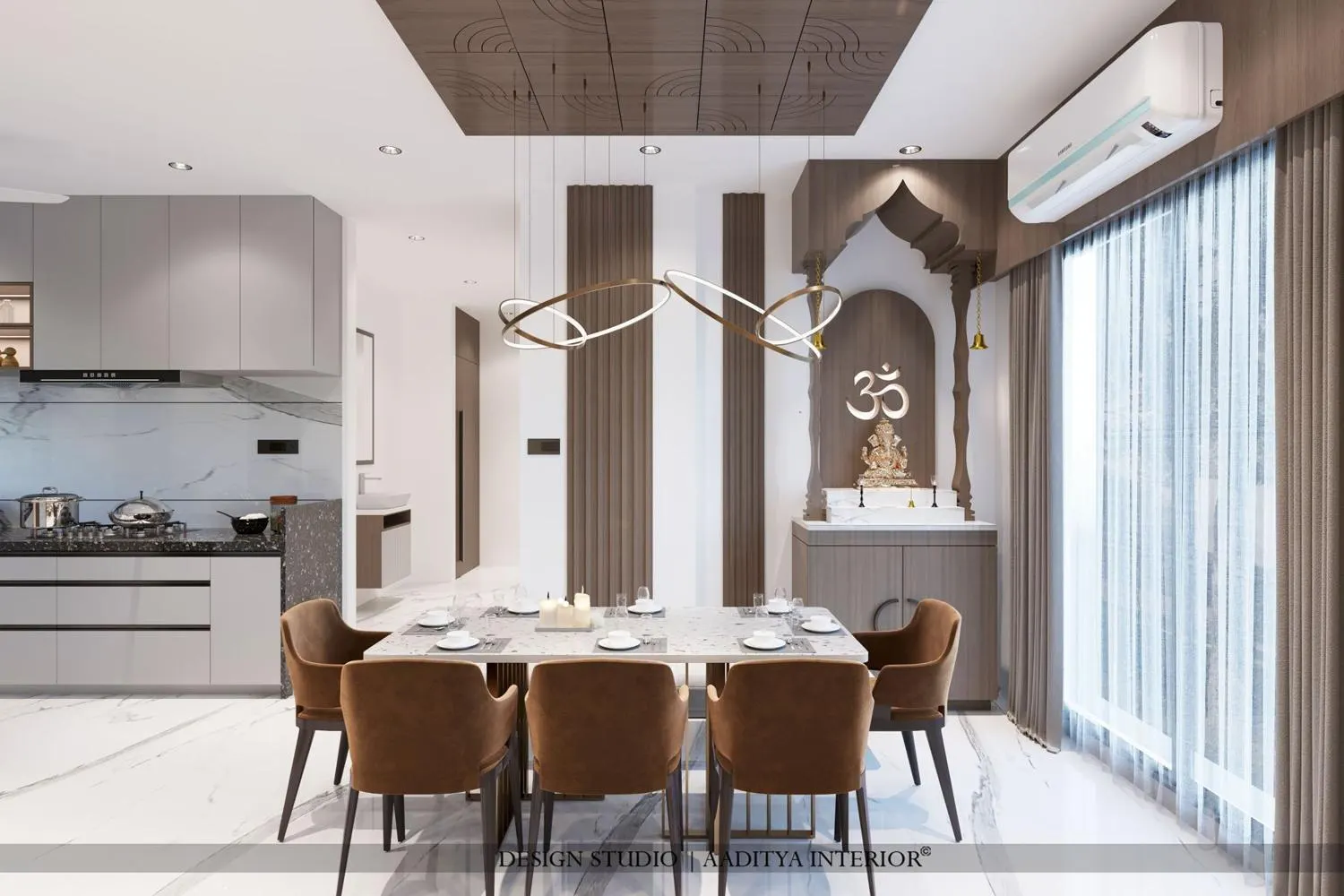
When the table sits between the kitchen and the pooja niche — a very common Indian layout — the pendant becomes the piece that claims the dining zone as its own. A single sculptural fitting hung over the centre does more than three scattered downlights ever could. The soft tan armchairs add warmth against the hard stone top and the cool marble floor, and because the chairs have arms, each place setting feels a little more generous. Keep the pendant above the table, not above the walkway, so no one walks into it.
3. Rose and tan velvet chairs for a softer room
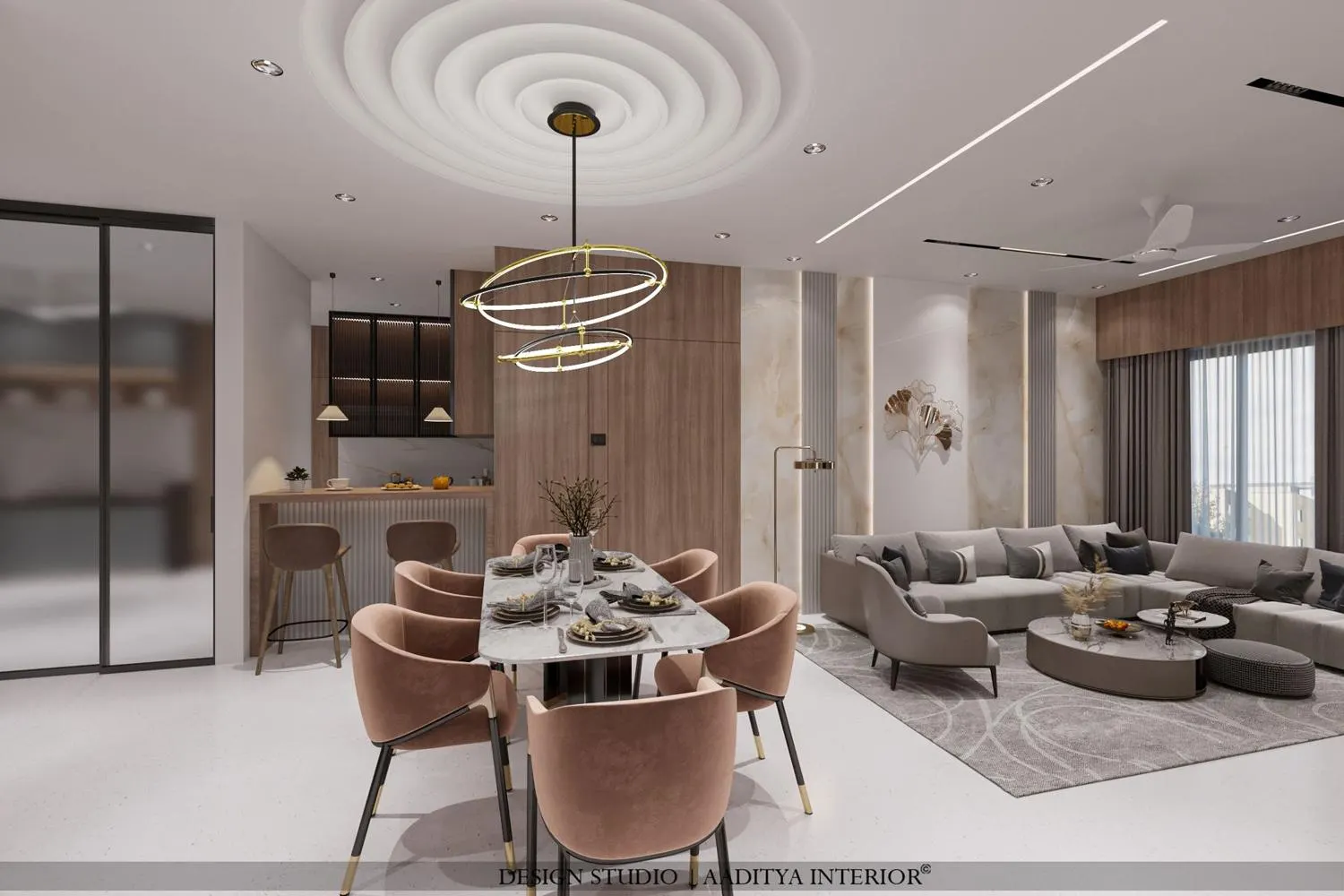
Colour on the chairs is the easiest way to warm a stone-and-white dining room without committing to a coloured top. Dusty-rose velvet reads as soft and a little formal; it works because everything else — the marble, the pedestal base, the floor — stays neutral. A pedestal (single central) base is worth noting as a practical choice: with no corner legs, chairs tuck in from any side and an extra guest can always squeeze onto a corner. Velvet looks beautiful but needs a stain-guard treatment in a daily-use dining room.
4. The six-seater that doubles as a work table
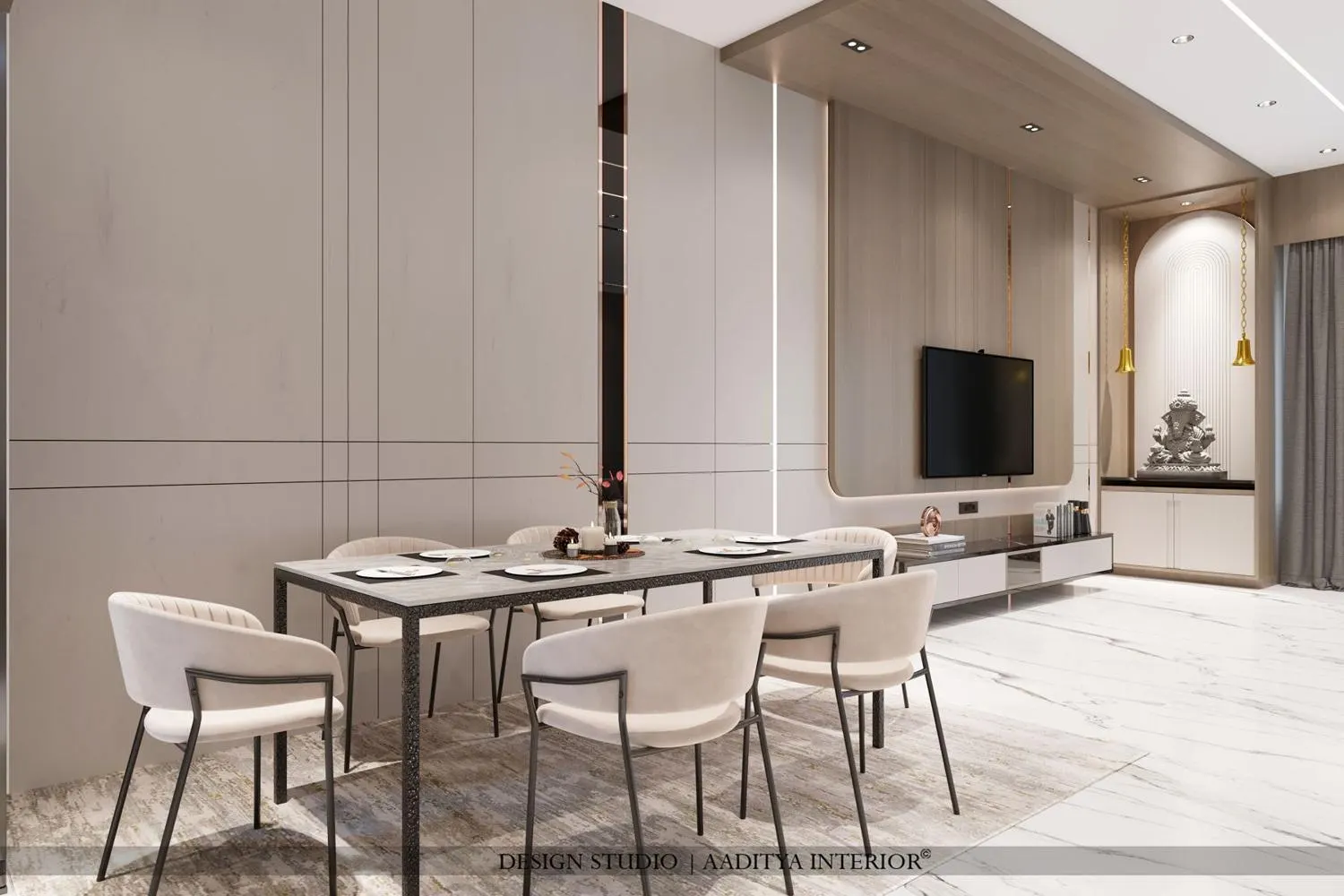
In flats where the dining table is also the home office, the exam-prep desk and the place bills get sorted, the top takes more abuse than in any formal dining room. A speckled terrazzo-style stone hides crumbs, ring marks and scratches far better than a plain white top or a polished veneer, which is exactly why it suits a busy family. The cream chairs keep the room light; wipe-clean faux-leather or a tight weave on the seats is wiser here than an open-pile fabric that stains.
5. Dining beside the kitchen and the mandir
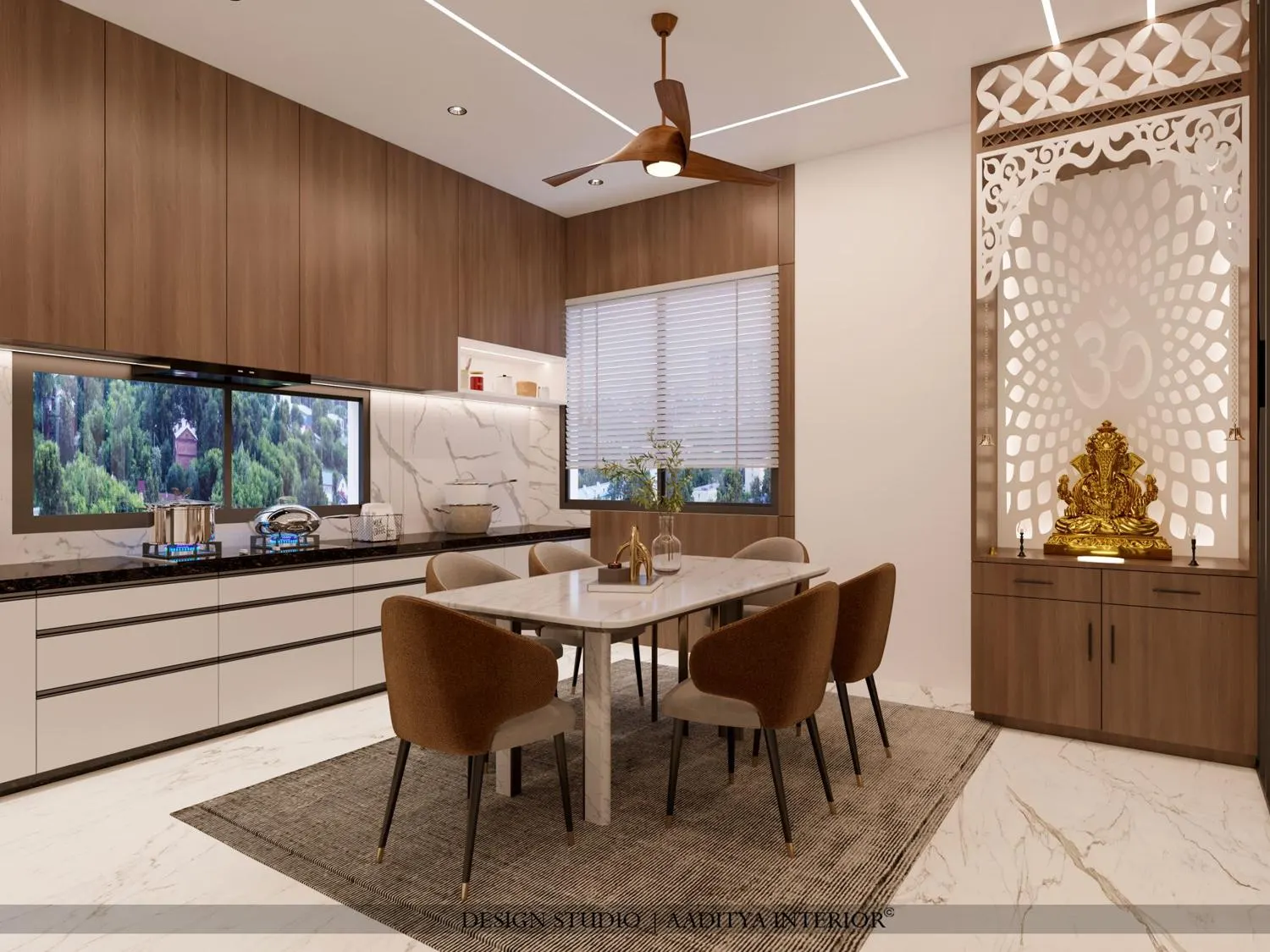
This is the most Indian of dining layouts: kitchen on one side, mandir on the other, the table in between so meals, cooking and the daily pooja all share one bright zone. The solid marble legs make the table feel permanent and substantial — a different character from the slim-metal-leg tables above — and mixing two chair styles (boucle on the ends, plain upholstery on the sides) keeps a long table from looking like a showroom set. When the table backs onto a backlit jaali, keep the tabletop clutter low so the screen stays the hero.
6. A formal dining zone in a double-height home
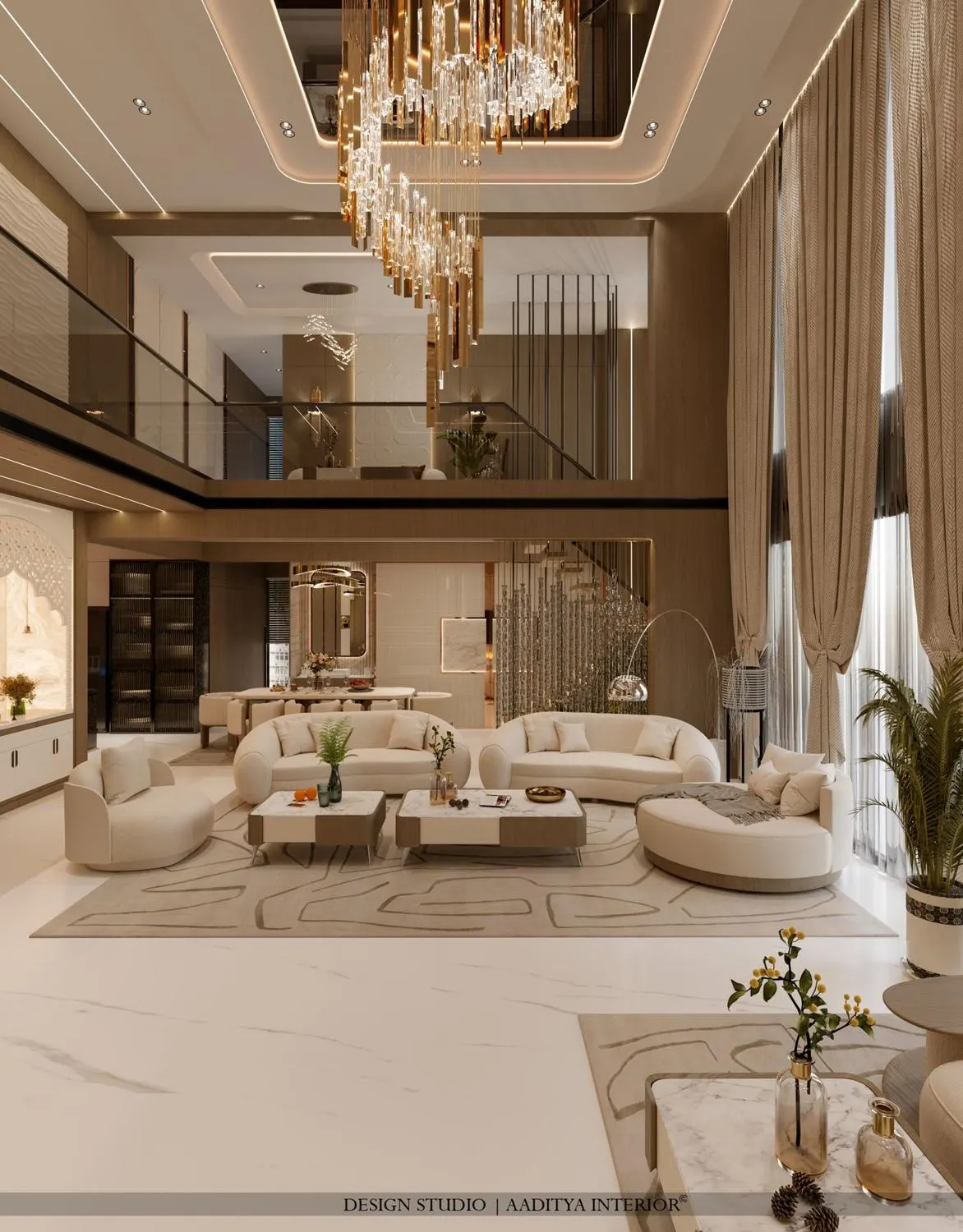
In a bungalow or duplex with a double-height living room, the dining can afford to be formal and a little separate. Giving it its own pendant — distinct from the main chandelier — draws an invisible boundary between lounging and eating without a single wall. The trick in a tall, open room is scale: a small table looks lost, so a longer eight-seater (or a round table with a generous diameter) holds the space better. Keep the two light fittings in the same metal family so the room still reads as one design.
Extendable tables: one top, two sizes
None of the tables above extend, and for a fixed-size family that is fine. But homes that host — festivals, both sides of the family, a steady stream of guests — gain the most from an extendable design: a six-seater most days that opens to eight or ten when needed. The two common mechanisms are the draw-leaf (leaves stored under the top and pulled out from the ends) and the butterfly or self-storing leaf (a central leaf folds up from inside, so nothing is stored in a cupboard and forgotten). The sketch shows how each works and the clearances the open table needs.
How to choose: a quick guide
| Top material | Feel and look | Durability in daily use | Watch out for | Indicative 6-seater (Oct 2026) |
|---|---|---|---|---|
| Natural marble | Cool, luxurious, veined | Good if sealed; etches with lemon/acids | Reseal yearly; wipe spills fast | ₹80,000–2,50,000+ |
| Engineered quartz / sintered stone | Marble look, uniform | Excellent; stain- and heat-resistant | Heavier; needs a strong base | ₹90,000–2,50,000+ |
| Solid wood (sheesham/teak) | Warm, timeless | Very good; re-polishable | Use coasters; keep out of direct sun | ₹45,000–2,50,000+ |
| Veneer / laminate on board | Wood look, lighter, cheaper | Fair; edges can chip, no water | Not for a wet-wipe daily table | ₹30,000–90,000 |
| Glass (toughened) | Light, airy, modern | Fair; shows every smudge | Use thick toughened glass only | ₹25,000–80,000 |
Frequently asked questions
Is a marble dining table practical for daily Indian use?
Yes, if it is sealed and treated with care. Natural marble etches when acidic food — lemon, tomato, pickle — sits on it, so spills must be wiped quickly and the top resealed about once a year. Families who want the marble look with none of the worry choose engineered quartz or sintered stone, which are non-porous, stain-resistant and heat-tolerant.
How many seats fit on a 1800 mm table?
A 1800 × 900 mm rectangle seats six comfortably — three along each long side — or six to eight if two end seats are added on a slightly narrower base. Allow about 600 mm of table width per diner so chairs do not touch, and keep at least 800 mm clear behind each chair to pull it out.
How low should a pendant hang over a dining table?
About 700–860 mm above the tabletop, so the light pools on the table without blocking the view across it or being walked into. Centre it over the table, not over the walkway, and put it on a dimmer so the same fitting can give bright light for serving and a low glow for dinner.
Sources & standards
- Neufert Architects' Data and Time-Saver Standards — dining furniture sizes and circulation clearances
- Bureau of Indian Standards — IS 303 (plywood), IS 710 (marine plywood) for table bases and board tops
- Studio project photographs: Avenue 203, The Imperia Riverview 701, Raghu Residence, Urban Apartment, Goti Residence, Luxury Duplex Residence
- Price ranges: indicative October 2026 estimates — confirm with a local fabricator before budgeting