A purely white, grey-and-glass minimalist living room photographs beautifully and then feels like a waiting room to live in. The 2026 shift is away from that coldness: same restraint, same clean lines and clear floors, but the palette moves to beige, taupe, oatmeal and wood, the fabrics turn soft, and the light goes warm. The result reads as calm rather than clinical — minimalist in discipline, warm in feel.
Warm minimalism is harder than it looks, because with so little in the room, every piece has to be right. The eight ideas below are drawn from real Aaditya Interior living rooms across Surat, Ahmedabad and beyond. Each shows one move you can copy — a base colour, a single sofa, a quiet feature wall, the right light — without turning the room cold or cluttered.
1. Choose one warm neutral and repeat it
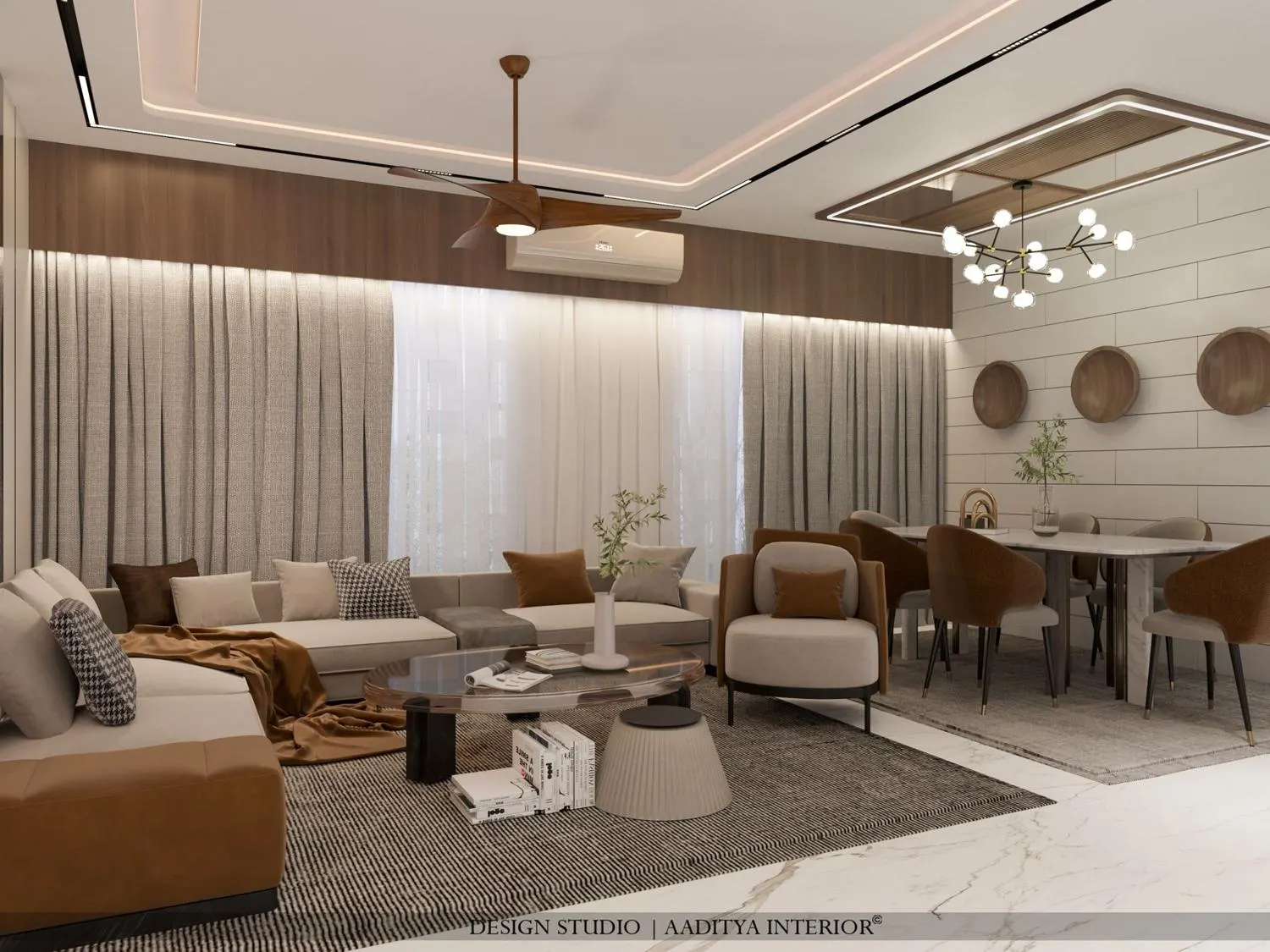
Warm minimalism starts with the base colour, and the safest base is a single warm neutral carried across the walls and the large upholstery — greige, oatmeal, soft taupe. Repeating one tone, rather than mixing three, is what makes a sparse room feel considered instead of empty. In the room below the sofas, the rug and the curtains all sit in the same warm beige family, so the eye reads one calm field; the cognac leather chair and the tan throw are the only departures, and they are warm departures. Pick your neutral against your floor and your daylight — a yellow-rich south light wants a cooler greige, a shaded north room wants a warmer beige — and resist adding a fourth and fifth colour.
2. One generous low sofa, not a crowded set
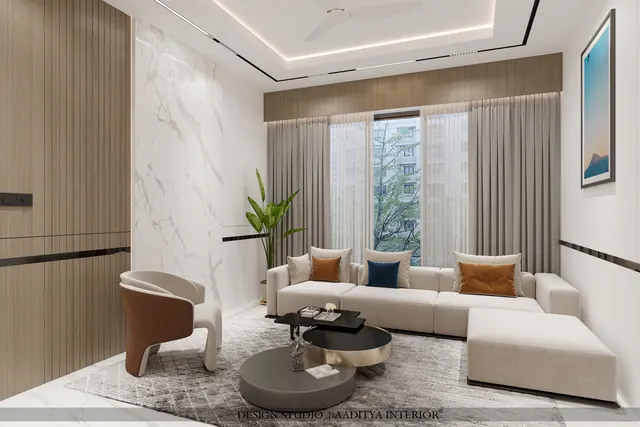
The quickest way to lose a minimalist room is to fill it with a three-piece suite plus chairs. The warmer, calmer move is a single generous low sofa — a long two- or three-seater with a deep chaise — and then stop. A low back keeps the room feeling open and the ceiling high; a soft upholstery in velvet or boucle adds the warmth that the clean lines take away; and leaving the rest of the floor clear is the whole point, not a gap to be filled. In the room below one large soft-grey sofa and a single accent chair do all the seating, a round terrazzo table anchors the centre, and the empty floor and warm wood pelmet keep it from feeling cold.
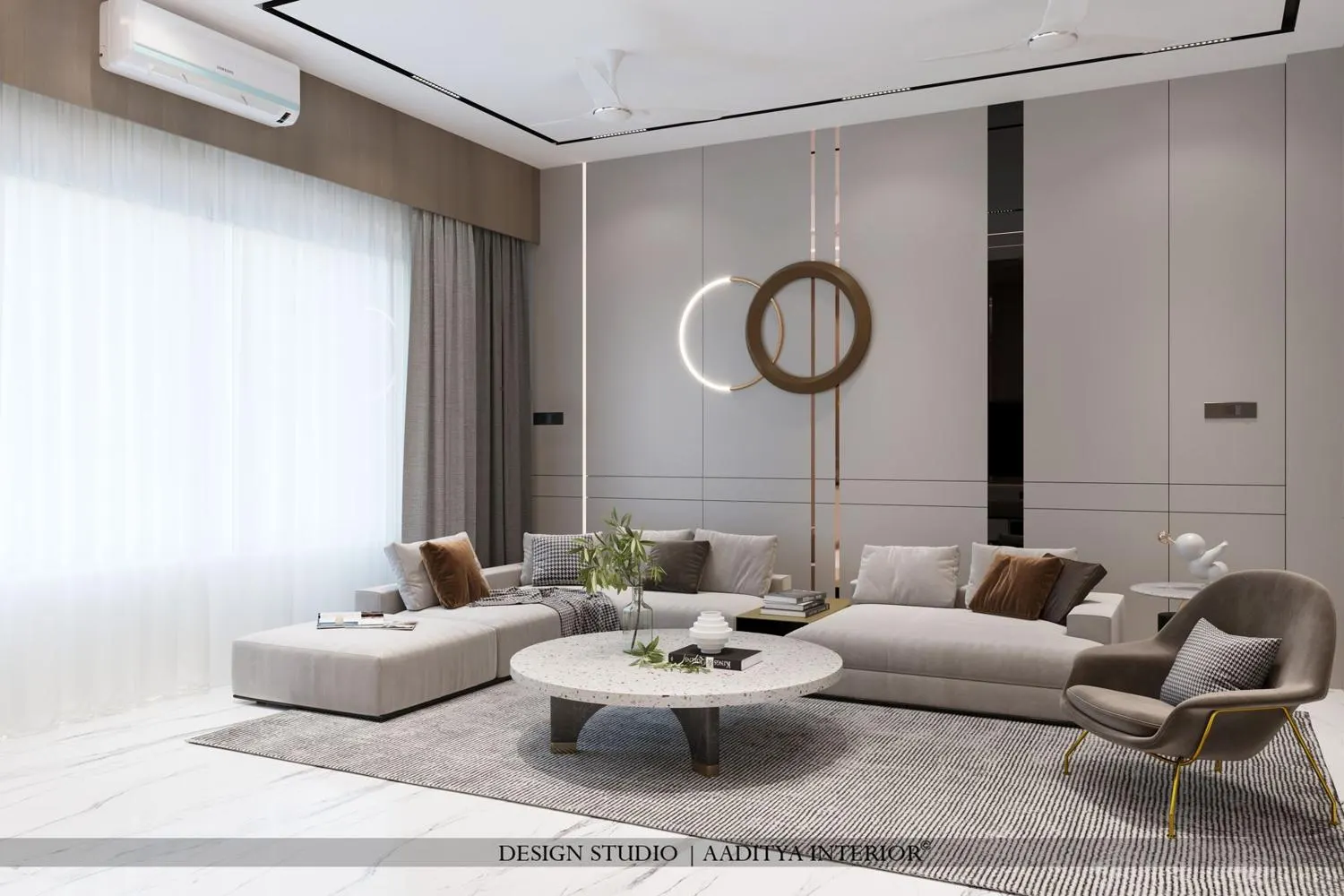
3. Face two matching sofas for quiet symmetry
Where a room is wide or used for family and guests, two matching sofas facing each other across a low table give a calm, symmetrical arrangement that suits warm minimalism better than an L-shape and a scatter of chairs. Symmetry does the decorating, so the pieces themselves can stay plain. Keep the two sofas identical, keep the cushions to two tones, and let one shared coffee table and a single rug hold the pair together. In the room below the two beige sofas, matched cushions and a round table create a still, hotel-lobby calm; a tan accent chair and copper wall art warm it, and nothing else competes.
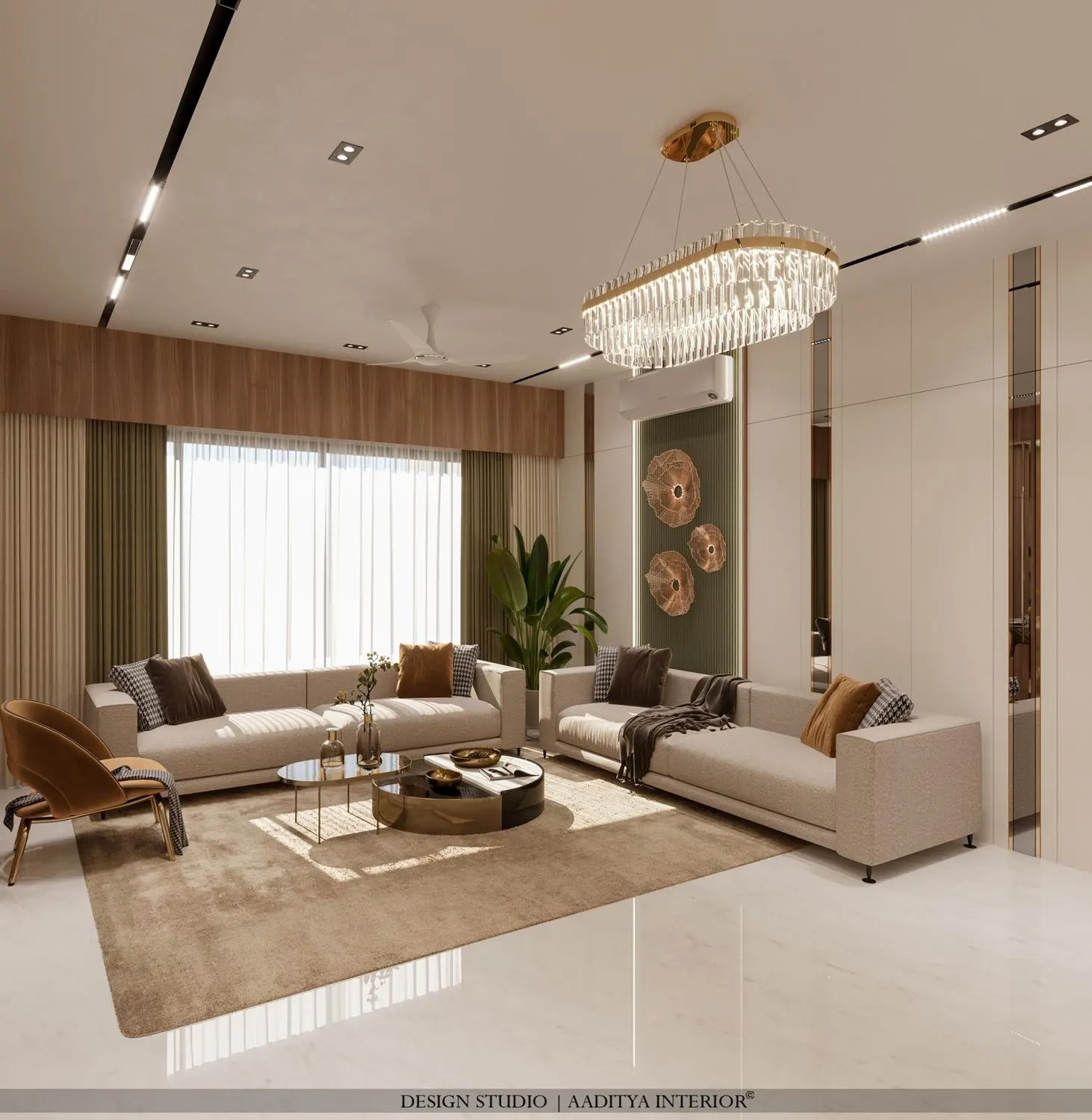
4. Keep the TV wall quiet
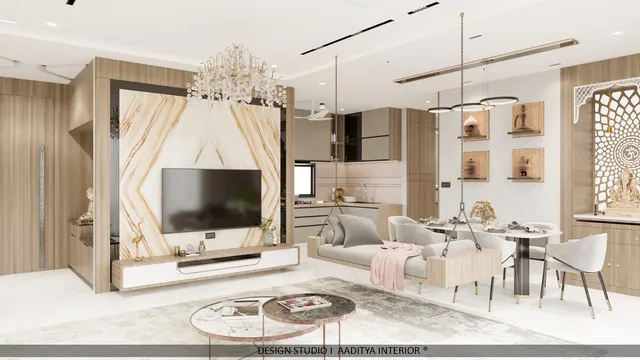
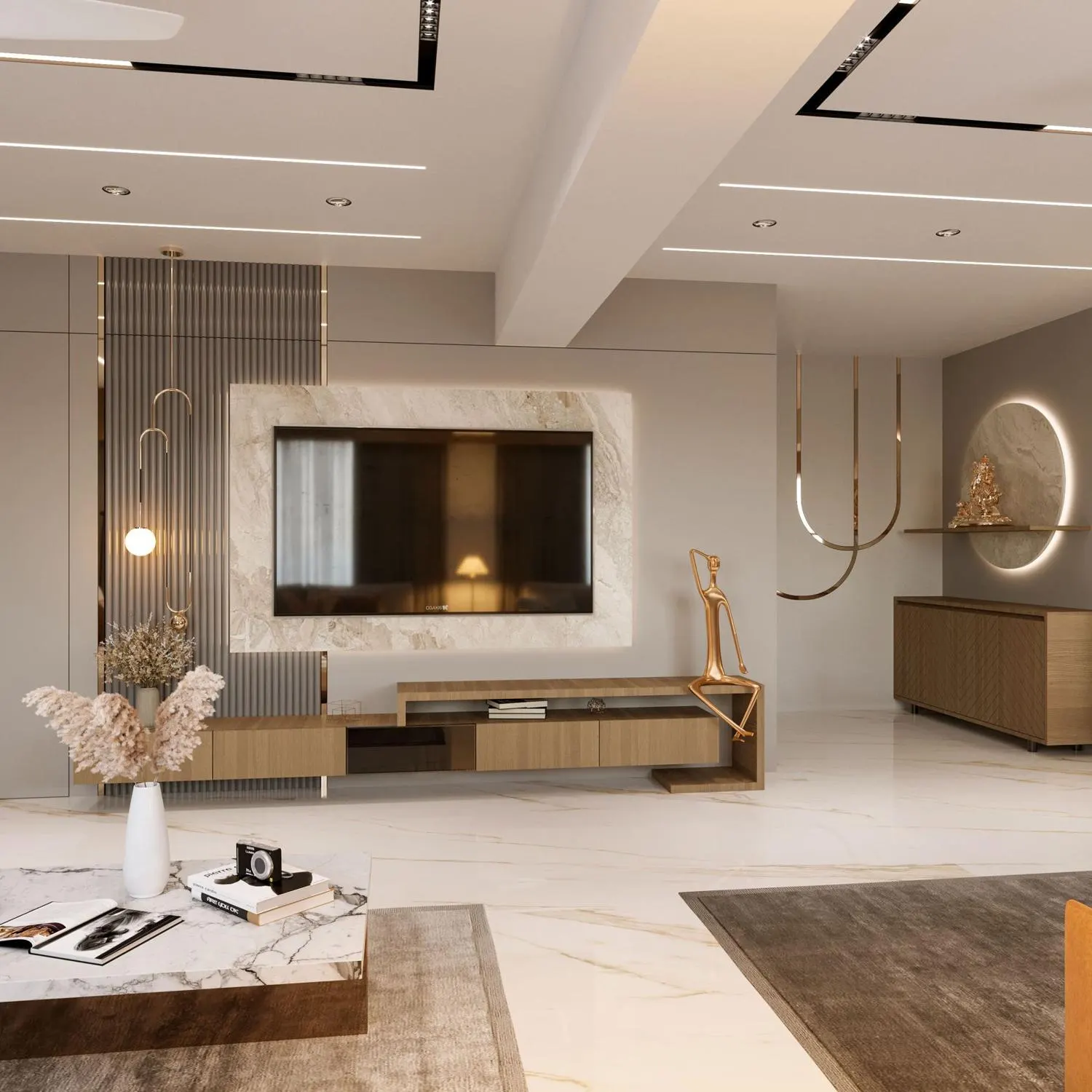
The television wall is where a calm room most often goes loud, with busy panelling, bright back-light and a crowded showcase. Warm minimalism keeps it quiet: a single material behind the screen, storage that floats and reads as a line rather than a cupboard, and open niches used sparingly for a few objects, not filled. In the room below the TV sits on a soft stone panel flanked by fluted wood and grey, the console floats as one low horizontal, and the arched display niches hold only a handful of pieces — the restraint is what makes the wall feel designed rather than decorated.
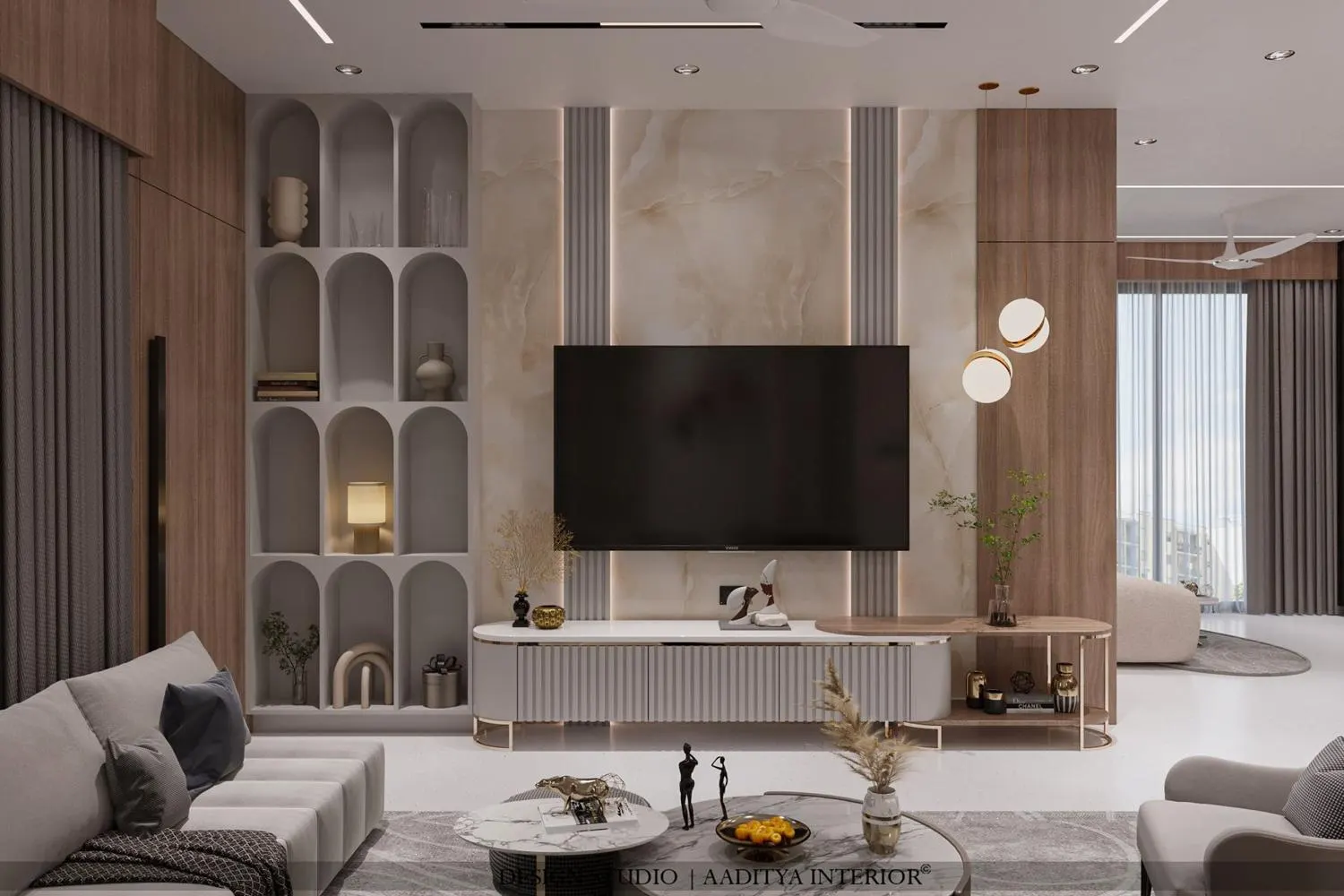
5. Let a single stone slab be the feature
If a warm minimalist room is going to have one bold element, let it be a single piece of natural stone, bookmatched so the veins mirror, and then keep everything around it plain. A full-height stone panel behind the television or the sofa gives the room all the pattern and movement it needs, which is exactly why the rest should stay quiet — plain walls, a floating console, one plant. The warmth comes from the stone's own tone: a beige or gold-veined marble reads far warmer than a cool grey one. In the room below a bookmatched gold-veined marble panel is the whole feature; walnut slats and a potted palm frame it, and nothing else asks for attention.
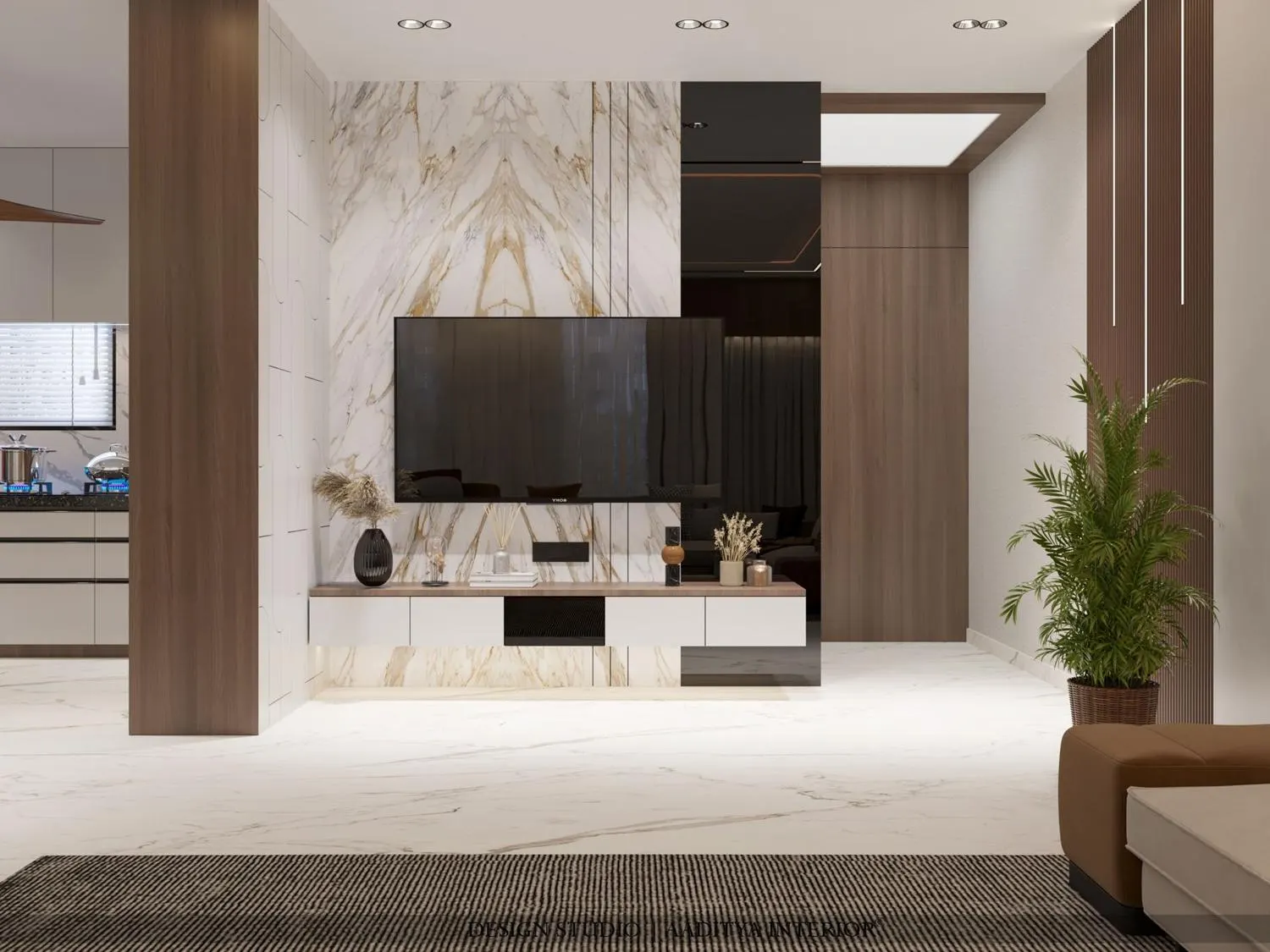
6. Use warm metal as the only shine
Minimalist rooms need a little sparkle or they go flat, but the metal you choose sets the temperature. Chrome and cool steel read cold; brass, bronze and antique gold read warm, and in a warm minimalist room they should be the only shine — repeated in the pendant, a mirror frame, the slim pulls and perhaps a light fitting, and nowhere else. Keeping to one warm metal, used in two or three places, ties the room together without clutter. In the room below brass pendants, a backlit round mirror and warm walnut are the only glints against calm grey walls and a stone panel; there is no competing chrome anywhere in the scheme.
7. Layer warm light instead of flooding it
Nothing turns a warm room cold faster than a ceiling full of bright, blue-white downlights. Warm minimalism lights in layers and in warm colour: a soft ambient layer from a cove or a few recessed spots at 2700–3000 K, a task layer for reading, and one accent — a single pendant, a wall light, a lamp — to give the room a focus after dark. Put the layers on separate switches or a dimmer so the room can drop to a low, warm glow in the evening. The diagram below shows the three layers at work; the rule is few fittings, warm colour, and light placed where it is needed rather than spread evenly across the ceiling.
8. Leave empty space on purpose
The hardest idea in warm minimalism is the most important: leave room empty and keep it empty. A clear stretch of floor, a bare patch of wall, a side table with one object — these are not unfinished, they are the design, and they are what let the few warm pieces breathe. Aim to keep at least a third of the floor clear, hang one artwork rather than a gallery, and group the few accessories you keep so the surfaces read calm. The warmth of the palette and the light means the emptiness never feels cold; it feels restful. When the family is tempted to fill a corner, the warm-minimalist answer is usually a plant and nothing else.
How to choose your warm-minimalist pieces
The table turns the eight ideas into a quick shopping guide. It is a starting point; the exact tones should be chosen against your own floor, daylight and the size of the room.
| Element | Warm-minimalist choice | Avoid |
|---|---|---|
| Wall colour | One warm neutral — greige, oatmeal, soft taupe | Stark white; cool blue-grey; three competing colours |
| Main sofa | One low, soft sofa in boucle or velvet | A full three-piece suite plus extra chairs |
| Palette departures | Leather, wood, one deeper warm tone | Bright or cool accent colours in large doses |
| Feature | One stone panel or a single artwork | A busy panelled wall plus a crowded showcase |
| Metal / shine | Brass, bronze or antique gold, in 2–3 places | Chrome and cool steel; many mixed metals |
| Lighting | Layered, 2700–3000 K, on a dimmer | A grid of bright 5000–6500 K downlights |
| Floor | Keep at least a third clear | Filling every corner with furniture or decor |
Frequently asked questions
What is a warm minimalist living room?
It keeps the clean lines, clear floors and restraint of minimalism but swaps the cold palette for warm neutrals — beige, taupe, oatmeal and wood — with soft textures and warm 2700–3000 K light. The discipline is the same as minimalism; the feel is cosy rather than clinical, which is why it reads as calm instead of empty.
What colours work for warm minimalism?
One warm neutral as the base — greige, oatmeal or soft taupe on the walls and the large upholstery — with departures in leather tan, walnut and one deeper warm tone such as cognac or terracotta. Keep the whole room inside a warm family and avoid stark white, cool blue-grey and bright accent colours used in large areas.
How do I keep a minimalist room from feeling cold?
Add warmth through texture, tone and light rather than through more objects: soft boucle or velvet upholstery, natural wood and stone, a warm neutral palette, brass instead of chrome, and layered 2700–3000 K light on a dimmer. The room can stay sparse and still feel cosy once the temperature of the materials and the light is warm.
Sources & standards
- Aaditya Interior — residential projects photographed for this article (Avenue 203, Urban Apartment, Venus 702, Raghu Residence, Royal Hill Residence)
- Ernst and Peter Neufert — Architects' Data: seating layouts, circulation clearances and viewing distances in living rooms
- Bureau of Indian Standards — National Building Code of India 2016, Part 8 (Building Services), Section 1: lighting levels and layering
- General lighting practice — correlated colour temperature (2700–3000 K warm white) for living spaces
- Price and material notes where given: indicative October 2026 — confirm locally before budgeting